To read the periodic table, start with one cell, then look at where that cell sits. The cell gives the element's atomic number (its proton count), its symbol, its average atomic mass and often its name. Its column, called a group, points to how the element behaves, and its row, called a period, points to its outermost electron shell.
Once you know those few rules, you can work out a lot about an element you have never met. This guide goes through each part using chlorine as the main example, then shows the limits of the rules, because the table has a few exceptions that confuse almost everyone at first.
What each cell tells you
A cell is a small ID card for one element. According to the OpenStax chemistry textbook, each box contains the atomic number, symbol, average atomic mass and sometimes the name.
Charts arrange these differently, so go by the kind of number and not its position. As the Royal Society of Chemistry notes, charts generally show two numbers: the smaller is the atomic number and the larger is the relative atomic mass. Here is chlorine:
| In the cell | Chlorine | What it tells you |
|---|---|---|
| Atomic number | 17 | 17 protons; a neutral atom also has 17 electrons |
| Symbol | Cl | A short name: a capital letter, then a lowercase letter if there is a second one |
| Name | Chlorine | Some charts leave this out |
| Atomic mass | 35.45 | The average mass of chlorine atoms found in nature |
Many charts also use color for metals, nonmetals and metalloids, and some mark whether an element is a solid, liquid or gas. Check the legend on your chart before you trust a color.
Atomic number and atomic mass explained
The atomic number tells you which element you have, and the atomic mass tells you how heavy its atoms are on average. Every chlorine atom has 17 protons. An atom with 16 protons would be a different element. The table runs in order of atomic number, which is why that number goes up by one from each element to the next.
You will see the second number called average atomic mass, relative atomic mass or atomic weight, depending on the chart or book. For reading a chart, treat them as the same number.
Why atomic mass has decimals
Atomic mass is an average across isotopes, which are atoms of the same element with different numbers of neutrons. OpenStax works through chlorine: natural chlorine is about 75.76% chlorine-35 and 24.24% chlorine-37, so the weighted average comes to about 35.45. No single atom weighs 35.45. It is like saying a family has 2.4 children on average.
How to find the number of neutrons
Neutrons = mass number − atomic number. The mass number is the count of protons plus neutrons in one specific isotope, so it is always a whole number. Chlorine-35 has 35 − 17 = 18 neutrons, and chlorine-37 has 37 − 17 = 20.
The common classroom shortcut is to round the atomic mass and subtract the atomic number. Treat that as a rough estimate only, because it can name an isotope that isn't there. Copper's atomic weight is 63.546, which rounds to 64, but CIAAW (the international commission that sets atomic weights) lists natural copper as about 69% copper-63 and 31% copper-65. Those have 34 and 36 neutrons, not 35. If a question names an isotope, use its mass number.
Brackets, dashes and ranges
These marks are not misprints. They show how well a single atomic weight can describe the element:
- Square brackets: IUPAC, the international chemistry body, uses them for elements with no characteristic natural isotope mix. The number inside is a mass number, that of the isotope with the longest confirmed half-life. NIST's data, for example, lists technetium (element 43) as [98].
- A dash: CIAAW's table gives no standard atomic weight at all for those same kinds of elements, such as technetium and everything from neptunium to oganesson.
- A range: isotope mixes vary between natural samples for some elements, so CIAAW's full table gives an interval, such as [35.446, 35.457] for chlorine. It also publishes shorter values for everyday use, which is where 35.45 comes from.
Groups: the 18 columns
Elements in the same group often behave in similar ways, largely because they have the same number of outer electrons, called valence electrons. These are the electrons most involved in chemical reactions. IUPAC has recommended numbering the groups 1 to 18 since 1988. Older charts, especially in the United States, use Roman numerals with letters, so check which system yours uses.
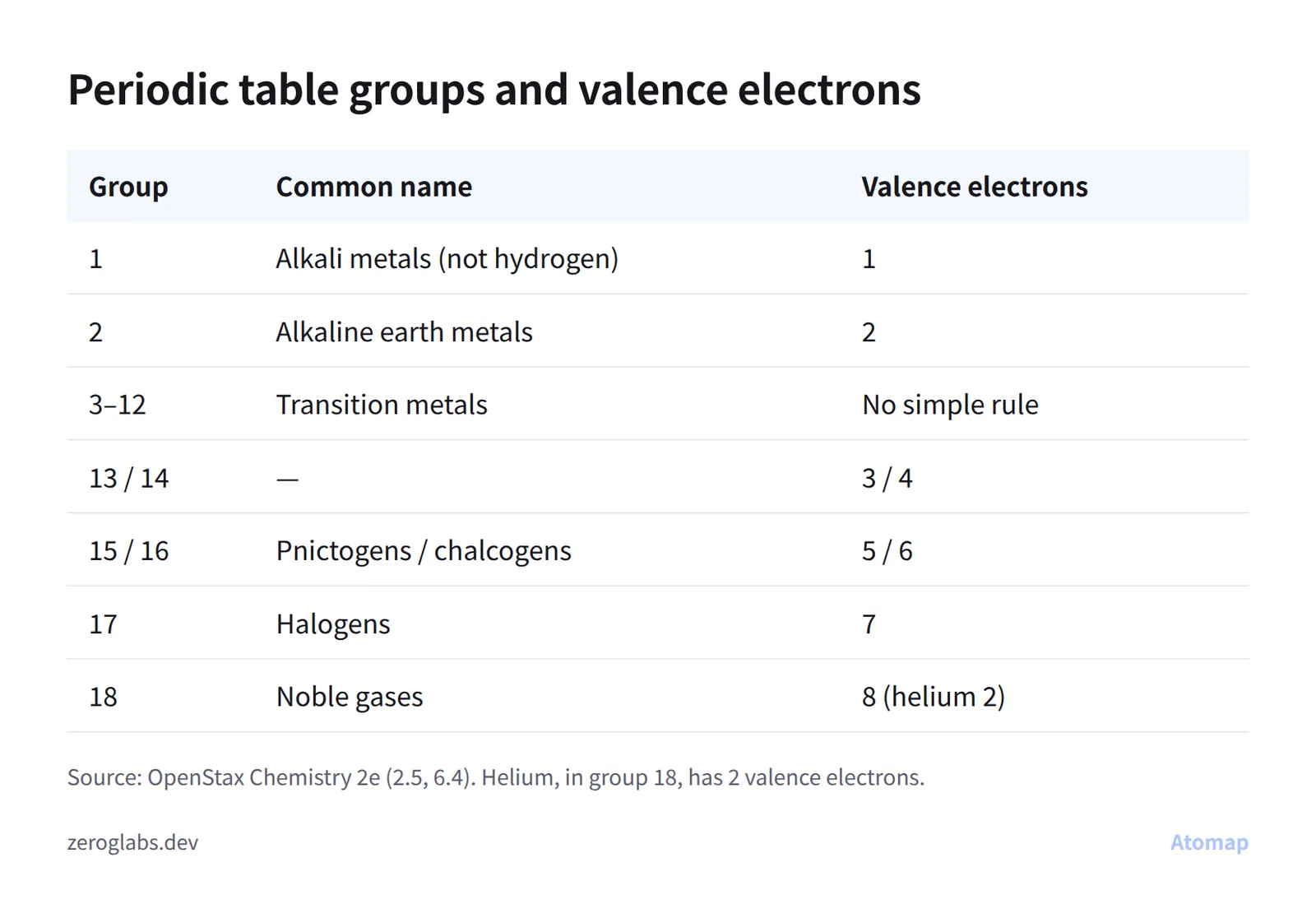
For groups 1 and 2, the valence count is the group number. For groups 13 to 18, subtract 10: chlorine is in group 17, so it has 7. Helium is the exception, because its atom holds only 2 electrons, even though it sits in group 18 with the noble gases.
The shortcut does not work for groups 3 to 12. OpenStax counts the valence electrons of these transition metals across two different shells, so no single subtraction gives the answer.
Periods: the 7 rows
The period number tells you which shell is the outermost one in main-group elements (groups 1, 2 and 13 to 18). Chlorine is in period 3, so its valence electrons are in shell 3.
The rows are not all the same length. If you count the two separate rows at the bottom as part of periods 6 and 7, the seven periods hold 2, 8, 8, 18, 18, 32 and 32 elements, which adds up to all 118. A new period begins as electrons start to fill a new shell, and properties repeat as you move along. That repeating pattern is why it is called the periodic table.
What position tells you about properties
An element's position lets you predict how it compares to its neighbors. These are general trends, so treat them as good first guesses:
- Metal or nonmetal: metals are on the left and in the center, and nonmetals are at the upper right. A zigzag line through groups 13 to 16 divides them, with in-between elements called metalloids (such as silicon and germanium) along it.
- Atom size: atoms generally get smaller from left to right across a period and larger going down a group.
- Ionization energy (the energy needed to remove an electron): generally rises across a period and falls down a group.
- Electronegativity (how strongly an atom pulls shared electrons): rises across a period and falls down a group. Fluorine, near the top right, is the highest of all at 4.0 on the Pauling scale.
- Reactivity in group 1: the Royal Society of Chemistry notes that elements lower in the group react more readily than those above them.
There are exceptions. Boron's ionization energy is lower than beryllium's, for instance, and oxygen's is lower than nitrogen's, even though both come later in the same period. Trends tell you what to expect, not what is guaranteed.
Blocks: why the table has that shape
Blocks are the four regions of the table, named after the type of orbital (the region where electrons are found) being filled. They explain the table's odd outline, because each block is as wide as the number of electrons its orbital type can hold.
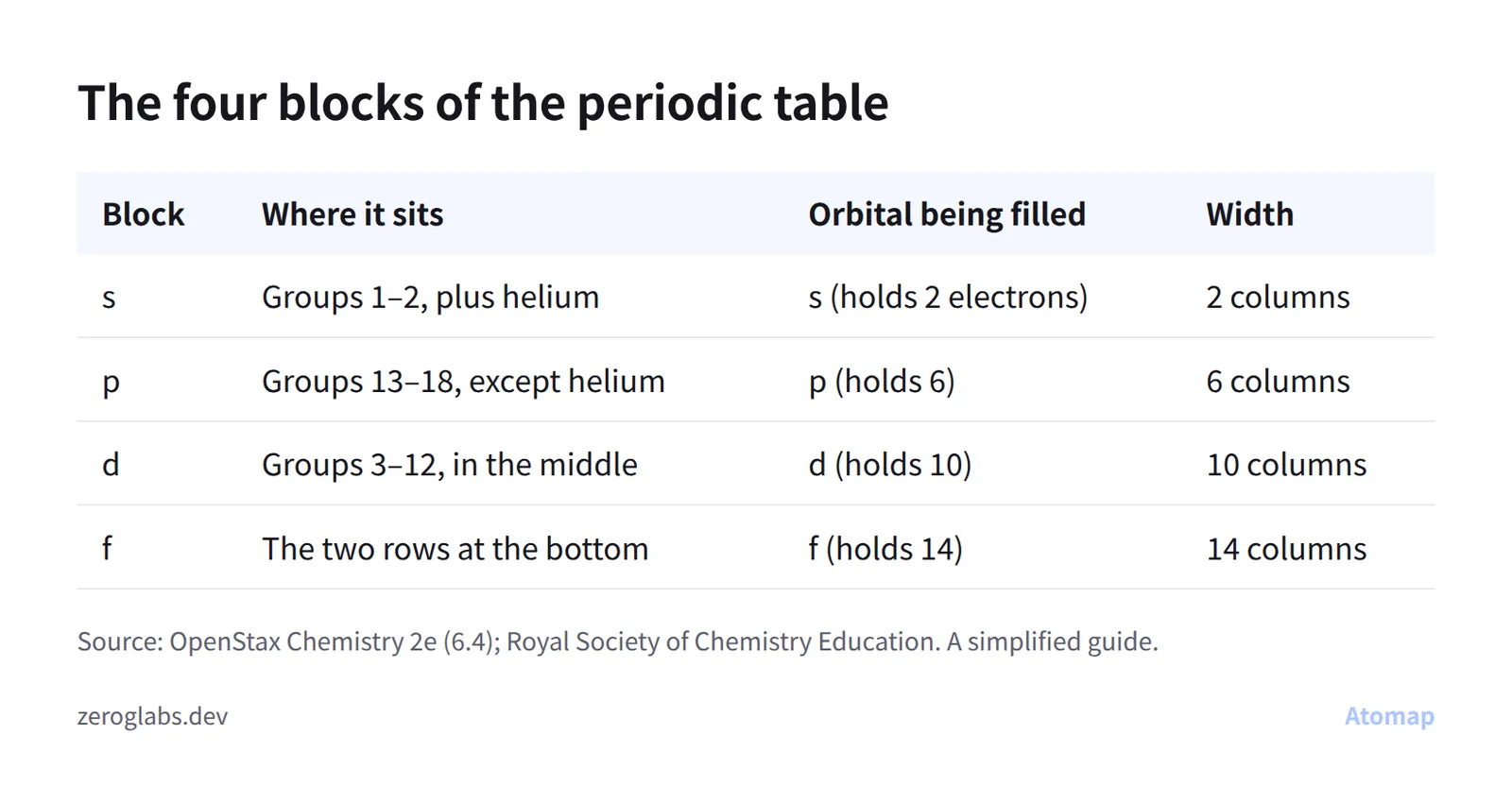
The bottom two rows, the lanthanides and actinides, are part of periods 6 and 7. OpenStax explains that they are pulled out so the table fits on a single page.
Not every chart draws this area the same way. IUPAC says the makeup of group 3 is still under review, with two options: scandium, yttrium, lutetium and lawrencium, or scandium, yttrium, lanthanum and actinium. So if your chart differs from your friend's here, neither is necessarily wrong.
Read any element in five steps
Use the same order every time, and the table becomes much easier to read:
- Read the cell. Note the atomic number, symbol and atomic mass.
- Find the column. Note the group number and any family name.
- Find the row. Note the period number.
- Name the block. Use the position to say s, p, d or f.
- Make a prediction. Use the position to guess whether it is a metal, how it compares to its neighbors, and how many valence electrons it has.
Sodium makes this easy. It has atomic number 11, an atomic mass of 22.990, and sits in group 1, period 3, in the s block. So it is an alkali metal with 1 valence electron, and it tends to lose that electron to form a 1+ ion.
Iron shows the limits. It has atomic number 26 and an atomic mass of 55.845, and sits in group 8, period 4, in the d block. You can tell it is a transition metal, but its position won't give you a single ion charge, because transition metals often form ions with different charges.
Use an interactive periodic table
A good printed chart is enough to learn all of this, and NIST offers a free one you can print. An interactive table helps when you want the details a printed cell has no room for. Here is how that works in Atomap, the periodic table app we make for Android.
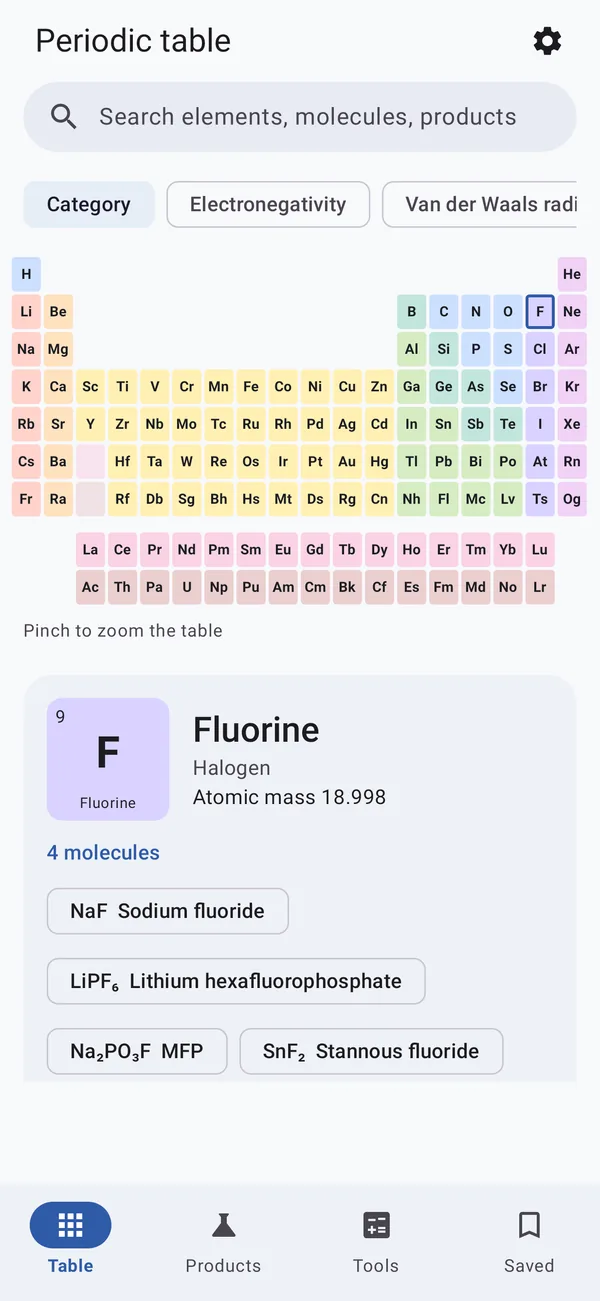
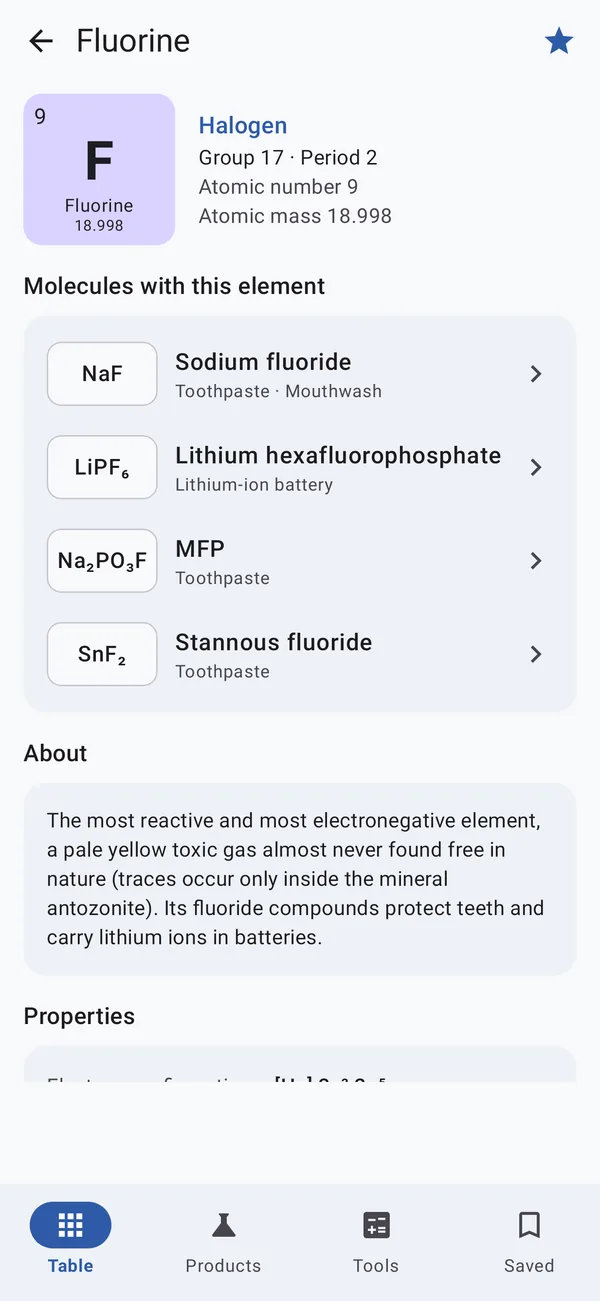
Tap an element and its page shows the molecules it is in, then its group and period, electron configuration, ionization energy, electron affinity, van der Waals radius, melting and boiling points, density, oxidation states, isotopes with half-lives and discovery year. That makes it easy to check your own predictions: guess the group, period and valence electrons first, then open the element.
The isotope list is handy for neutron problems, since you can see the real isotopes and not just a rounded average.
Color maps are the fastest way to see trends. Instead of memorizing that electronegativity rises toward the upper right, switch the table to the electronegativity map and look at it. The electronegativity, van der Waals radius and melting point maps are free. Twelve more open with a 24-hour pass, which you get by watching an optional ad.
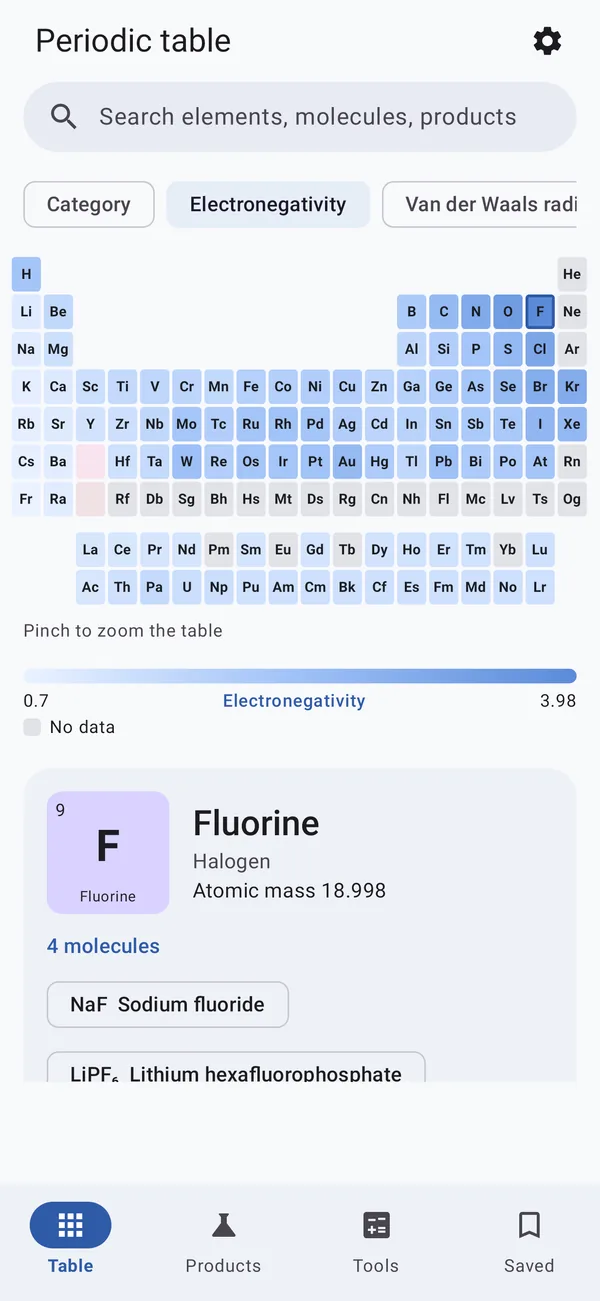

For ion questions, Atomap also has an ion charge table. On phones you can pinch to zoom the table, and the data is built into the app, so it works offline. Each page lists its sources, so you can check a value against the original reference.
Common questions
What is the difference between a group and a period?
A group is a vertical column and a period is a horizontal row. Elements in a group often behave in similar ways because they have the same number of valence electrons. Elements in a period share the same outermost shell if they are main-group elements, and their properties change step by step across the row.
Why are two rows separate at the bottom?
They are placed there so the table fits on one page. The lanthanides belong to period 6 and the actinides to period 7. Printed in their proper place, they would make the table much wider.
Why isn't the table in order of atomic mass?
The modern table is ordered by atomic number, since an element's properties repeat with atomic number. Early tables were ordered by mass, and the two orders mostly match. Argon (element 18, 39.95) is heavier than potassium (element 19, 39.098), and the same happens with cobalt and nickel, and with tellurium and iodine.
Why is hydrogen in group 1 if it isn't an alkali metal?
Hydrogen is a unique nonmetal with properties similar to both group 1 and group 17. OpenStax notes that it may be placed at the top of either group, or by itself. The alkali metal family excludes hydrogen, even on charts that put it above lithium.
Can the table tell me an ion's charge?
For many main-group elements, yes. Group 1 metals form 1+ ions, group 2 metals form 2+ ions, group 16 atoms form 2− ions and group 17 atoms form 1− ions. The pattern gets weaker toward the center of the table: copper, for example, can form 1+ or 2+ ions.
A quick practice drill
The best way to make this stick is to predict first and check afterwards. Pick five elements you don't know. For each one, write down the group, period, block and whether it is a metal, and add the valence electrons if it is a main-group element. Then check your answers on a chart or an element page. The misses are worth a second look, since many of them will be the transition metals and other exceptions this guide warned you about. After a few rounds, the table starts to read like a map and not a list of facts to memorize.