To split expenses on a group trip, agree on the rules before anyone books. Then sort every cost into shared (everyone), partial (only some of you) or personal, log each shared cost on the day it happens, and settle up once at the end. Each person then pays or receives only their net balance, so nobody chases a pile of small debts and nobody pays for a dinner or a tour they skipped.
Most money fights on trips are not really about the amounts. They come from rules nobody said out loud: whether the couple pays the same as the single friend, whether the non-drinker splits the bar tab, or who covers the fee on a foreign card. This guide turns the advice from travel and personal finance guides into a four-step system, with a worked example you can copy.
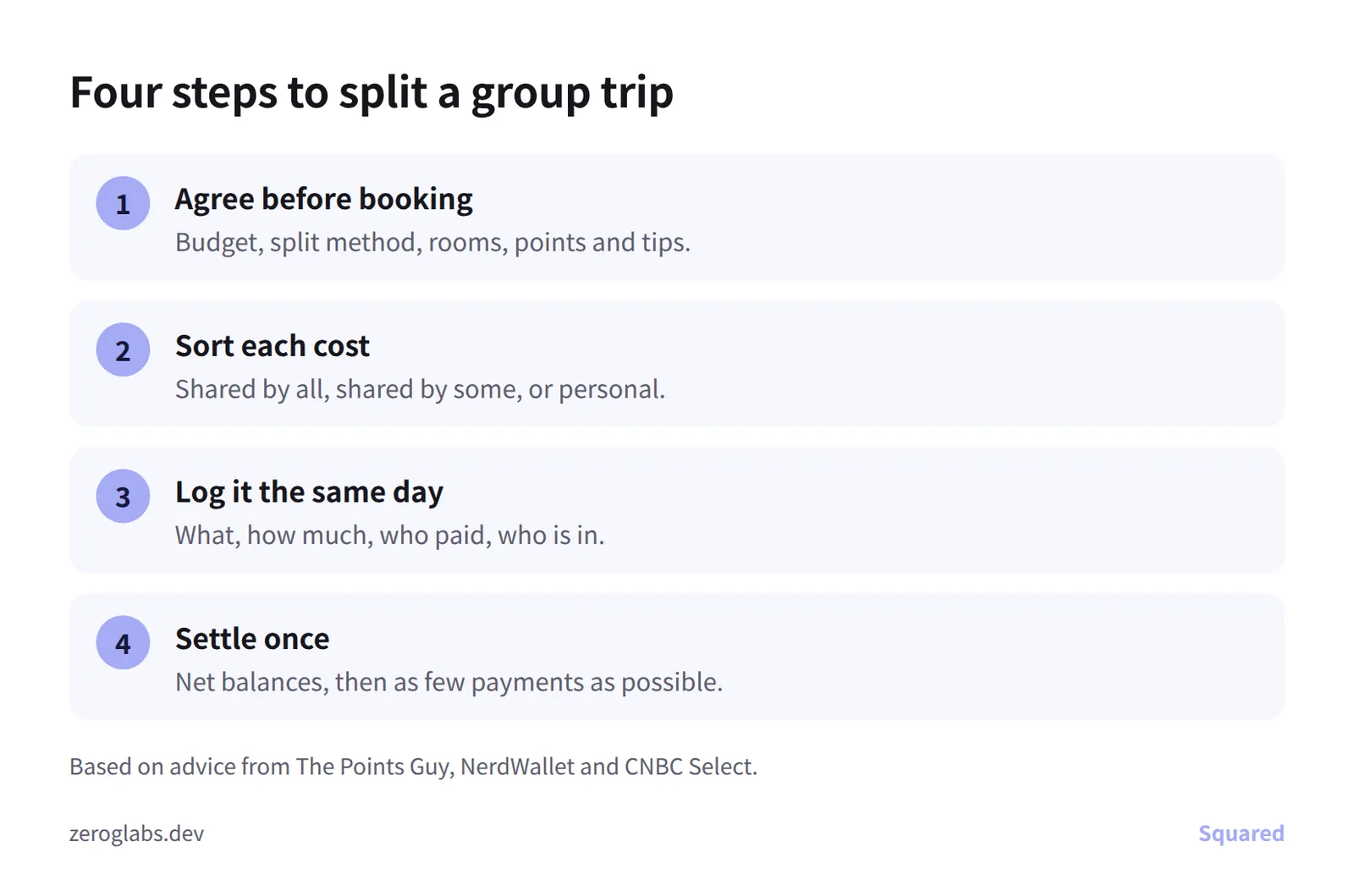
Agree on the rules before anyone books
The most useful step happens before the trip. The Points Guy recommends talking about costs before booking so that nobody is pressured into spending more than they can afford, and a NerdWallet guide says to decide whether receipts will be pooled evenly or not before you book. Once the rental is paid, changing the rules feels like an accusation.
A short message in the group chat covering these points is enough:
- Budget. A rough total per person for lodging, transport, food and activities. If someone can't stretch to it, change the plan now. NerdWallet adds that it is also fine for someone to back out of the trip.
- Split method. Split everything evenly; split shared costs evenly and let people pay for personal items themselves (CNBC Select calls this pay as you go); or take turns paying for group activities, a “round robin”.
- Rooms. If everyone pays the same, everyone should get the same amount of space, says a planner quoted by The Points Guy. Otherwise, charge different nightly rates for different rooms, and never assume someone will take the sofa bed without asking.
- Points. If one person books flights or a hotel with credit card points, agree on a cash value before booking. NerdWallet warns that charging the full cash price can feel unfair given how the points were earned.
- Small details. The Points Guy lists tipping levels, exchange rates and foreign transaction fees (the extra charge some cards add when you pay in another currency) as things to agree on, along with which expenses are shared and which are personal.
There is no single correct method. As The Points Guy puts it, the only right answer is the one you all agree on.
Sort every cost into shared, partial or personal
Every expense on a trip falls into one of three types, and naming the type when you pay prevents most arguments.
| Type | Who splits it | Typical examples |
|---|---|---|
| Shared | Everyone on the trip | Lodging, rental car, fuel, groceries for the house |
| Partial | Only the people who took part | A boat tour three of five joined, a bar tab |
| Personal | Nobody; the person pays | Souvenirs, a solo spa visit, your own flight |
Partial costs cause the most friction. NerdWallet suggests compensating people who get less value from a shared cost, for example by covering a non-drinker's share of a meal, or by leaving a late arrival out of the groceries bought before they came. The simplest way to do that is to treat drinks or a pricey add-on as a partial cost and split it only among the people who had it.
A few rules of thumb:
- Lodging and transport are usually shared, even if someone skips one car ride. Splitting a fuel tank by distance driven is rarely worth the effort.
- Mixing is fine. NerdWallet gives the example of booking flights separately while sharing the rental.
- Personal costs never go into the shared log. That keeps the log short and the final numbers clean.
Log costs the day they happen
Write down each shared or partial cost on the same day: what it was, how much, who paid and who it is split between. Memory fades fast on a trip and receipts get lost; three days later nobody remembers whether the taxi was 18 or 28 euros.
You don't need one person to pay for everything, but it helps to keep the payers to a few. The Points Guy describes having one person put all group costs on their card, often to earn rewards, with the others paying that person back at the end, or rotating who pays so that the totals even out. CNBC Select notes that putting the whole trip on one card makes the charges easier to review on a single statement. Some services, such as Uber and Airbnb, can split a cost at checkout, which takes it off your log entirely.
For foreign currency, write the amount in the currency you paid and record the rate you will use. If a card statement later shows a different converted amount because of the bank's rate or a fee, use the amount that was actually charged, as long as the group agreed to that rule in step one.
Whoever keeps the log should share it, or a summary, every evening or two. A mistake is easy to fix the next day and hard to fix a week later.
Settle up once, with net balances
At the end, don't repay expense by expense. Add up what each person paid and what each person's share is, take the difference, and settle only that net balance. With four people this usually takes three payments or fewer instead of a dozen.
Here is a worked example with four friends on a weekend away (amounts in dollars):
- Ana paid for the cabin, 800, shared by all four: 200 each.
- Ben paid for a kayak tour, 180, for Ben, Cal and Dee, because Ana stayed back: 60 each.
- Cal paid for groceries, 120, shared by all four: 30 each.
- Dee bought souvenirs. That is a personal cost, so it is not in the log.
Each person's share is Ana 230, Ben 290, Cal 290 and Dee 290. Subtract that from what each person paid: Ana is owed 570, Ben owes 110, Cal owes 170 and Dee owes 290. The balances add up to zero, which is a quick check that nothing was missed. Three payments settle the trip: Ben pays Ana 110, Cal pays Ana 170 and Dee pays Ana 290.
Two practical points:
- Leftover cents. 100 split three ways is 33.33 each, which leaves one cent over. Agree on who absorbs leftovers, or spread them evenly; it is only a cent, but a clear rule keeps the totals from drifting.
- When to settle. Settling once at the end is simplest for a trip of a week or so. On a long trip, settle at the halfway point too, so that nobody carries a large balance for weeks.
Logging a trip by date in Squared
A shared spreadsheet can do all of this. If you would rather keep it on your phone, Squared, the bill-splitting app we make for Android, is built around this kind of trip. A trip keeps its expenses on a calendar, day by day, which makes step three a habit: open the day and add what was spent.
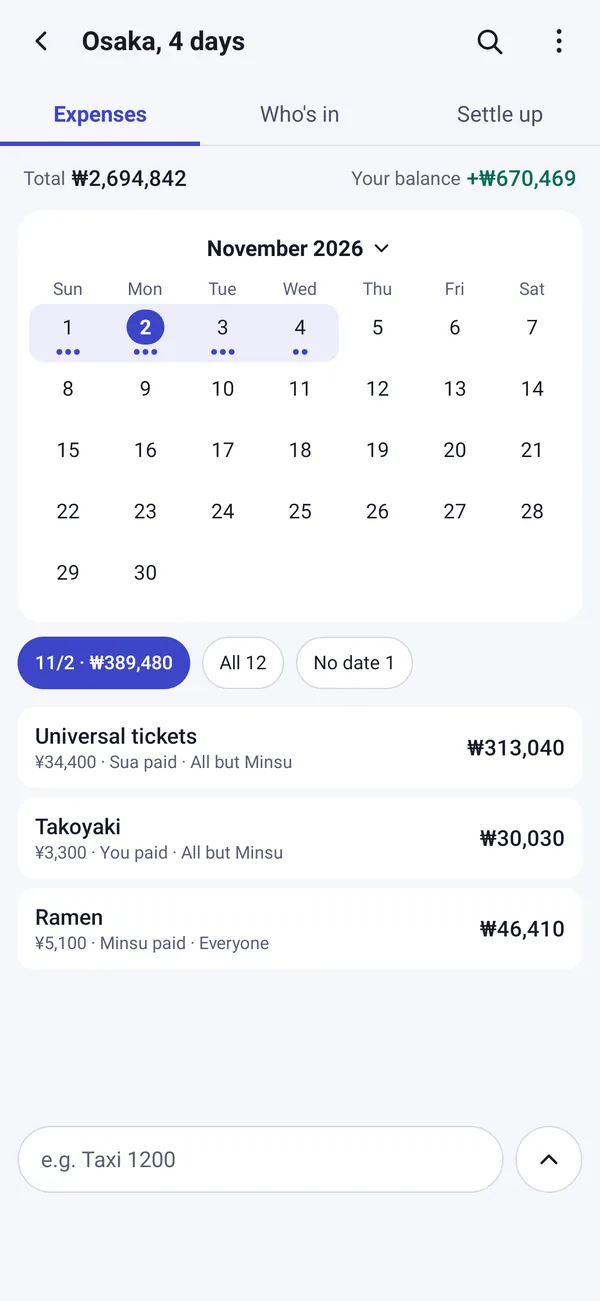
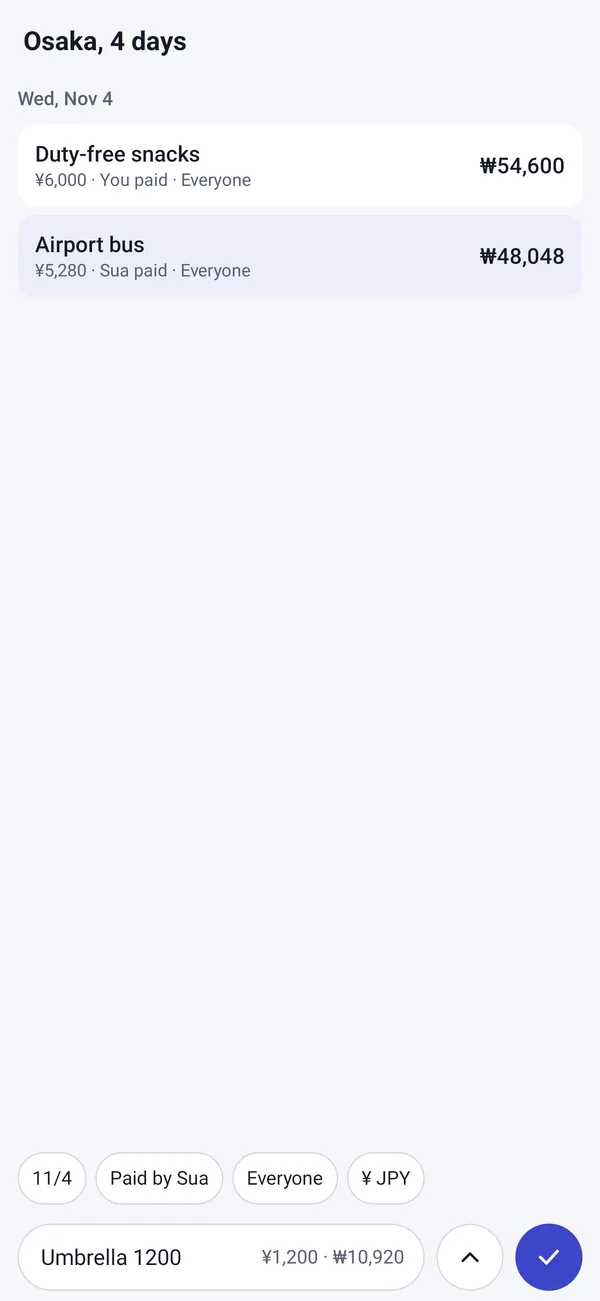
Adding a cost takes one line. Type “Taxi 1200” and it is added; you can enter several expenses at once and add anything you forgot later, on its own date. Each group has its own exchange rates: enter a rate yourself, or set one for a single expense, such as the amount your card was charged. With the 24-hour unlock, which opens when you watch one optional ad, Fill in rate looks up the rate for you.
Partial costs go on one table that shows every expense and every person: tap to take someone out of an expense, like Ana from the kayak tour, or to put them back. When someone joins late or leaves early, a helper updates the expenses from that day on. At the end, Squared works out the fewest payments that settle everyone up, and See the math shows why each amount is what it is. When a bill doesn't divide evenly, it spreads the leftover as evenly as possible across the whole total and shows what it did, or you can hand the leftover to one person.
There is no sign-up, and one phone can enter everything for the whole group, so nobody else needs the app; share the result as text or a CSV file. Each group holds up to 30 expenses and 10 photos for free, one more reason to log only shared and partial costs.

Common questions
What is the fairest way to split costs on a group trip?
The fairest method is the one everyone agreed to before booking. For most groups that means splitting shared costs such as lodging and transport evenly, splitting partial costs only among the people who took part, and paying personal costs yourself. Splitting everything evenly is simpler, but it works best when budgets and interests are similar.
Should a couple pay the same as a single traveler?
It depends on what you agree, but space is a fair basis. A planner quoted by The Points Guy says that if everyone pays equally, everyone should get an equal amount of space, so a couple sharing one room could pay per room rather than per person. Whatever you choose, settle it before booking.
How do we split costs when someone doesn't drink?
Treat alcohol as a partial cost and split it only among the people who drank. NerdWallet suggests compensating anyone who gets less value from a shared cost, for example by covering a non-drinker's share of the meal. Deciding this upfront avoids a tense moment when the bill arrives.
Should we use a shared kitty or pay as we go?
A kitty, where everyone puts in the same amount and shared costs are paid from it, is simple, but NerdWallet notes that pooling money can cause resentment when priorities differ. Paying as you go and logging each cost takes more record keeping, but it matches what each person actually did. Many groups mix the two, for example a kitty for groceries and a log for everything else.
How do we handle points used to book flights or a hotel?
Agree on a cash value for the points before anyone books. NerdWallet suggests options other than the full cash price, such as sharing the card's annual fee, and recommends thanking the person who provided the points. Then log the agreed amount as a shared cost paid by that person.