The most reliable way to tell if you snore is to have someone listen while you sleep, or to record yourself for a few nights and listen back. If you sleep alone, morning clues such as a dry mouth, a headache on waking or feeling unrested after a full night can hint at snoring. They have other causes too, so a recording is what settles it. If anyone has ever heard you stop breathing, gasp or choke in your sleep, see a doctor instead of relying on a recording.
Snoring is very common, and the NHS says it is not usually caused by anything serious. It happens when the tongue, mouth, throat or the airways in the nose relax and narrow during sleep and vibrate as you breathe. This guide covers the signs you can notice on your own, a simple routine for recording a few nights, what different snoring patterns can point to, and the warning signs of sleep apnea, a condition in which breathing stops and restarts many times during sleep.
Signs you snore when you sleep alone
No single morning symptom proves that you snore, but two or three together are worth checking with a recording. Most of the clues you can notice by yourself appear on official symptom lists for sleep apnea, the sleep problem snoring is most often linked to:
- A dry mouth when you wake up. The US National Heart, Lung, and Blood Institute (NHLBI) lists dry mouth among the symptoms of sleep apnea you may notice yourself.
- Headaches on waking. The NHS lists them among the daytime symptoms of sleep apnea, and the NHLBI lists headache too.
- Feeling tired after a full night in bed. MedlinePlus, the US National Library of Medicine's health site, says being often tired during the day or not feeling rested are reasons to see a healthcare provider.
- Waking often during the night, including to urinate. Both appear on the NHLBI and NHS lists.
- What other people tell you. A roommate, a relative on a trip or a friend who shared a tent is the closest thing to a bed partner. The NHLBI notes that you may not know you have these symptoms until someone tells you.
Your risk factors matter too. The NHS says snoring is more likely if you are overweight, smoke, drink heavily or sleep on your back. MedlinePlus adds that it is more common in older people, though thin people snore as well.
Each of these clues also has everyday causes, such as a dry room, a cold, stress or a late coffee. That is why the next step is to listen for yourself.
How to record yourself for a few nights
Record at least three nights in a row and listen to the loud parts each morning. One night can mislead you, because snoring often depends on things that change from night to night, such as alcohol or the position you fall asleep in.
- Place the phone close to your head, on a nightstand within about an arm's length, with the microphone uncovered and the charger plugged in.
- Keep the room as quiet as you can. In a study of a snoring app, quiet snoring and sounds close to the background noise were the ones most likely to be missed, so a loud fan or air conditioner works against you.
- Sleep alone in the room for these nights if you can. The same study notes that an app may not be able to tell one person's snoring from another's in the same room.
- Write a one-line note before bed: any alcohol, sleeping pills, a blocked nose, and the position you lay down in. The NHS names heavy drinking, sleeping pills and sleeping on your back as things that can bring on snoring.
- Listen the next morning. Skip the silence and go to the loud parts. Listen for how loud the snoring is, whether it is steady, and whether it ever stops and ends with a gasp or snort.
For phone settings, battery and placement in more detail, see our guide on how to record yourself sleeping. If your recordings turn up talking rather than snoring, why people talk in their sleep explains what is behind it.
What snoring patterns can mean
When you snore, and what your bedtime note says, can hint at the cause. That is useful because the NHS matches treatments to the cause. Compare your notes with your recordings:
| What you notice | What it may point to | What the NHS suggests |
|---|---|---|
| Snoring mostly on your back | Sleeping position | Sleep on your side, for example with a tennis ball attached to your sleepwear, or a pillow or bed wedge |
| Snoring mostly after drinking or sleeping pills | Alcohol or sedatives | Avoid heavy drinking and sleeping pills |
| Snoring when your nose is blocked | Blocked nose | Nasal strips or dilators, decongestants or nasal sprays |
| Your mouth falls open as you sleep | Breathing through your mouth | A chin strap or a vestibular shield that encourages nose breathing |
| Loud snoring broken by silence, then a gasp, snort or choke | Possible sleep apnea | See a doctor |
| Occasional soft snoring and you feel fine | Common snoring | Lifestyle changes; see a GP if they don't help or snoring affects your life or your partner's |
A tongue that blocks the throat is another cause, and for it the NHS lists a mandibular advancement device, a mouth device that moves the tongue forward. You can't spot this cause on a recording. A doctor can look inside your mouth and nose to find out what is behind your snoring.
What a phone recording can't tell you
A recording tells you whether and when you snored. It can't tell you whether you have sleep apnea, so a quiet night doesn't rule it out and a loud one doesn't prove it.
Two small studies show the limits. In 2021, researchers compared a free snoring app with home polygraphy, an overnight test that measures breathing, in 19 healthy adults. The app did best at spotting nights of heavy snoring, but it did not detect obstructive events, the moments when the airway closes. Another 2021 study had 11 adults record 201 nights with a paid app and compared the results with an ear, nose and throat specialist scoring the same recordings by hand. Overall snoring rates agreed closely, but the app caught only 78% of snoring on average, and about a third of what it flagged as snoring was something else.
There is also a basic problem: an apnea is silence. A pause in breathing makes no sound, so it is easy to miss on a recording unless it ends with a gasp or snort. Only a sleep study, which measures your breathing directly, can diagnose sleep apnea.
Sleep apnea warning signs that need a doctor
See a doctor if your breathing stops and starts while you sleep, if you gasp, snort or choke, or if you feel tired all day, even when your recordings sound fine. These are the main signs the NHS lists. Sleep apnea happens when the airway becomes too narrow during sleep, and the NHLBI says that untreated sleep apnea increases the risk of stroke, heart attack and other serious problems.
A short questionnaire called STOP-Bang is used to estimate the risk. It has eight yes-or-no questions:
- Do you snore loudly, loud enough to be heard through closed doors, or does a bed partner elbow you for it?
- Do you often feel tired, fatigued or sleepy during the day?
- Has anyone seen you stop breathing, choke or gasp in your sleep?
- Do you have high blood pressure, or are you treated for it?
- Is your body mass index over 35?
- Are you older than 50?
- Is your neck 40 cm (16 inches) or more around?
- Are you male?
In the version from the University Health Network, which publishes the questionnaire, 0–2 yes answers means low risk, 3–4 intermediate risk and 5–8 high risk of moderate or severe obstructive sleep apnea. It estimates risk and does not diagnose anything. If you sleep alone, the snoring question is the one your recordings help you answer. The questionnaire grew out of a 2008 study of surgical patients by Chung and colleagues, which found that adding body mass index, age, neck size and sex to the four original questions made it better at catching moderate and severe sleep apnea.
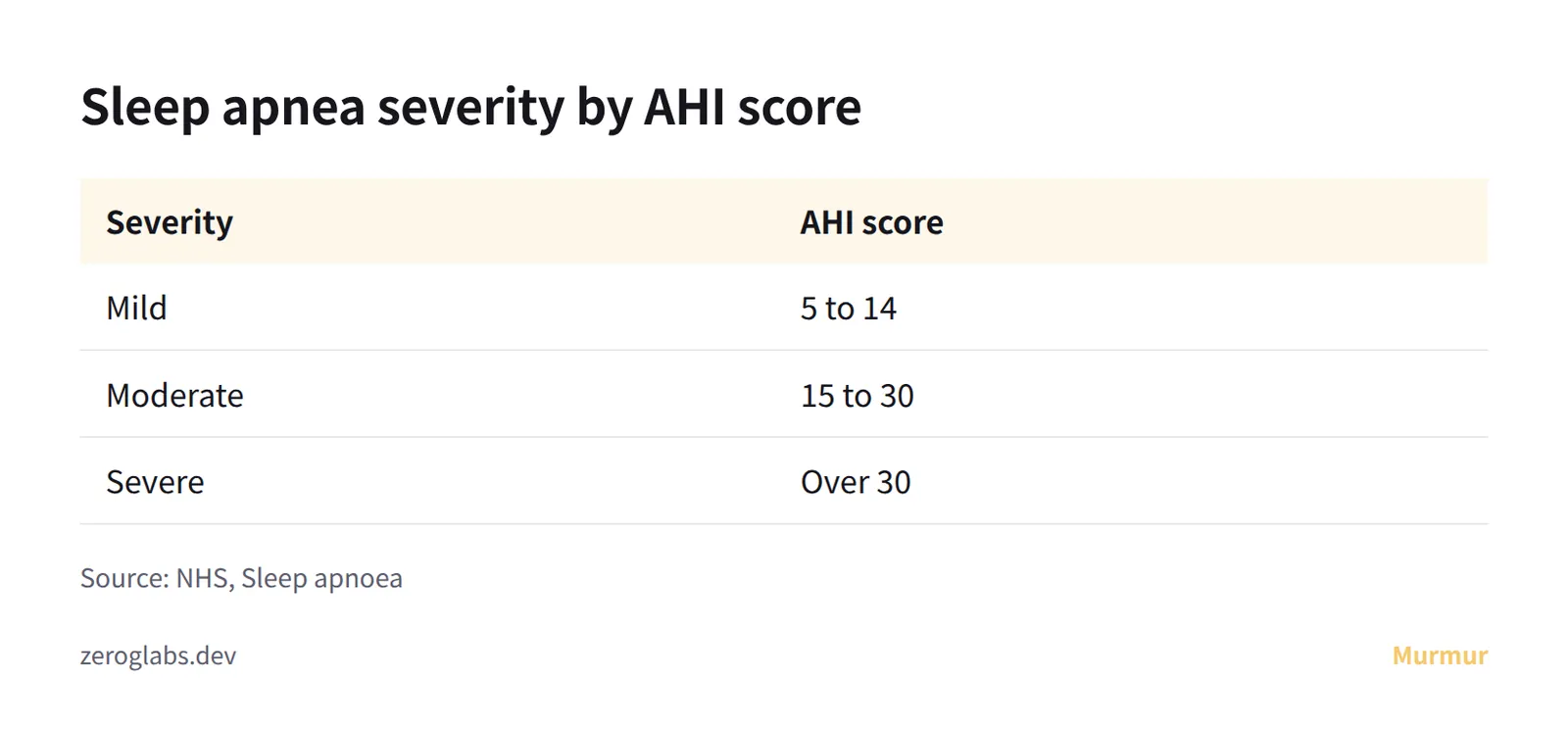
If your doctor suspects sleep apnea, the next step is usually a sleep study. The NHS says the devices check things like your breathing and heartbeat while you sleep, usually at home, though sometimes you stay overnight at a clinic. The result is an AHI (apnea-hypopnea index) score that shows how severe it is.
If you can, bring someone who has seen your symptoms to the appointment, as the NHS suggests. If you sleep alone, a few saved clips of the loudest stretches can help you describe what happens. In the UK, the NHS adds that once excessive sleepiness is confirmed, you must not drive until it is under control. Wherever you live, don't drive when you feel drowsy.
Checking your nights with Murmur
Murmur, the sleep talk and snoring recorder we make for Android, is built for this kind of check. Tap Start sleep before bed and it saves a clip only when it hears a sound, including the 3 seconds before the sound started, so you aren't scrolling through hours of silence. Recording continues with the screen off, and no ads show while it records.
Each night gets its own timeline with a sound graph, so the loud stretches are easy to find. After the night ends, Murmur sorts each clip into talking, snoring or other sounds on your phone, and the night list shows how many of each. Listening by kind opens with a pass, which you get by watching an optional ad. Sorting is automatic and some clips may land in the wrong group, so every clip also stays under All.
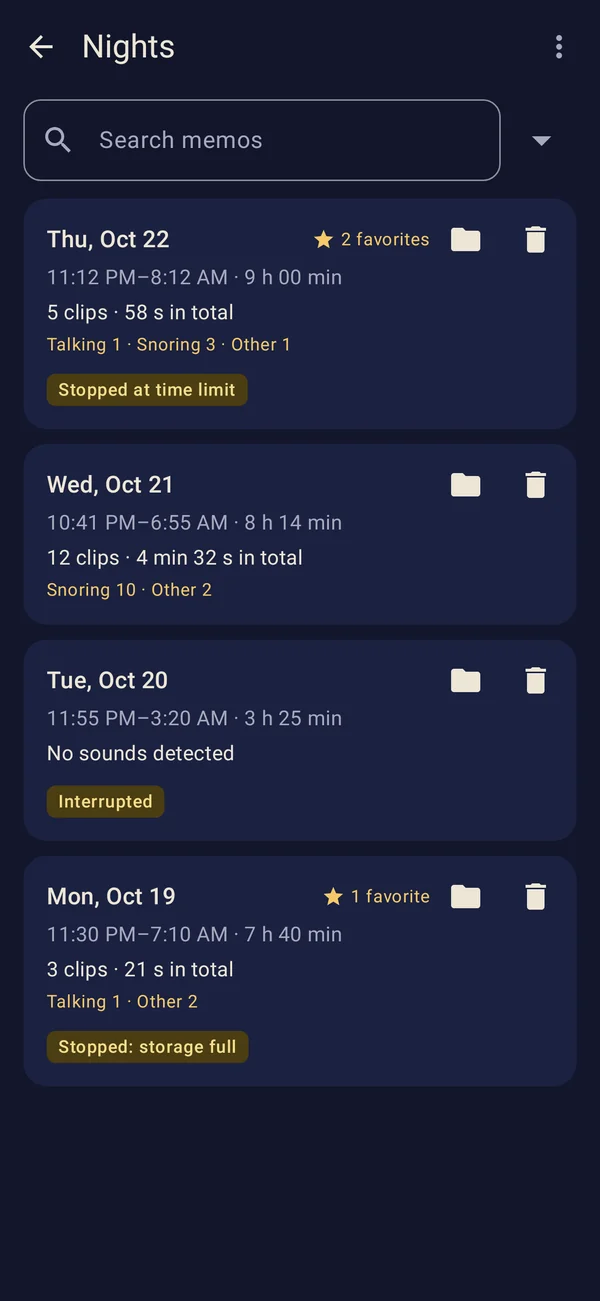
The free plan records up to 9 hours a night and keeps your 3 most recent nights and 3 favorites, which is enough for a three-night check. Mark the clips you might want to play for a doctor as favorites. Recordings stay in the app's private storage on your phone. Murmur records sounds and does not test for sleep apnea, so the warning signs above still apply whatever your clips sound like.

Common questions
Can you snore and not know it?
Yes. You are asleep when it happens, and the NHLBI notes that people may not know about symptoms such as loud snoring or pauses in breathing until someone tells them. If nobody shares your room, recording a few nights is the simplest way to find out.
Can you tell if you snore without recording yourself?
Only roughly. A dry mouth, headaches on waking and daytime tiredness are hints, but each has other causes. Asking someone who has slept near you, or recording a few nights, gives you a real answer.
Is snoring every night a sign of sleep apnea?
Not on its own. The NHS says snoring is very common and not usually serious, although the NHLBI lists frequent loud snoring among sleep apnea symptoms. Loud snoring every night together with pauses in breathing, gasping or daytime sleepiness is a reason to see a doctor.
Can thin or young people snore?
Yes. MedlinePlus notes that thin people can snore too, even though snoring is more common in older and overweight people. The NHS says sleep apnea becomes more likely as you get older, but children and young adults can have it as well.
Are snoring apps accurate?
They are reasonably good at showing whether and when you snored, but not perfect. In small studies, apps missed some snoring, flagged other sounds as snoring, could not detect obstructive events and might confuse two people in the same room. Treat the result as a record of sounds, not a diagnosis.