People talk in their sleep because the brain doesn't always settle fully into sleep. As Mass General Brigham neurologist Milena Pavlova puts it, “You're asleep, but part of your brain hasn't quite transitioned to sleep mode.” The exact cause is still unclear, but genes, stress, sleep loss and alcohol all seem to make it more likely, and on its own it is usually harmless.
The useful question is rarely why you said something odd at 3 a.m. It is whether the talking comes with anything else, such as shouting, violent movements, loud snoring or tired days. This guide covers how common sleep talking is, when in the night it happens, what sets it off, and when a doctor should take a look.
What sleep talking is
Sleep talking is speech during sleep that you aren't aware of. Its medical name is somniloquy, and the Sleep Foundation classes it as a parasomnia, a word for unusual behavior during sleep. It can be mumbling, gibberish or something that sounds like one side of a real conversation.
Episodes are short. WebMD says sleep talkers normally speak for no more than 30 seconds at a time, although some people talk many times in one night. The Sleep Foundation adds that people are very rarely aware of it and typically don't remember it later, which is why most of us only hear about it from someone else.
How common sleep talking is in children and adults
Most people do it at some point, but only a small share of adults do it regularly. The numbers vary because they rely on people knowing about something they slept through.
- At any point in life: up to 66% of people have had an episode, but only 17% reported one in the last three months, according to the Sleep Foundation.
- Children: Mass General Brigham says half of young children talk in their sleep. In a survey of 2,022 schoolchildren aged 3 to 10, about half did so at least once a year and fewer than 10% did so every day. That study found no clear link with age, sex or social class.
- Adults: about 5% keep talking in their sleep, according to Mass General Brigham and WebMD. A telephone survey of 1,000 Norwegian adults also found it among the most common parasomnias, though its authors warned about a low response rate and single-question measures.
Pavlova links the gap between children and adults to brain development: children's brains move between waking and sleep less smoothly.
It also runs in families. A study of more than 3,700 Finnish twin pairs estimated that genes explained about half of the differences between people in childhood sleep talking (54% in males, 51% in females) and 37% to 48% in adults. Whether sex matters is less settled: the Sleep Foundation says it occurs equally in women and men, while the twin study found it more common in adult men.
Which sleep stages it happens in
Sleep talking can happen in any stage of sleep, which makes it unusual among parasomnias, according to the Sleep Foundation. That includes REM (rapid eye movement) sleep, the stage most associated with dreaming, and non-REM sleep, which covers both light and deep sleep.
The stage may change how the talking sounds. Healthline describes speech in lighter sleep as easier to understand, while speech in deep sleep tends to sound more like moaning or gibberish. In a sleep lab study of 232 adults, negative words and swearing were more common in non-REM sleep, and episodes of verbal abuse lasted longer in REM sleep.
Don't read too much into this at home. Only a sleep study can show which stage you were in, and 92% of the people in that lab study were recorded during a sleep disorder, so typical sleepers may differ. Talking also isn't a reliable sign of dreaming: the Sleep Foundation says it may at times be related to dreams, but not always.
Common triggers: stress, alcohol and sleep loss
Anything that disturbs your normal sleep pattern seems to make sleep talking more likely. One honest limit: we found no controlled trial that isolates these triggers for sleep talking alone. Most of this comes from clinical experience and from research on parasomnias in general.
- Stress and anxiety: these can make it harder for the brain to move through sleep stages, according to Mass General Brigham. A 2022 review also lists situational stress and emotional stimulation before bed among the things that can set off non-REM parasomnias.
- Sleep loss: Mass General Brigham lists sleep deprivation as a cause in adults. The same review says recovering from lost sleep can make non-REM parasomnias worse, because it brings a rebound in deep sleep.
- Alcohol: the Sleep Foundation says alcohol may trigger or worsen parasomnias, including sleep talking, by unsettling the shifts between sleep stages. It also makes sleep more broken in the second half of the night, as blood alcohol falls.
- Shifted sleep times: jet lag and daylight saving time changes are both on Mass General Brigham's list.
- Illness and medication: WebMD lists fever and certain medications, and Healthline also names sickness.
- Other sleep problems: sleep apnea, in which breathing repeatedly stops during sleep, is a possible cause that you may not notice yourself. A bed partner may be the one who reports the snoring.
What sleep talkers actually say
Most sleep talk is unclear, and it doesn't reveal your secrets. In the lab study above, 59% of the 883 speech episodes were nonverbal: mumbles, shouts, whispers and laughs.
The understandable part was surprisingly well formed. It followed normal grammar and left pauses as if waiting for a reply. “No” was the most common word, negations made up 21.4% of clauses, and 9.7% of clauses contained swear words. The authors describe it as mostly a tense conversation with someone who isn't there.
That can sound alarming to a bed partner, but it is not a confession. The Sleep Foundation says the content isn't clearly tied to a person's life, and Pavlova calls the idea of hidden truths a myth from the movies.
When it is harmless and when to see a doctor
Sleep talking on its own is usually harmless, and WebMD says no tests are needed to diagnose it. Book an appointment when it comes with other signs or starts to affect your days.
| What you notice | Why it matters |
|---|---|
| Short mumbling now and then, and you feel rested | Usually harmless, and rarely needs treatment |
| It starts suddenly in adulthood, or for the first time after age 25 | WebMD and Healthline advise getting it checked, as there may be an underlying cause |
| Screaming, intense fear, or violent movements | A possible sign of REM sleep behavior disorder, or another problem worth checking |
| Snoring or heavy daytime sleepiness | Sleep apnea should be considered |
| Sleepwalking or nightmares as well | It may point to a larger sleep problem |
| It keeps disturbing you or someone you sleep near | That alone is a fair reason to ask for help |
| A child who seems to have sleep problems | WebMD suggests consulting a pediatrician |
REM sleep behavior disorder (RBD) means acting out dreams during sleep. Mass General Brigham says it affects about 1% of people and is linked to being over 50, being male, narcolepsy, certain medications including antidepressants, alcohol or opioid use, nighttime seizures and Parkinson's disease. Pavlova notes that it “can start with benign talking but transition into shouting and gradually turn into violent actions.” A diagnosis needs a sleep study in a lab, because a home test isn't sufficient.
How to reduce sleep talking
There is no proven way to stop it, and most people don't need treatment. The Sleep Foundation says little is known about methods that work, and Pavlova says she doesn't prescribe medication for sleep talking alone. Better sleep habits are the sensible first step, because they also address the triggers above.
- Keep the same sleep schedule, and protect your total sleep time.
- Avoid alcohol and caffeine before bed. Pavlova advises no coffee after noon.
- Wind down without screens for at least 30 minutes.
- Get daytime light and regular exercise, and keep the bedroom calm and comfortable.
If the talking keeps someone else awake, the Sleep Foundation suggests earplugs or headphones, a white noise machine or fan, or separate rooms if needed.
How to find out if you talk in your sleep
The simplest way is to ask whoever sleeps near you. If nobody does, record yourself over several nights. One night often proves little: the Sleep Foundation says even regular sleep talkers may need four nights or more of recording to capture an episode.
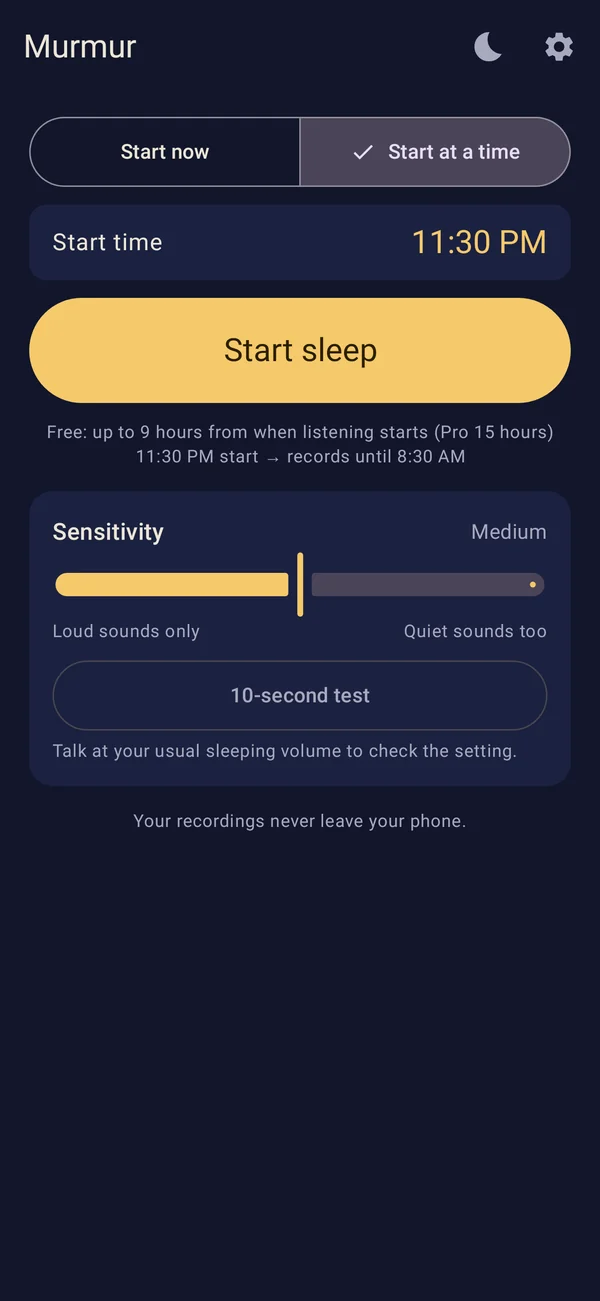
A recording app avoids hours of silence. Murmur, the sleep talk recorder we make for Android, is one way to do it. Tap Start sleep before bed, and it saves a clip only when it hears a sound, including the 3 seconds before the sound began, so the first word isn't cut off. Recording continues with the screen off, and no ads show while it runs.
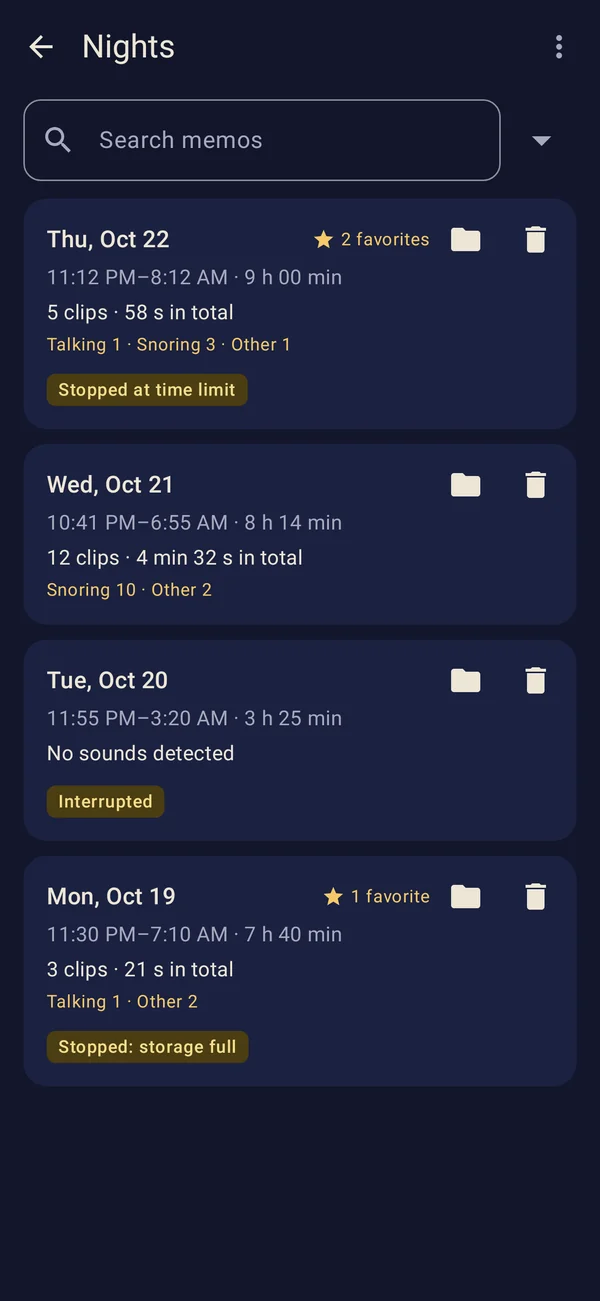
In the morning, each night has its own timeline with a sound graph. A few things help with a multi-night check:
- Keep what matters. The free version keeps your 3 most recent nights and 3 favorites, so mark a clip as a favorite if you want to keep it. Keeping every night is opened with a pass, which you earn by watching an optional ad.
- Note the day before. Night memos, also with a pass, let you write down late drinks, a stressful day or a short night. A few nights can't prove a cause, but a pattern gives you something to change or mention to a doctor.
- Check the kind of sound. With a pass, you can listen to talking, snoring and other sounds separately. Sorting is automatic and some clips may land in the wrong group, so every clip also stays under All.

Two limits are worth knowing. Murmur can't diagnose anything, and it doesn't turn speech into text or recognize who is speaking, so a partner's snoring may be saved too. Tell anyone sharing the room that you're recording. Your recordings stay on your phone unless you choose to share or export a clip (with a pass), for example to play it for a doctor.
Common questions
Do people tell the truth when they talk in their sleep?
There is no good reason to treat it as the truth. Pavlova calls that idea a myth from the movies, and most sleep talk is mumbling or fragments. The content isn't clearly tied to a person's real life, so it's best not to treat it as evidence of anything.
Why did I suddenly start talking in my sleep?
A recent change is often worth looking for first, such as stress, short nights, jet lag, alcohol, illness or a new medication. If it starts suddenly in adulthood, WebMD advises seeing a doctor, and Healthline says the same if it first appears after age 25. Later onset may have an underlying medical cause.
Is sleep talking a sign of stress or a mental health problem?
Stress can contribute, but sleep talking alone doesn't mean you have a mental health condition. In the Finnish twin study, psychiatric problems were more common in adult sleep talkers, especially when the talking began in adulthood, yet the authors say most cases aren't linked to serious psychopathology. If you're also struggling with your mood, anxiety or a past trauma, that is worth raising in its own right.
Is it normal to talk in your sleep every night?
It is less common than talking occasionally, and it doesn't automatically mean something is wrong. Fewer than 10% of the children in one large survey talked every night. In adults, the question to ask is whether it bothers you or comes with other symptoms such as daytime sleepiness. If it does, the Sleep Foundation advises talking to a doctor.
Is sleep talking linked to serious health problems?
Usually not, but there are exceptions, mainly RBD and sleep apnea. One Chinese study followed 8,001 adults for 8 years and found a modestly higher stroke risk in those who reported sleep talking (hazard ratio 1.30). That shows an association, not a cause, and sleep talking was measured only by questionnaire. It's no reason to panic, but it is a reason to take the warning signs above seriously.
Can you stop talking in your sleep?
No method is proven to stop it completely, and it rarely needs treatment. WebMD says managing stress and keeping a regular sleep schedule may help. If another condition such as sleep apnea is behind it, a doctor can look at that condition directly.
The short version
People talk in their sleep because the brain doesn't always move neatly through sleep, and genes and disrupted sleep make it more likely. If it's occasional and you feel rested, you can usually leave it alone. See a doctor if it starts suddenly in adulthood, turns into shouting or violent movements, or comes with snoring or tired days.