The official labels give a simple rule for GLP-1 injection site rotation: inject under the skin of the abdomen, thigh or upper arm, and use a different spot every week. You can stay in the same body area, as long as you move to a new spot inside it. Skip skin that is bruised, tender, scarred, hard or lumpy. A plain pattern such as left abdomen, right abdomen, left thigh, right thigh gives each area three weeks of rest between shots.
This guide covers what the semaglutide and tirzepatide labels actually say, how to rotate between areas and within an area, what research on insulin injections found about lumps from using the same spot, and an easy way to remember where your last shot went. This is not medical advice. Follow your healthcare provider's instructions, and ask your prescriber or pharmacist to check your injection technique.
Where GLP-1 shots go: what the labels say
The labels for weekly GLP-1 injections name the same three areas: the abdomen (stomach area), the thigh and the upper arm. They are subcutaneous injections, which means the medicine goes into the fatty layer just under the skin. The semaglutide Medication Guide says not to inject into a muscle or a vein.
The details differ a little between products, so check the Instructions for Use that came with your own pen:
- Semaglutide. The prescribing information lists the abdomen, thigh or upper arm. Its prefilled-syringe Instructions for Use describe the stomach area, the thighs and the back of the upper arm, the last one only with help from someone else. Stomach injections should be at least 2 inches (about 5 cm) from the belly button.
- Tirzepatide. The prescribing information says to inject in the abdomen or thigh, or to have another person inject in the back of the upper arm. The pen instructions also say to stay at least 2 inches from the belly button.
- NHS guidance. The NHS page on semaglutide says to inject into the fatty areas of your thigh, tummy or upper arm.
Does the area change how much medicine you get? For semaglutide, the clinical pharmacology section of the label says that similar exposure is reached whether it is injected in the abdomen, thigh or upper arm. So the choice between the three usually comes down to comfort and reach. The semaglutide instructions also note that your healthcare provider can help you choose the injection site that is best for you.
Rotating between areas and within an area
Rotation means two things: changing the area, and changing the exact spot inside that area. The labels allow both approaches, but the spot has to change every week.
- The semaglutide prescribing information tells healthcare providers to instruct patients to use a different injection site each week when injecting in the same body region. Its Medication Guide says to change (rotate) your injection site with each injection and not to use the same site every time.
- The tirzepatide pen instructions say to change your injection site each week. You may use the same area of your body, but choose a different injection site in that area.
- The NHS says the same: change the place each week. You can use the same area again, but not the exact same spot.
It helps to think of six areas rather than three: the left and right sides of the abdomen, the left and right thighs, and the left and right upper arms. A weekly shot adds up to 52 injections a year. Spread over four areas, each area gets about 13 shots a year, and within each area you can keep moving to a fresh spot.
The labels we read don't give an exact distance between spots. If you want a specific spacing, ask your pharmacist or diabetes nurse to show you on your own body.
If you also use insulin, the semaglutide and tirzepatide labels say you can inject both in the same body region, but not right next to each other. The NHS page on semaglutide suggests injecting it in a different place from your insulin. Follow whichever instruction your care team gives you.
Skin to avoid
Don't inject into skin that looks or feels different from the skin around it. The tirzepatide vial Instructions for Use give the clearest list:
- skin that has pits, is thickened or has lumps
- skin that is tender, bruised, scaly or hard
- scars or damaged skin
On the abdomen, also keep at least 2 inches (about 5 cm) away from the belly button, as the pen and syringe instructions describe.
Some redness is common. The NHS lists itchy or red skin where you inject as a common side effect of semaglutide, and notes that redness may be harder to see on brown or black skin. If last week's spot is still sore, bruised or raised on shot day, use a different area. Tell your healthcare provider about any site reaction that worries you or that doesn't go away.
Why rotation matters: what insulin studies found about lumps
Using the same spot over and over can cause lipohypertrophy, a buildup of fatty tissue under the skin that feels like a lump or a thickened, rubbery patch. Most research on it comes from insulin, and in that research, poor rotation is the strongest risk factor.
- Blanco and colleagues, 2013. A diabetes nurse examined the injection sites of 430 outpatients who injected insulin. Nearly two-thirds (64.4%) had lipohypertrophy. Not rotating sites was strongly linked to it, and correct rotation was the strongest protective factor. People with lipohypertrophy also reported more unexplained low blood sugar and more variable glucose, and they used more insulin.
- Mader and colleagues, 2025. This meta-analysis pooled 51 studies of people using insulin. Incorrect site rotation was the strongest risk factor, with a pooled prevalence odds ratio of 8.85. Put simply, people who rotated incorrectly had about 8.85 times the odds of having lipohypertrophy compared with people who rotated correctly. Reusing needles (3.20) and more than two injections a day (2.27) also raised the odds.
- Expert recommendations, 2016. The insulin injection recommendations published in Mayo Clinic Proceedings call lipohypertrophy a frequent complication that distorts insulin absorption. They say not to inject into these lesions and that correct site rotation helps prevent them.
There are honest limits here. These studies are about insulin, which many people inject several times a day. A weekly GLP-1 shot means far fewer injections, and we did not find large studies that measure how common lipohypertrophy is with weekly GLP-1 pens. Still, the GLP-1 labels tell you to rotate and to avoid lumpy or thickened skin, so the same habit applies.
A simple weekly rotation pattern
The easiest pattern is a fixed order of areas, plus a new spot inside each area every time you come back to it. Here is one way to set it up:
- Pick the areas you can use. On your own, that is usually the two sides of the abdomen and the two thighs. Add the backs of the upper arms if someone can inject for you, as the labels describe.
- Fix the order. For example: left abdomen, right abdomen, left thigh, right thigh. With four areas, each one rests for three weeks between shots.
- Move the spot on every lap. The first time round, use one part of each area; the next time, use a different part, such as lower instead of higher.
- Skip, don't stop. If the next area is bruised or sore, move on to the following one in your order and continue from there.
- Write it down. A week is long enough to forget which side you used last.
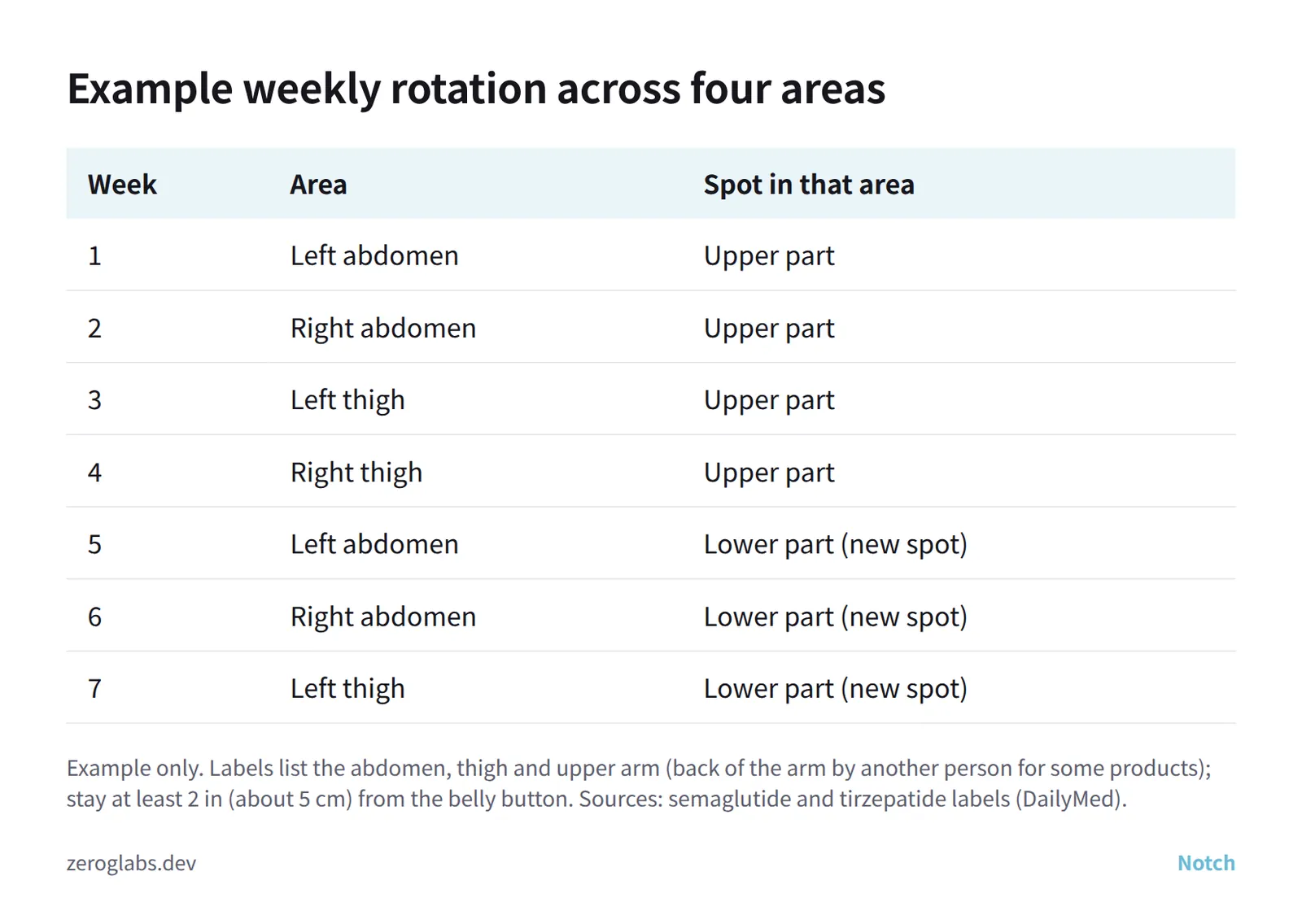
This is a structure, not a medical protocol. If your prescriber or pharmacist has shown you a different pattern, use theirs.
Keeping track of your last site
The hard part of rotation is remembering. A written log, a note in your calendar or an app all work, as long as you record the site every time.
Notch, the GLP-1 shot log we make for Android, has a body map for this. When you log a shot, you pick the site on the map: abdomen, thighs and upper arms, left and right. Notch highlights the site you used least recently and selects it for you, so you can follow it or tap another site. If nobody can help you with your arms, you can turn off the sites you don't use, or add your own.
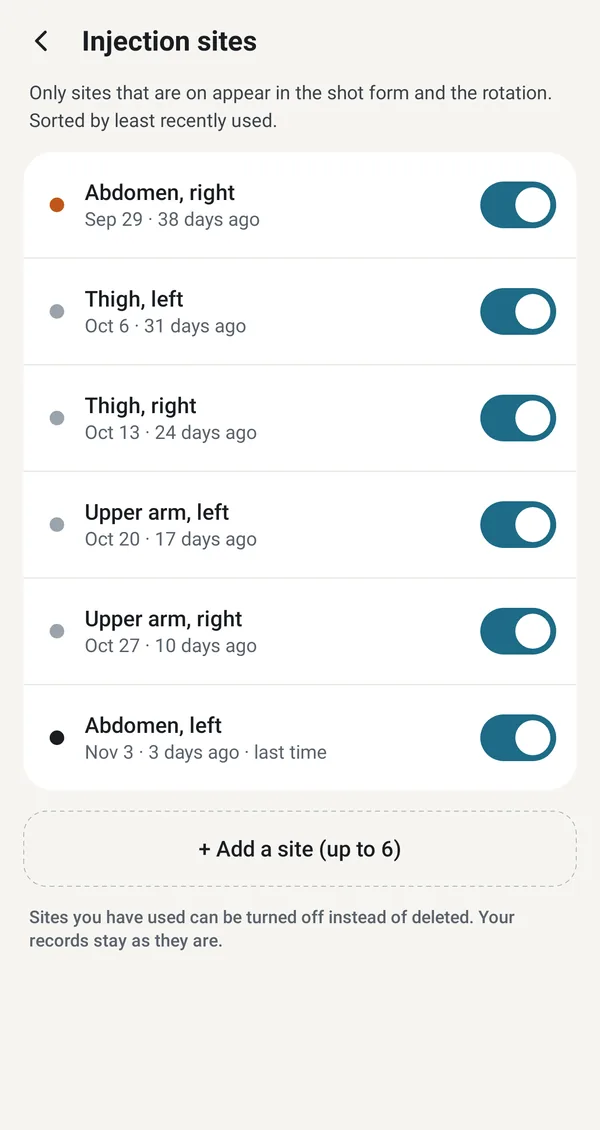
Each shot entry also holds the date and time, medication, dose and a note, so you can write down things like a bruise at that spot. The history screen shows your past shots, and a reminder arrives on shot day without naming your medication. Site rotation is free. Notch doesn't tell you where you should inject or what dose to take. It only remembers what you logged, so your technique still comes from your healthcare provider.

Common questions
Does it matter where I inject my GLP-1 shot?
The labels allow the abdomen, the thigh and the upper arm. For semaglutide, the label says exposure is similar in all three, so the choice usually comes down to comfort and reach. What matters most is that the exact spot changes every week and that you avoid damaged skin.
Can I inject in the same spot every week?
No. The labels say to change (rotate) your injection site with each injection and not to use the same site every time. You can stay in the same area, such as your abdomen, as long as you pick a different spot inside it each week.
Is the stomach or the thigh better for GLP-1 injections?
The labels don't rank them; both are listed as standard sites. Many people use both, alternating sides in a fixed order. Your healthcare provider can help you choose what suits you.
Can I inject into my upper arm by myself?
The tirzepatide label and the semaglutide prefilled-syringe instructions say the back of the upper arm should be injected by another person. If you inject alone, the abdomen and thighs are usually easier. Check the Instructions for Use for your own pen.
What should I do if I get a bruise or lump at the injection site?
Don't inject into it. The instructions say to avoid skin that is bruised, tender, hard, thickened or lumpy, so use a different area that week. Itchy or red skin is a common side effect, but tell your healthcare provider about a lump or reaction that doesn't go away.
How far from the belly button should I inject?
The semaglutide syringe and tirzepatide pen instructions both say at least 2 inches (about 5 cm) from the belly button. Beyond that, move to a new spot on the abdomen each time you use it.