Solubility rules tell you whether an ionic compound dissolves in water. Compounds of Group 1 metals (lithium, sodium, potassium and the rest), ammonium, nitrate and acetate are soluble. Chlorides, bromides, iodides and sulfates are mostly soluble, with a short list of exceptions led by silver, lead and mercury(I). Carbonates, phosphates, chromates, sulfides and hydroxides are mostly insoluble, unless they are paired with a Group 1 cation or ammonium.
The main use of the rules is to predict whether mixing two solutions makes a solid, called a precipitate. This guide gives the rules as one chart, shows how to read it in the right order, works through examples, and then explains what "insoluble" really means in numbers, why different solubility tables disagree, and how to learn the exceptions without memorizing a wall of text.
The solubility rules at a glance
Read the chart from the top: if a compound contains an ion from the first two rows, it is soluble, whatever the other ion is. The rows below are the guidelines in Table 4.1 of OpenStax Chemistry 2e, the free college textbook.
| Ion in the compound | Usually | Exceptions |
|---|---|---|
| Group 1 cations (Li⁺, Na⁺, K⁺ …) and ammonium (NH₄⁺) | Soluble | None |
| Nitrate (NO₃⁻), acetate (CH₃COO⁻), chlorate (ClO₃⁻), bicarbonate (HCO₃⁻) | Soluble | None |
| Chloride (Cl⁻), bromide (Br⁻), iodide (I⁻) | Soluble | Ag⁺, Hg₂²⁺, Pb²⁺ |
| Fluoride (F⁻) | Soluble | Group 2 cations, Pb²⁺, Fe³⁺ |
| Sulfate (SO₄²⁻) | Soluble | Ag⁺, Ba²⁺, Ca²⁺, Hg₂²⁺, Pb²⁺, Sr²⁺ |
| Carbonate (CO₃²⁻), chromate (CrO₄²⁻), phosphate (PO₄³⁻), sulfide (S²⁻) | Insoluble | Group 1 cations, NH₄⁺ |
| Hydroxide (OH⁻) | Insoluble | Group 1 cations, Ba²⁺ |
Hg₂²⁺ is the mercury(I) ion. A cation is a positive ion and an anion is a negative ion. If the group numbers are new to you, our guide on how to read the periodic table explains them.
The order matters because the always-soluble rows override the insoluble rows. Carbonates are on the insoluble side, but sodium carbonate (Na₂CO₃) contains a Group 1 cation, so it dissolves. The same goes for potassium phosphate (K₃PO₄) and ammonium carbonate ((NH₄)₂CO₃). If neither ion is in the first two rows, find the anion's row and check whether the cation is on its exception list.
A few worked examples:
- NaCl: soluble. Sodium is a Group 1 cation.
- AgCl: insoluble. Chlorides are soluble, but Ag⁺ is an exception.
- PbI₂: insoluble. Iodide with Pb²⁺ is an exception.
- CuSO₄: soluble. Cu²⁺ is not on the sulfate exception list.
- BaSO₄: insoluble. Ba²⁺ is a sulfate exception.
- CaF₂: insoluble. Calcium is a Group 2 cation, an exception for fluorides.
- CaCO₃: insoluble. Calcium is neither Group 1 nor ammonium.
- Mg(OH)₂ and Ba(OH)₂: magnesium hydroxide is insoluble, while barium hydroxide is the listed exception and dissolves.
What soluble and insoluble actually mean
"Insoluble" means that very little dissolves, not that nothing does. OpenStax defines solubility as the maximum concentration of a substance that can be reached under given conditions, and says substances with relatively low solubilities are called insoluble.
Purdue University's general chemistry pages put numbers on the labels, using molarity (M, moles of dissolved substance per liter of solution) at room temperature:
- Soluble: at least 0.1 M dissolves.
- Slightly soluble: between 0.001 M and 0.1 M.
- Insoluble: less than 0.001 M.
Why do some salts dissolve and others don't? Purdue explains that dissolving an ionic solid means overcoming the strong attraction between oppositely charged ions. A salt dissolves when the energy released as its ions interact with water makes up for the energy needed to pull the ions apart. The rules are a summary of which ion pairs win that contest and which don't, worked out from experiments.
How insoluble is insoluble? Ksp numbers
The solubility product constant, Ksp, turns "insoluble" into a number: the smaller it is, the less of the salt dissolves. Ksp is the equilibrium constant for a solid dissolving into its ions. For a salt that splits into one cation and one anion, such as AgCl, the molar solubility is roughly the square root of Ksp. For a salt like PbCl₂ that gives one cation and two anions, it is roughly the cube root of Ksp divided by 4.
The Ksp values below are from the LibreTexts reference table, which takes them from the CRC Handbook of Chemistry and Physics (84th edition). The molar solubility column is our estimate from those values, and the label applies Purdue's thresholds to it.
| Compound | Ksp at 25 °C | Estimated solubility | Label |
|---|---|---|---|
| AgCl | 1.77 × 10⁻¹⁰ | 1.3 × 10⁻⁵ M | Insoluble |
| BaSO₄ | 1.08 × 10⁻¹⁰ | 1.0 × 10⁻⁵ M | Insoluble |
| CaCO₃ | 3.36 × 10⁻⁹ | 5.8 × 10⁻⁵ M | Insoluble |
| CaSO₄ | 4.93 × 10⁻⁵ | 7.0 × 10⁻³ M | Slightly soluble |
| Ca(OH)₂ | 5.02 × 10⁻⁶ | 1.1 × 10⁻² M | Slightly soluble |
| PbCl₂ | 1.70 × 10⁻⁵ | 1.6 × 10⁻² M | Slightly soluble |
Two things stand out. First, the "insoluble" exceptions are not all equally insoluble: lead(II) chloride dissolves about a thousand times better than silver chloride. Second, calcium sulfate and calcium hydroxide land in the slightly soluble band, even though the simple rules put them on the insoluble side. Keep in mind that these square-root estimates ignore other ions in the water and other effects, so treat them as orders of magnitude, not exact lab values.
How to predict a precipitate with the rules
To predict a precipitation reaction, swap the partners of the two compounds and check each new pair against the chart. OpenStax defines a precipitation reaction as one in which dissolved substances react to form one or more solid products.
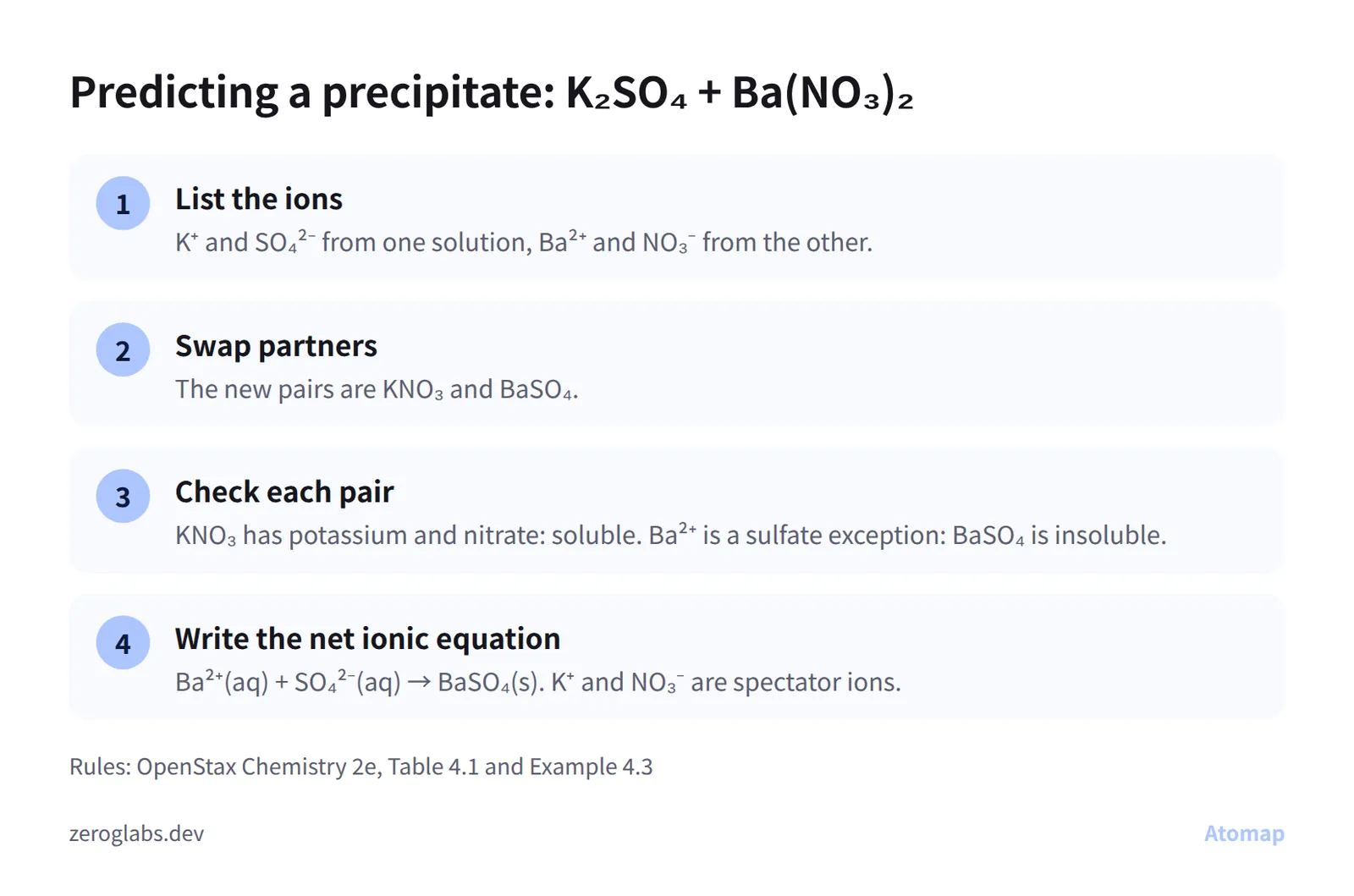
This is the example OpenStax works through. Mixing potassium sulfate with barium nitrate could give potassium nitrate and barium sulfate. Potassium nitrate is soluble, but barium sulfate is a sulfate exception, so it comes out of solution as a solid. The net ionic equation keeps only the ions that change: Ba²⁺(aq) + SO₄²⁻(aq) → BaSO₄(s). The ions that stay dissolved on both sides, here K⁺ and NO₃⁻, are called spectator ions and are left out.
Two more cases to practice on:
- Silver nitrate + sodium chloride. The new pairs are NaNO₃ (soluble) and AgCl (insoluble), so silver chloride precipitates: Ag⁺(aq) + Cl⁻(aq) → AgCl(s), one of the net ionic equations OpenStax gives.
- Sodium chloride + potassium nitrate. The new pairs are KCl and NaNO₃, and both are soluble. No precipitate forms; you simply have four kinds of ions in one solution.
If both swapped products are insoluble, you get two precipitates. If you aren't sure the reaction happens at all, the rules can only tell you whether a solid is expected, not how fast it forms or how much you get.
Why solubility tables disagree
Different tables disagree mainly at the borderline salts, so use the table your course or exam provides. Comparing OpenStax with Purdue shows where the differences sit:
- Sulfates. OpenStax lists Ag⁺ and Ca²⁺ among the sulfate exceptions. Purdue names BaSO₄, SrSO₄ and PbSO₄ as insoluble and calls Ag₂SO₄, CaSO₄ and Hg₂SO₄ slightly soluble. The Ksp estimates above back this up: calcium sulfate sits at about 0.007 M.
- Hydroxides. OpenStax makes exceptions for Group 1 and Ba²⁺. Purdue also lists Sr(OH)₂ as soluble and Ca(OH)₂ as slightly soluble.
- Halides. Purdue adds Cu⁺ to the silver, lead and mercury(I) exceptions for chlorides, bromides and iodides.
- Sulfides. OpenStax makes exceptions only for Group 1 and ammonium. Purdue also lists MgS, CaS, SrS and BaS among the exceptions.
None of these are real contradictions. They come from where each author draws the line between "slightly soluble" and "insoluble", and from how many ions each table chooses to cover. The rules describe ions in water at room temperature and are guidelines, not laws, so a rare compound may not follow them.
Tips for learning the solubility rules
Learn the rules in layers instead of as one list. This order works well:
- The always-soluble ions first. Group 1, ammonium, nitrate and acetate. Any compound with one of these dissolves, which settles a large share of exam questions on its own.
- The three troublemakers. Ag⁺, Pb²⁺ and Hg₂²⁺ are exceptions for the halides and again for the sulfates. Learn them once and you have most of both exception lists.
- The heavier Group 2 ions for sulfate. Add Ca²⁺, Sr²⁺ and Ba²⁺ to the sulfate exceptions.
- The insoluble anions. Carbonate, chromate, phosphate, sulfide and hydroxide, with Group 1 and ammonium as the escape route, plus Ba²⁺ for hydroxide.
- Practice swaps. Pick two salts from the chart, swap partners and decide whether a solid forms. Ten minutes of this sticks better than rereading.
It also helps to know the ion charges cold, because you can't write AgCl or Ca₃(PO₄)₂ correctly without them. When you need grams instead of moles, our guide on how to calculate molar mass shows the conversion.
Looking up salts in a solubility table app
A lookup table is handy for checking your answers while you practice. Atomap, the periodic table and molecules app we make for Android, includes a solubility table for common salts in water and an ion charge table, both free.
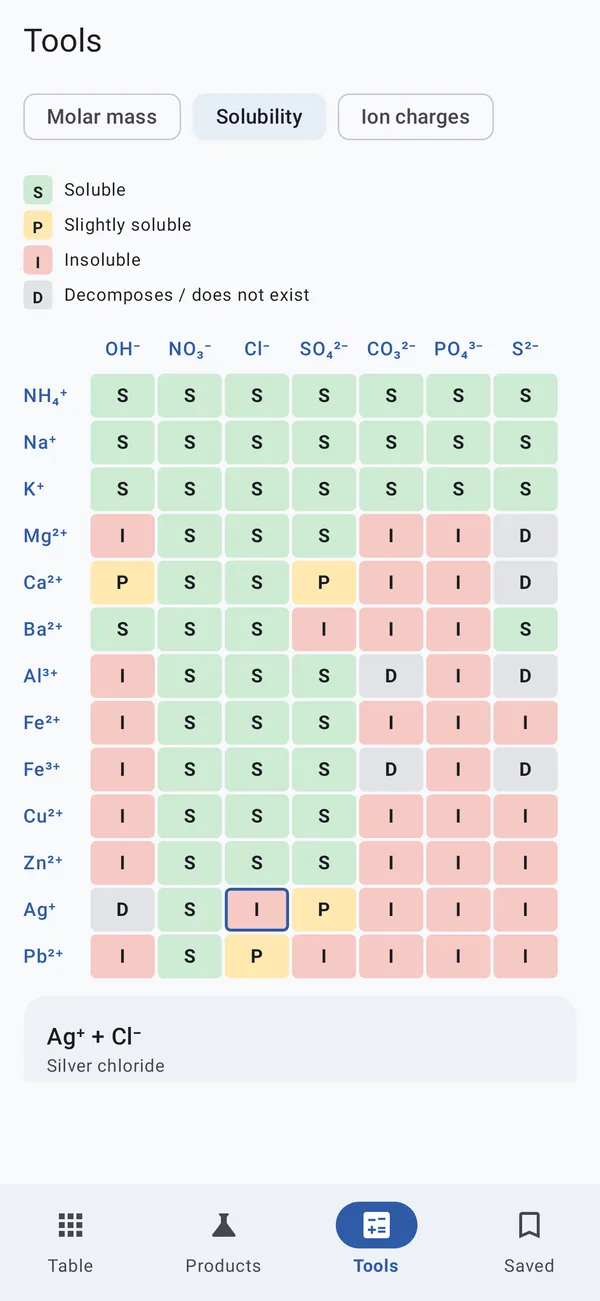
The ion charge table lists the charges you need to build formulas like the ones in this guide, so you can go from "barium and sulfate" to BaSO₄ before checking it in the solubility table.
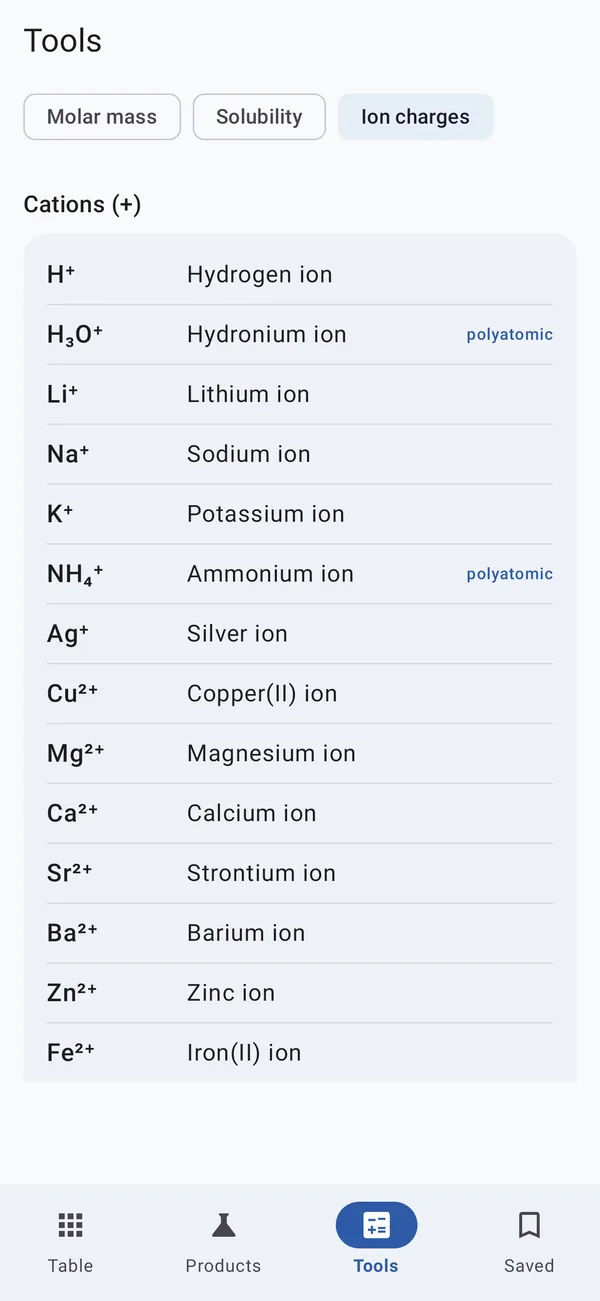
With a 24-hour pass, which you get by watching an optional ad, you can also mix two solutions in the solubility table. The data is built into the app, so it works offline, and each page lists its sources; if you spot a value that looks wrong, the "Found a mistake?" card lets you email us. If you go on to work with real salts in a lab, remember that several of the exceptions above are lead, silver, barium and mercury compounds, so check the safety data sheet before handling any chemical.

Common questions
Is AgCl soluble in water?
No. Silver chloride is one of the classic exceptions to the rule that chlorides are soluble. Its Ksp at 25 °C is 1.77 × 10⁻¹⁰, which works out to about 1.3 × 10⁻⁵ M, or roughly 2 mg per liter. That is far below Purdue's 0.001 M line for insoluble.
Are all nitrates soluble?
Yes, for the compounds a general chemistry course covers. Both OpenStax and Purdue list nitrates as soluble with no exceptions, and the same is true of acetates and of compounds of Group 1 cations and ammonium. That makes nitrate salts, such as silver nitrate, a common way to get a metal ion into solution.
What does insoluble mean in chemistry?
It means very little of the compound dissolves, not that none does. Purdue's guide calls a salt insoluble if less than 0.001 M dissolves at room temperature, slightly soluble between 0.001 M and 0.1 M, and soluble above that. Ksp values show how small the dissolved amount really is.
Is calcium carbonate soluble in water?
No. Carbonates are insoluble unless paired with a Group 1 cation or ammonium, and calcium is neither. CaCO₃ has a Ksp of 3.36 × 10⁻⁹ at 25 °C, which gives an estimated solubility of about 6 × 10⁻⁵ M.
Do the solubility rules work for every compound?
No. They are guidelines for common ions in water at room temperature, and the words "usually" and "generally" matter. Borderline salts like calcium sulfate are classed differently in different tables, so follow the table your course uses, and look up a Ksp value when you need a real number.