In the UK, best before is about quality and use by is about safety. Food past its best before date is usually still fine, though it may have lost some flavor or texture. Food past its use-by date should not be eaten, the Food Standards Agency says. In the US the same words mean something else: federal rules require a date only on infant formula, and USDA calls “Best if Used By”, “Sell-By” and “Use-By” on other foods quality dates, not safety deadlines.
So the answer depends on where the food was labeled. This guide covers what each common label means, how the rules differ in the US, the UK and Canada, what official guidance says to do when a date is close or has passed, and a simple way to keep track of the dates in your kitchen. It reports what food agencies say. It can't tell you whether a particular food is safe.
What the US date labels mean
In the US, nearly every date on food is the maker's estimate of quality, not a safety cutoff. The USDA Food Safety and Inspection Service (FSIS) says it plainly: except for infant formula, federal regulations don't require product dating. Manufacturers decide whether to add a date and what words to use.
FSIS defines the phrases you will see:
- Best if Used By or Best if Used Before. When the product will taste best or be at its best quality. It is not a deadline for the store and not a safety date.
- Sell-By. Tells the store how long to display the product, for inventory management.
- Use-By. The last date recommended for using the product while it is at peak quality.
- Freeze-By. When to freeze the product to keep its peak quality.
FSIS adds that if the date passes while the food is stored at home, the product should still be safe and wholesome if handled properly, until signs of spoilage appear. Spoiled food develops an off odor, flavor or texture from naturally occurring spoilage bacteria.
The one exception is infant formula. Federal regulations require a Use-By date on its label. The FDA explains that this is the date up to which the manufacturer guarantees the formula's nutrient content and quality, and FSIS says not to use formula after it.
Why are there so many phrases? In December 2024 the FDA and USDA asked the public for input on date labeling. Their announcement says three things. Both agencies recommend that companies voluntarily use “Best if Used By” for quality dates. Current rules don't stop companies from using other phrases, such as “Sell By” or “Use By”, if they are truthful and not misleading. And confusion over date labels is estimated to cause about 20% of food waste in the home. Separately, FSIS estimates that 30 percent of the food supply is lost or wasted at the retail and consumer levels.
How the UK uses use-by and best before
In the UK the two dates have fixed and different jobs: use-by is about safety and best before is about quality. Food Standards Agency (FSA) guidance on GOV.UK says use-by dates tell you when the food is no longer safe, and eating food after its use-by date could make you ill.
There is one way past a use-by date. You can eat food after it if the food was cooked or frozen on or before the use-by date. The guidance says to:
- cool cooked food, keep it in the fridge and eat it within 48 hours, or freeze it;
- keep your freezer at -18°C, follow the label's freezing and defrosting instructions, and mark what the food is and when you froze it;
- use defrosted food within 24 hours.
Best before works differently. After that date, the FSA says, food is usually fine but may not be of the same quality, and you can use sight, taste or smell to decide whether to eat it. You might smell dairy to see if it has soured, taste crisps to see if they are stale or look for mould on bread. Food Standards Scotland draws a clear line: smell and looks are fine for judging best-before foods, but food should not be eaten past its use-by date even if it looks and smells fine.
Both dates hold only if you store the food as the label says. If the pack tells you to refrigerate it after opening, the guidance says to keep it at 5°C or below. Eggs often surprise people. Food Standards Scotland notes that they carry a best before date no more than 28 days after laying, and that they can be eaten a day or two after that date if cooked thoroughly.
Canada: best before, packaged on and expiration dates
Canada uses best before for quality and keeps a separate, stricter expiration date for a short list of special foods. Health Canada says a best before date must appear on prepackaged foods that will keep fresh for 90 days or less. Foods expected to keep longer don't need one.
Three points from Health Canada are worth knowing:
- A best before date applies to unopened products only. Once a pack is opened, its shelf life may change.
- Food can still be sold and eaten after its best before date, but the date does not guarantee that the product is safe.
- When the year is shown, it comes first, then the month, then the day.
Food packaged in the store may show the date it was packaged, along with best before information and storage instructions. Only prepackaged fresh yeast may say “use by” instead of best before.
The expiration date is the strict one. It must appear on infant formulas, meal replacements, nutritional supplements, formulated liquid diets and foods for very low-energy diets. Health Canada says to discard these foods once the date has passed.
The labels side by side
The same words carry different weight in different countries, so it helps to see them together.
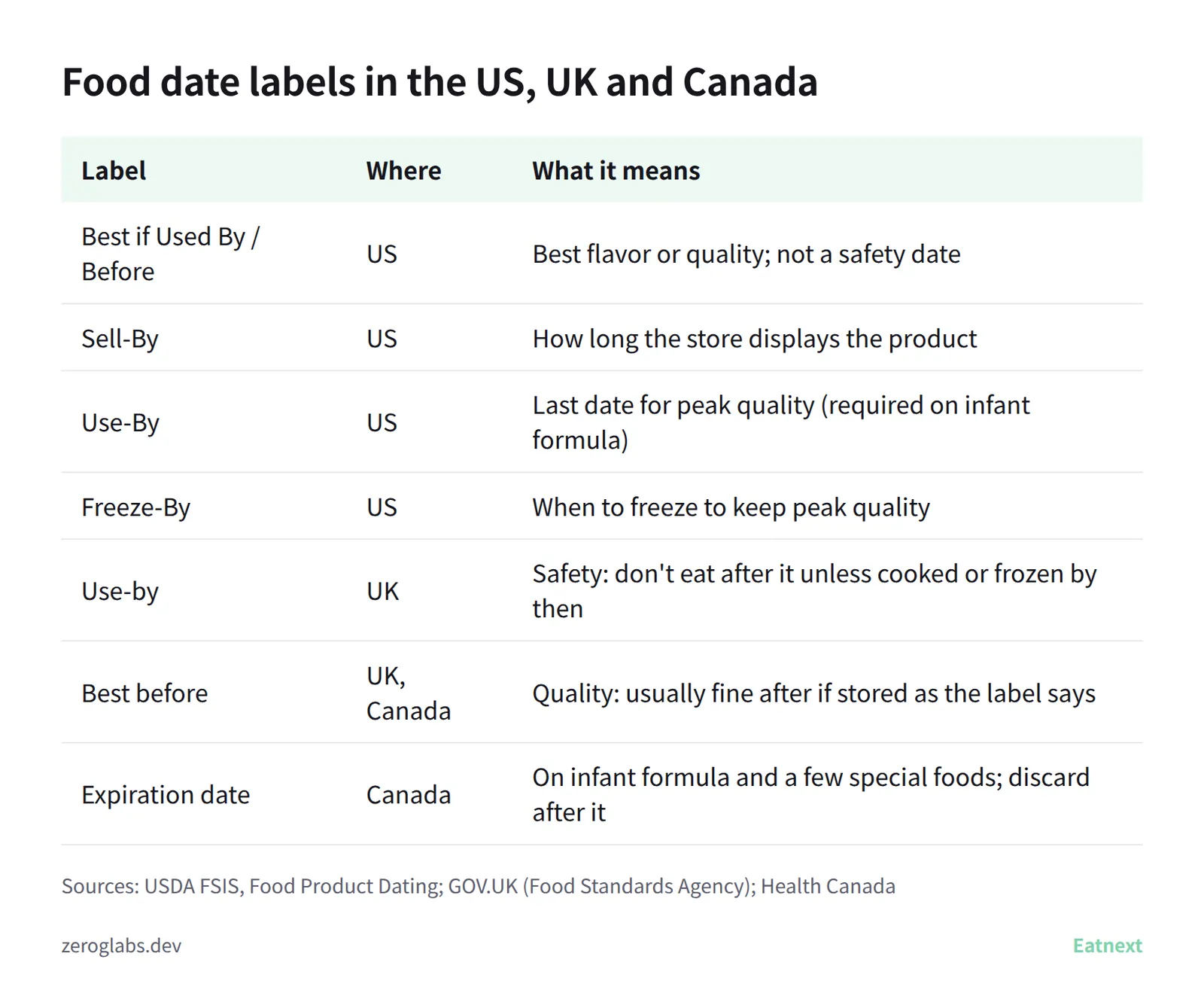
Two patterns stand out. A use-by date is a safety line in the UK but a quality suggestion in the US. And in all three countries, infant formula carries a firm date that the rules require.
What to do when a date is close or has passed
First work out which kind of date it is, then follow the guidance for that kind. The routine below is based on what the agencies above say.
- Read the exact words and check which country's rules apply. A UK use-by date, a Canadian expiration date or a date on infant formula is one to follow. A best before date, a sell-by date or a US best if used by date is about quality.
- Check the storage instructions. All three agencies assume the food was stored properly. Food kept warmer than the label says can spoil before its date.
- Note when you opened it. Health Canada says best before dates apply only to unopened packs, and many labels give a separate “once opened” time.
- Freeze in time. UK guidance lets you freeze food up to its use-by date, and US Freeze-By dates exist for the same reason.
- For quality dates, check the food. FSIS lists an off odor, flavor or texture as signs of spoilage. In the UK, smell is a check only for best-before foods, never for use-by foods.
When you are unsure, go by the label and your national food agency, not a rule of thumb.
Keeping track of whichever date is printed
Most of this routine only works if you notice which packs are near their date before they get forgotten at the back of the fridge. A paper list, a whiteboard or a phone note all work. Our guide on how to keep track of food expiration dates compares these methods.
Eatnext, the food expiry app we make for Android, is another way. You scan a product's barcode and Eatnext fills in its name from Open Food Facts, a free, open food database. How many products it knows varies a lot by country. A barcode never contains the expiry date, so the date comes from the pack. Point the camera at it, and Eatnext shows you what it read before anything is saved, so you can correct it.
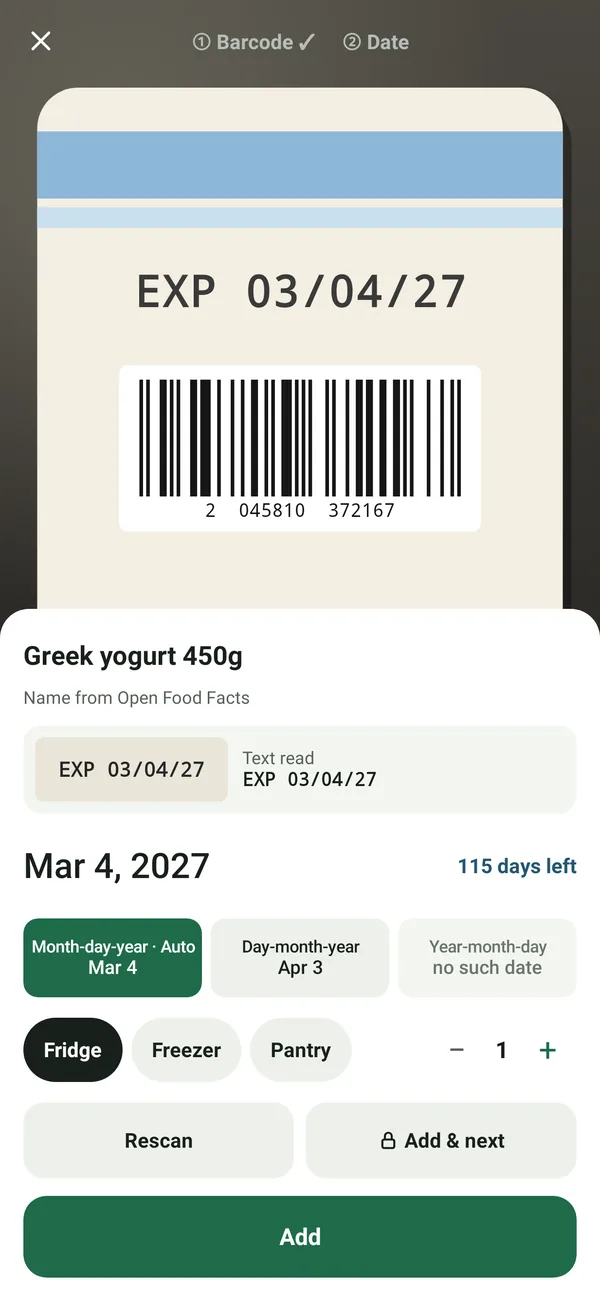
Some dates can be read two ways, such as 03/04. You pick the order once and Eatnext remembers it for that product, which helps with imported food or Canada's year-first dates. For food with no date to scan, pick +3 days, +1 week or +1 month, choose a day on a calendar, or type the date in. Eatnext doesn't know whether a date is a best before or a use-by date, so it's worth writing “use-by” in the item's note. Search finds items by their notes too.
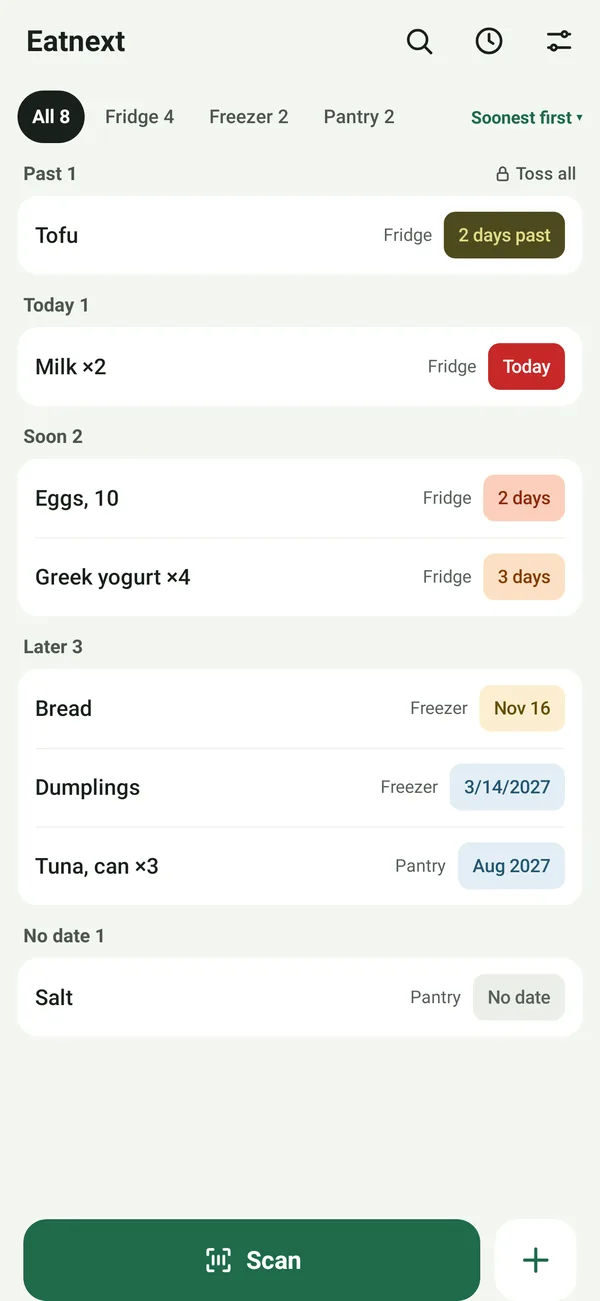
The list puts what expires first at the top, grouped into past, today, soon and later, with tabs for the fridge, freezer and pantry. You get at most one reminder a day, at the time you choose: a set number of days before the date, which you pick, and on the day itself. The free list holds up to 50 items, the camera reads dates 5 times a day, and typing a date is always free.
Eatnext only remembers the printed date and counts the days left or passed. It does not judge whether food is safe. Check the package and the food yourself, and follow the label and your food agency's guidance.

Common questions
Can you eat food after the best before date?
In the UK and Canada, official guidance says food is usually still fine after its best before date if it was stored as the label says, though its quality may drop. Health Canada adds that the date applies only to unopened packs and does not guarantee safety. In the US, FSIS says products should stay safe and wholesome past the date if handled properly, until signs of spoilage appear.
Is use by the same as an expiration date?
Not everywhere. In the UK, the use-by date is the safety date, and the FSA says not to eat food after it unless the food was cooked or frozen by then. In the US, FSIS defines Use-By as the last date for peak quality, except on infant formula. Canada has a separate expiration date for infant formula, meal replacements and a few other foods.
What does sell by mean?
In the US, FSIS says a Sell-By date tells the store how long to display the product, for inventory management. It is not a safety date, and you don't have to use the food by then. Once the food is home, follow the storage instructions on the pack.
Can you freeze food on its use-by date?
UK guidance says food frozen on or before its use-by date can be eaten later, and frozen food doesn't spoil because bacteria can't grow on it while it is frozen. Once you defrost it, use it within 24 hours. Follow the freezing and defrosting instructions on the label.
Why does infant formula have a required date?
Infant formula is the only food that US federal rules require to carry a date. The FDA says its Use By date is the date up to which the maker guarantees its nutrient content and quality, and FSIS says not to use formula after it. Canada also requires an expiration date on infant formulas.