Snoring is the sound of tissue in your airway vibrating while you keep breathing. Obstructive sleep apnea (OSA) is a breathing disorder in which the airway narrows or closes again and again during sleep, so your breathing stops and starts. Loud snoring is a common sign of sleep apnea, but not everyone who snores has it. What points to apnea is snoring broken by silent pauses, gasping or choking, and feeling sleepy during the day.
Only a sleep study can tell the two apart for certain. This guide covers the signs that separate them, how to score the STOP-Bang checklist that doctors use for screening and what the score really means, how sleep apnea is diagnosed, and how a recording of your nights can help at the appointment without being a diagnosis. It is general information, not medical advice.
What simple snoring is
Simple snoring is noise without blocked breathing. The NHS explains that snoring comes from your tongue, mouth, throat or the airways in your nose vibrating as you breathe. It lists being overweight, smoking, drinking a lot of alcohol and sleeping on your back as things that make snoring more likely.
On its own, this kind of snoring is mostly a problem for the people trying to sleep near you. The NHS self-help advice is practical: lose weight if you are overweight, sleep on your side, avoid smoking and drinking too much alcohol, and avoid sleeping pills, which can sometimes cause snoring. It suggests seeing a GP if those changes don't help or if snoring is seriously affecting your life or your partner's.
If you are not even sure you snore, start with our guide on how to tell if you snore.
What obstructive sleep apnea adds
Sleep apnea adds pauses in breathing, and those pauses are what make it a medical problem rather than a noise problem. MedlinePlus, from the US National Library of Medicine, describes the typical pattern: snoring that gets very loud, is interrupted by a long silent period while breathing stops, and ends with a loud snort and gasp. The pattern repeats through the night.
The US National Heart, Lung, and Blood Institute (NHLBI) lists these signs during sleep:
- breathing that starts and stops
- frequent loud snoring
- gasping for air
And these during the day or night that you may notice yourself: daytime sleepiness and tiredness, dry mouth, headaches, trouble sleeping, and waking up often to urinate. NHLBI notes that fatigue, headache and insomnia are more common in women, and loud snoring is more common in men. It also points out that you may not know about the night-time symptoms until someone tells you. MedlinePlus agrees that most people with OSA don't know it is happening and that a bed partner usually notices.
This matters because untreated OSA may lead to or worsen heart problems, including high blood pressure, irregular heartbeat, heart failure, heart attack and stroke, according to MedlinePlus, and daytime sleepiness raises the risk of falling asleep at the wheel. It is also very common. A 2019 analysis in The Lancet Respiratory Medicine estimated that 936 million adults aged 30 to 69 worldwide have mild to severe OSA, and 425 million have moderate to severe OSA.
Snoring vs sleep apnea side by side
The clearest dividing line is what happens between the snores and how you feel the next day. Steady snoring with normal days leans toward simple snoring. Snoring with pauses, gasps and constant tiredness leans toward apnea.
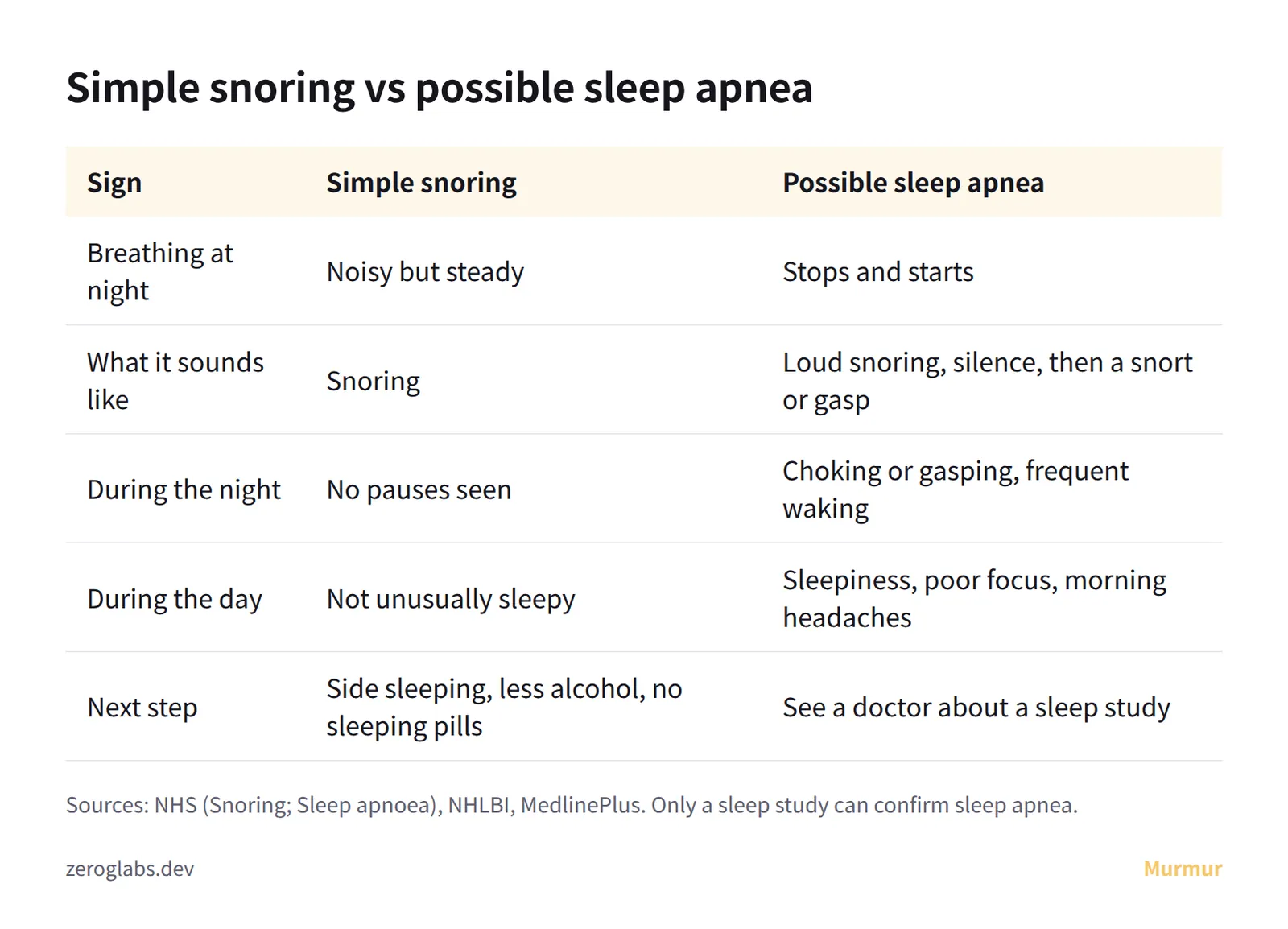
No single sign settles it, and the risk factors overlap. The NHS lists being overweight, a large neck, getting older, a family history, drinking alcohol, smoking, large tonsils or adenoids, sleeping on your back and COPD as linked to sleep apnea. Several of these also make plain snoring worse, which is one reason doctors use a structured checklist instead of a guess.
The STOP-Bang checklist
STOP-Bang is an eight-item yes or no checklist for the risk of obstructive sleep apnea. Each yes is worth one point, so the score runs from 0 to 8. The questions below follow the official STOP-Bang site.
| Letter | Ask yourself (yes = 1 point) |
|---|---|
| S, Snoring | Do you snore loudly, loud enough to be heard through a closed door, or does your partner elbow you for it? |
| T, Tired | Do you often feel tired, fatigued or sleepy during the day? |
| O, Observed | Has anyone seen you stop breathing, choke or gasp in your sleep? |
| P, Pressure | Do you have high blood pressure, or are you being treated for it? |
| B, BMI | Is your body mass index over 35 kg/m²? |
| A, Age | Are you older than 50? |
| N, Neck | Is your shirt collar 16 inches (40 cm) or larger, measured around the Adam's apple? |
| G, Gender | Are you male? |
The STOP-Bang site sorts the total like this for the general population:
- 0 to 2: low risk
- 3 to 4: intermediate risk
- 5 to 8: high risk. A score also counts as high if you answer yes to at least 2 of the four STOP questions and are male, have a BMI over 35, or have a neck size of 16 inches (40 cm) or more.
A worked example: a 55-year-old man who snores loudly already scores 3 (S, A and G), which is intermediate. If his partner has also seen him stop breathing, he has 2 STOP answers plus male sex, and the site puts him at high risk.
What STOP-Bang can and can't tell you
STOP-Bang is good at catching people who may have sleep apnea and poor at proving that they do. A study of 219 patients referred to a sleep lab found that a score of 3 or more picked up 93.2% of those who turned out to have moderate to severe OSA. But its specificity was only 40.5%, which means most people who did not have moderate to severe OSA also scored 3 or more. The authors concluded that the checklist had limited use in that setting.
In plain terms: a high score is a good reason to see a doctor, but it is not a diagnosis, and a low score does not cancel out clear symptoms such as witnessed pauses. The American Academy of Sleep Medicine (AASM) guideline says plainly that questionnaires and prediction tools should not be used to diagnose OSA in adults without a sleep test.
The checklist is meant for people with symptoms. The US Preventive Services Task Force concluded in 2022 that there is not enough evidence to weigh the benefits and harms of screening adults who have no signs or symptoms of OSA. If you do have symptoms, the advice from NHLBI is simple: talk to your healthcare provider about them.
How sleep apnea is diagnosed
Sleep apnea is diagnosed with a sleep study, either at home or in a sleep lab. The NHS describes the usual route: your GP refers you to a sleep clinic, and you wear devices overnight that check things like your breathing and heartbeat, usually at home and sometimes in the clinic.
The main result is the apnea-hypopnea index (AHI), the number of times per hour your breathing stops (apnea) or becomes too shallow (hypopnea). The NHS gives these bands:
- 5 to 14: mild
- 15 to 30: moderate
- over 30: severe
The AASM guideline recommends either a full sleep study in a lab or a home sleep apnea test on a suitable device for uncomplicated adults whose symptoms suggest moderate to severe OSA. If a single home test comes back negative, inconclusive or technically poor, it recommends a lab study rather than repeating the home test. People with significant heart or lung disease, neuromuscular weakness, a past stroke or long-term opioid use should have the lab study instead.
If sleep apnea is confirmed, the NHS lists lifestyle changes, a CPAP machine (a mask that gently pumps air to keep the airway open), a mouth guard-like device that holds the jaw forward, and in some cases surgery. Safety comes first in the meantime: if you are very sleepy during the day, don't drive while drowsy. In the UK, the NHS says you may need to tell the DVLA, and that once sleep apnea with excessive sleepiness is confirmed you must not drive until the symptoms are under control.
Recording your nights before the appointment
A recording helps you describe your nights to a doctor; it cannot replace the sleep study. The AASM position on consumer sleep technology says these apps and devices cannot be used to diagnose or treat sleep disorders, but they may help the conversation between patient and clinician as part of a proper evaluation. The NHS suggests bringing someone who has seen your symptoms to the appointment. If you sleep alone, or your partner sleeps through it, a recording is the next best thing.
A simple routine for the week before your visit:
- Record two or three ordinary nights. Keep your usual bedtime and habits so the recording reflects a normal night.
- Write a line each morning. Note your bedtime, any alcohol or sleeping pills, which way you slept if you know, and how rested you felt.
- Pick a few clips. One of steady snoring, and any where the snoring stops and then comes back with a snort or a gasp.
- Fill in STOP-Bang. Bring the score and the morning notes along with the clips.
Murmur, the sleep talk and snoring recorder we make for Android, is built for this kind of night. Tap Start sleep before bed and it listens with the screen off, saving a clip only when it hears a sound, including the 3 seconds just before the sound started. In the morning, each night has its own timeline with a sound graph, where you can play clips and mark favorites. The free plan keeps your 3 most recent nights and 3 favorites, so mark the clips you want to play at the appointment.
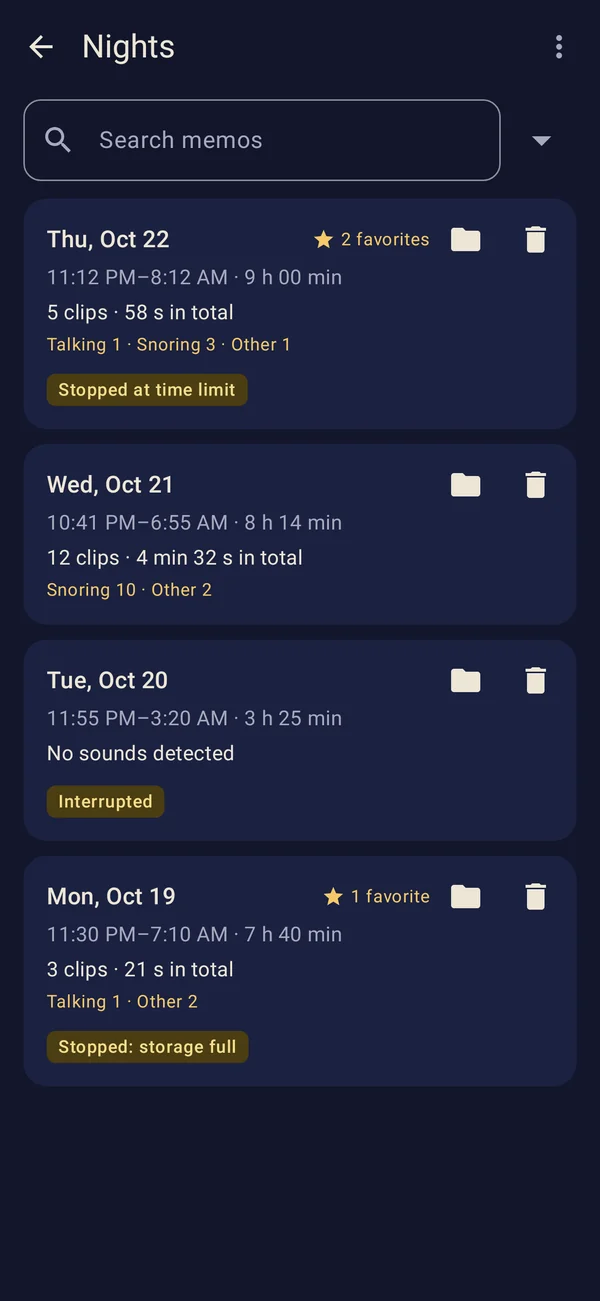
After the night ends, Murmur sorts each clip into talking, snoring or other sounds on your phone. With a pass, which you get by watching one optional ad and which opens every feature for 24 hours, you can pick snoring on the timeline and play those clips in a row, and share or export clips if your doctor wants them. The sorting is automatic and some clips may land in the wrong group, so every clip also stays under All. Recordings stay on your phone unless you share them yourself.
Be clear about the limits. Murmur records sound; it does not measure your breathing, oxygen level or sleep stages, and it cannot tell you whether you have sleep apnea. A pause in breathing is silent, so it is not saved as a clip on its own; what you may hear is snoring that stops and a snort or gasp when it starts again. A quiet recording does not rule apnea out. For phone placement and settings, see how to record yourself sleeping.

Common questions
Can you have sleep apnea without snoring?
Loud snoring is one of the most common signs, but it is not the only one. NHLBI also lists daytime sleepiness, morning headaches, dry mouth, insomnia and waking at night to urinate, and notes that fatigue, headache and insomnia are more common in women. If you have those symptoms, mention them to a doctor even if no one has heard you snore.
What STOP-Bang score means I should see a doctor?
The STOP-Bang site rates 3 to 4 as intermediate risk and 5 to 8 as high risk. Either is a reasonable prompt to book an appointment, especially with witnessed pauses or daytime sleepiness. A low score does not rule out sleep apnea if you have clear symptoms, because the checklist is a screen, not a test.
Can a phone app or recording diagnose sleep apnea?
No. The AASM says consumer sleep apps and devices cannot be used to diagnose sleep disorders, and diagnosis needs a sleep study at home or in a lab. A recording can still help your doctor hear what your partner would describe, such as snoring that stops and then ends in a gasp.
Is snoring every night a sign of sleep apnea?
Not by itself. MedlinePlus notes that not everyone who snores has OSA. Nightly snoring is worth checking when it comes with pauses in breathing, choking or gasping, or feeling sleepy during the day, which is when the NHS advises seeing a GP.
Should I get tested if I have no symptoms?
The US Preventive Services Task Force found in 2022 that the evidence is not enough to recommend for or against screening adults without signs or symptoms. Testing is aimed at people with symptoms. If you are unsure whether what you have counts, your doctor can help you decide.