Yes, sleep talking is normal for most people, and on its own it is usually harmless. It is very common in young children. In a survey of 1,000 Norwegian adults, two in three said they had talked in their sleep at some point, and about one in six had done it in the past three months. It is worth raising with a doctor when it starts suddenly in adulthood, comes with shouting, kicking or acting out dreams, or keeps your bed partner awake.
Doctors call sleep talking somniloquy. They group it with parasomnias: unusual things people do or experience while asleep, such as sleepwalking, night terrors and nightmares. This guide covers how common sleep talking is at each age, what a normal episode looks like, how it connects with other parasomnias, habits that may make it less frequent, and the signs that deserve a medical opinion. For the causes in more depth, see our article on why people talk in their sleep.
How common sleep talking is at each age
Sleep talking is most common in early childhood, and it stays common in adults. The larger population studies agree on that, even though their numbers differ because they asked different questions.
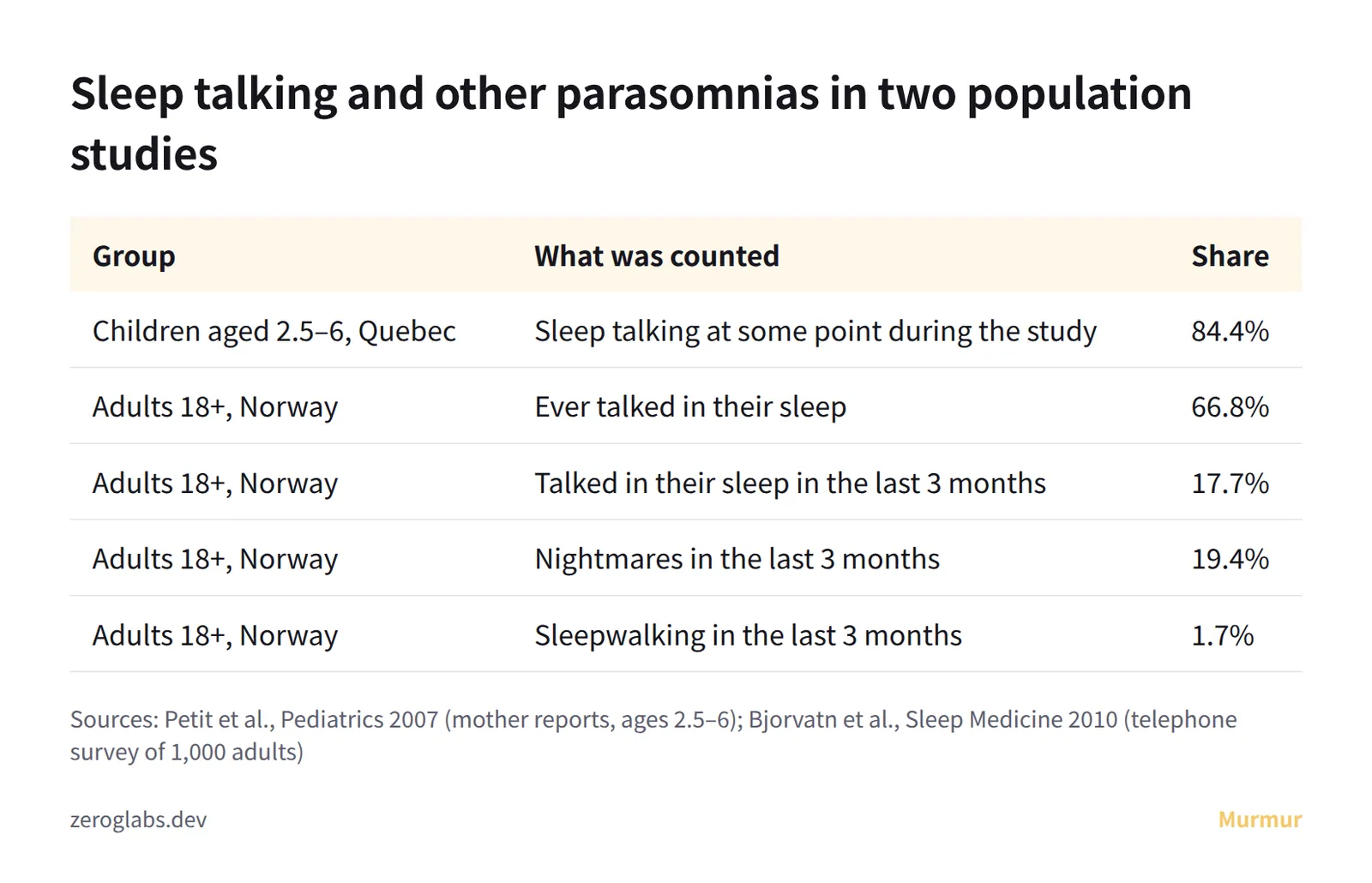
- Young children. A Quebec study followed a representative group of children born in 1997–1998, starting with 1,997 families interviewed when the children were 2.5 years old. Across the study, which ran to age 6, mothers reported sleep talking in 84.4% of the children. That was the highest figure of any parasomnia in the study.
- Older children. An earlier Quebec study of 1,353 children (Laberge 2000) found that sleepwalking, night terrors and bedwetting fell sharply during childhood. Sleep talking did not: it was still among the most common parasomnias at age 13, much as in adults.
- Adults. In the Norwegian telephone survey (Bjorvatn 2010), 66.8% of adults said they had ever talked in their sleep, and 17.7% had done so at least once in the last three months. The UK's Sleep Charity puts the share of adults who talk in their sleep at around 5%, which shows how much the figure depends on how often someone has to do it to count.
These numbers come from people reporting on themselves or their children, so they have limits. Sleep talkers rarely hear themselves, and the Norwegian survey had a response rate of about 25%, which its authors flag as a weakness. Still, every study points the same way: talking in your sleep now and then is something most people do.
Genes play a part too. In a Finnish study of more than 3,700 adult twin pairs (Hublin 1998), about half of the variation in childhood sleep talking was linked to genes (54% in men and 51% in women). Childhood and adult sleep talking were strongly linked, and adult sleep talking was more common in men.
What counts as normal sleep talking
Sleep talking is normal when it happens on its own, nobody gets hurt, and it doesn't keep you or your partner from sleeping. Whether it is a few words or a long speech matters less than those three things.
The Sleep Charity describes the usual range: a few random words, a jumbled sentence, or a longer one-sided speech. It notes that sleep talking can run in families, appears more often in men and in children, and that most children grow out of it.
Sleep talking also comes and goes. The Sleep Charity lists triggers such as lack of sleep, stress, anxiety, depression, alcohol, drugs and fever. A burst during an exam week or a cold is not the same as a new, lasting change, so look at the pattern over a few weeks rather than one loud night.
| Usually normal | Worth raising with a doctor |
|---|---|
| Mumbling, single words, short sentences or a one-sided speech | Shouting, kicking or thrashing during episodes |
| Has come and gone since childhood, or runs in the family | Starts suddenly in adulthood |
| More often when stressed, short on sleep or after alcohol | Acting out dreams, or someone gets hurt |
| Your partner can sleep through it | It regularly keeps you or your partner awake |
What a typical episode sounds like
Most sleep talk is not clear speech. In the largest study of recorded sleep talking (Arnulf 2017), French researchers analysed 883 speech episodes from 232 adults recorded overnight in a sleep lab. In 59% of the episodes there were no words at all, only mumbles, shouts, whispers or laughs.
When people did speak, the words followed normal grammar and even left room for turn-taking, like one side of a real conversation. The most frequent word was "no". Negations appeared in 21.4% of clauses, questions in 26% of episodes, and swear words in 9.7% of clauses, more often outside REM sleep (REM is the stage of sleep with rapid eye movements, when most vivid dreams happen). The authors described the speech as mostly a tense conversation with people who weren't there. Men talked more than women.
Keep the study's limits in mind: most of the people recorded had a parasomnia such as REM sleep behaviour disorder or sleepwalking, and only 15 were healthy volunteers. Still, it explains why hearing yourself argue or swear on a recording is common and not by itself a sign that something is wrong.
How sleep talking relates to other parasomnias
Sleep talking often travels with other parasomnias, especially sleepwalking, but having it doesn't mean you will develop anything else. In the Finnish twin data (Hublin 2001), childhood sleep talking was most closely linked with sleepwalking, then with nightmares and teeth grinding, and the same order held in adulthood. The link with sleepwalking was partly genetic: about half of the genetic effects were shared.
In the Quebec preschool study, children whose sleep talking persisted were also more likely to have persistent sleepwalking or sleep terrors at age 6, and sleep talking was associated with separation anxiety. Among the Norwegian adults, about 12% reported five or more parasomnias, and depressed mood was linked to several of them.
The link with mental health is weaker than people fear. The Finnish twin study found an association with serious psychiatric illness only for adult sleep talking, strongest when it began in adulthood (about 3.8 times the odds), and the authors concluded that most sleep talking is not linked to serious psychopathology.
Sleep talking can also be one part of a different condition, REM sleep behaviour disorder (RBD), in which people act out their dreams with talking, shouting, kicking or thrashing. RBD mostly affects older adults. In a study of 1,280 people with RBD and no other known cause, from 24 sleep centres (Postuma 2019), the average age was 66 and 82.5% were men. In that group, 6.3% a year went on to develop parkinsonism or dementia, reaching 73.5% after 12 years. This is about RBD diagnosed in sleep clinics, not ordinary sleep talking, but it is why new dream enactment in later life is worth a doctor's visit.
Habits that may make sleep talking less frequent
The habits below target known triggers and are the basics of good sleep. They are not a proven cure, but they are low-risk and easy to try for a couple of weeks.
- Get enough sleep on a regular schedule. Lack of sleep is a common trigger (Sleep Charity). The CDC recommends at least 7 hours a night for adults aged 18–60, and going to bed and getting up at the same times every day.
- Go easy on alcohol near bedtime. The Sleep Charity lists alcohol and drugs as triggers, and the CDC advises avoiding large meals and alcohol close to bedtime.
- Wind down before bed. The Sleep Charity suggests relaxation techniques to reduce stress, and the CDC suggests putting electronic devices away at least 30 minutes before bed.
- Cut caffeine later in the day. The CDC advises cutting it out in the afternoon and evening.
- Keep a sleep diary for two weeks. The Sleep Charity suggests noting sleep times, mood and caffeine to spot patterns. Add alcohol, stress and illness, and mark the nights someone heard you talk.
For children the same basics apply. The CDC recommends 9–12 hours for school-age children (6–12 years) and 10–13 hours, including naps, for ages 3–5. Since most children grow out of sleep talking, a calm, regular bedtime matters more than trying to stop it.
This article is general information, not medical advice. If you are worried about your own or your child's sleep, talk to a doctor.
Red flags worth bringing to a doctor
See a doctor, or ask about a sleep clinic, if sleep talking:
- starts suddenly in adulthood,
- comes with shouting, kicking or thrashing, which the Sleep Charity says can point to REM sleep behaviour disorder or night terrors,
- involves acting out dreams, or you or a partner get hurt,
- regularly disturbs your partner's sleep or your own,
- appears along with new low mood or anxiety.
Bring notes on when it started, how often it happens, what it sounds like, any movements, alcohol, medicines you take and whether relatives do the same. The doctor may suggest a sleep study (polysomnogram), an overnight recording of sleep in a clinic. If loud snoring is part of the picture, our guide on how to tell if you snore helps you describe it.
Recording a few nights before you decide
A few nights of recording tell you more than a guess. They show how often you talk, how long episodes last and whether there is shouting, which is what a doctor will ask about. Our guide on how to record yourself sleeping covers phone placement and setup.
Murmur, the sleep talk recorder we make for Android, is one way to do it. Tap Start sleep at bedtime, and it saves a clip only when it hears a sound, including the 3 seconds before the sound started so the first word isn't cut off. In the morning, each night has its own timeline with a sound graph, where you can play clips and mark favorites. The free version keeps your 3 most recent nights and records up to 9 hours a night, enough for a short check before and after a change such as skipping evening alcohol.
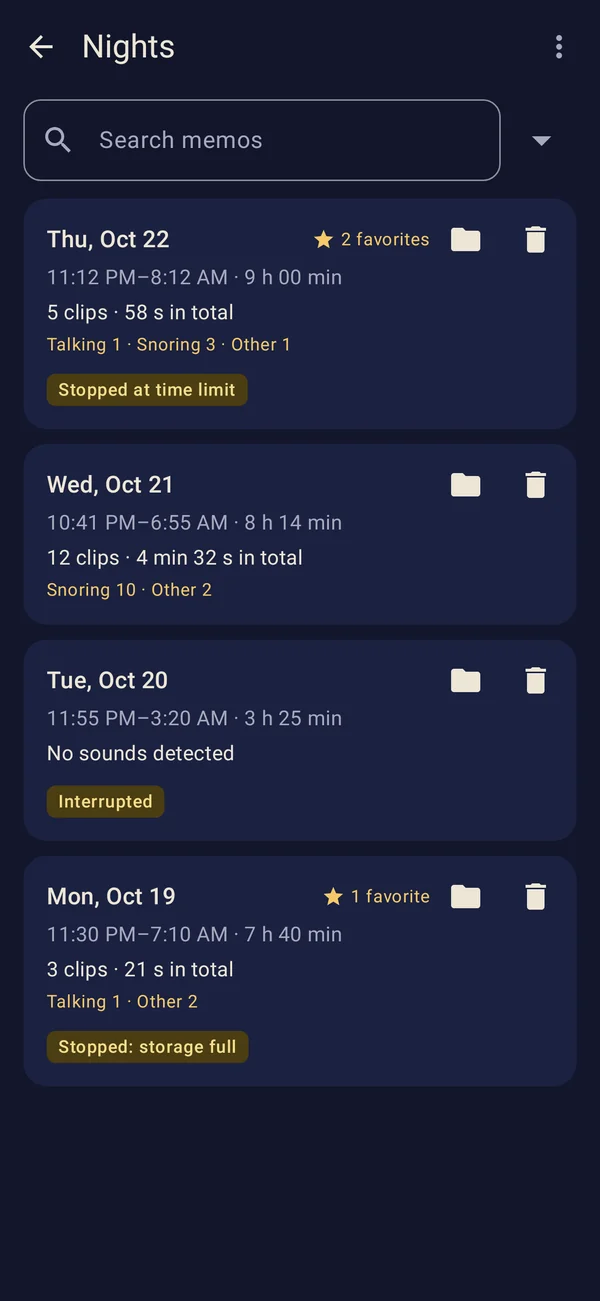
With a 24-hour pass, opened by watching an optional ad, Murmur also lets you listen to talking, snoring and other sounds separately and see how many of each a night has, and you can export a clip to bring to an appointment. The sorting runs on your phone and is automatic, so some clips may land in the wrong group, and every clip also stays under All. Recordings stay on your phone unless you share or export them. If you share a room, ask the other person before recording.

Common questions
Is it normal to talk in your sleep every night?
Frequent sleep talking, even on most nights, can still be harmless if it is calm and doesn't disturb anyone. It tends to rise with stress, short sleep and alcohol, so check those first. If nightly talking is new in adulthood, includes shouting or movement, or keeps someone awake, mention it to a doctor.
Is sleep talking a sign of mental illness?
Usually not. A Finnish twin study found a link with serious psychiatric illness only for adult sleep talking, strongest when it started in adulthood, and concluded that most sleep talking is not linked to serious psychopathology. Stress, anxiety and depression can make it more frequent, so it is worth noticing alongside your mood.
Do people tell the truth when they talk in their sleep?
There is no reason to treat sleep talk as a reliable statement. In recordings, most episodes were mumbles or other sounds, and the clear speech sounded like a tense conversation with people who weren't there, which reads more like part of a dream. Don't take a sleep-talk sentence as fact.
Will my child grow out of sleep talking?
Most children do, according to the Sleep Charity, although a Quebec study found sleep talking was still common at age 13. It is very common in preschoolers. Talk to your child's doctor if episodes include screaming, thrashing or injuries, or if you are worried.
Does sleep talking mean I'm sleeping badly?
Not necessarily, since most people talk in their sleep at some point. Lack of sleep is a known trigger, though, so a run of sleep talking can be a nudge to check whether you are getting the 7 or more hours the CDC recommends for adults.