To keep track of food expiration dates, pick one place where every date lives (the package itself, a whiteboard on the fridge, a spreadsheet or an app). Record the date as soon as food comes into your kitchen, and check that list once a week before you shop. Write your own date on anything that doesn't have one, such as leftovers and opened jars.
Most printed dates are about quality, not safety, so the point of tracking is to use food while it is at its best. Nobody wastes food on purpose. It happens because a tub of yogurt slides behind the milk, or because nobody remembers when the soup was made. This guide explains what the dates on packages mean and compares the four tracking methods people actually use at home. It ends with a short weekly routine that keeps whichever method you choose up to date.
What the dates on food packages mean
In the United States, most dates on food are quality dates set by the manufacturer, not safety deadlines. The U.S. Food and Drug Administration (FDA) says federal law and regulation don't require manufacturers to put quality-based date labels on packaged food, with one exception: infant formula. The FDA also estimates that confusion over date labels causes about 20 percent of consumer food waste.
Utah State University Extension, citing the FDA and USDA, describes the common wordings like this:
- Best if Used By: when the product will have its best flavor or quality. It is not a shopping deadline or a safety date, and it is the wording the FDA supports as the standard phrase.
- Sell-By: tells the store how long to display the product, for inventory. It is not a safety date.
- Use-By: the last date recommended for using the product at peak quality. It is not a safety date, except on infant formula.
- Freeze-By: when to freeze the product to keep its peak quality.
A date passing doesn't decide anything by itself. After the date, the FDA advises checking food for signs of spoilage and avoiding it if its color, consistency or texture has clearly changed. Iowa State University Extension makes the same point: before you decide what to do with a food, take a second look at both its quality and its safety.
Two kinds of food matter most for tracking, because neither has a printed date: leftovers and things you have opened. Iowa State University Extension notes that the USDA recommends eating refrigerated leftovers within 3 to 4 days. It also says it is always a good idea to date food you put in the fridge or freezer. A system that only copies the dates printed on packages misses exactly the food that spoils fastest.
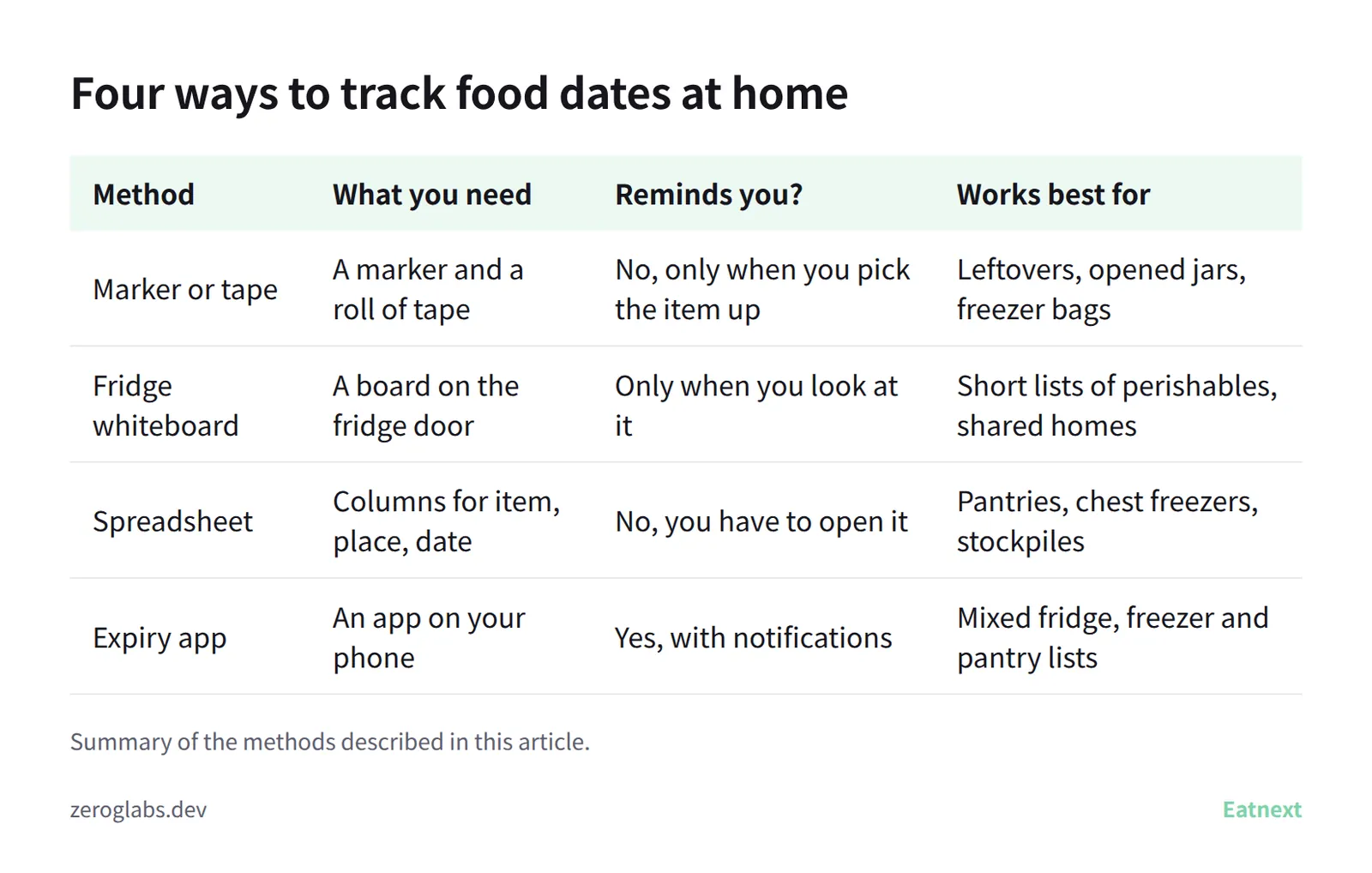
Four ways to track expiration dates at home
The best method is the one you will keep updating. For most households, that means writing dates on leftovers and keeping one list of everything that matters. Here is how the four common approaches compare.
Marker or tape on the package
Keep a permanent marker and a roll of masking or painter's tape near the fridge. Write the date on anything without a clear printed date: leftovers, opened jars, meat you split into portions to freeze, rice poured into a canister. Utah State University Extension recommends labeling leftovers and cooked food with the date and contents before they go into the fridge or freezer.
This costs almost nothing, and the date stays with the food. The weakness is that you only see the date when you pick the item up. A labeled container at the back of the fridge can still be forgotten.
A whiteboard on the fridge
A magnetic whiteboard on the fridge door is one of the most common tips in home cooking forums. People list what is ready to eat and its date, often only perishables and leftovers, and wipe items off when they are gone. Because the board hangs at eye level, everyone in the house sees it each time they open the door.
It works well for a short list, but only if it stays current. If one person forgets to wipe off finished food, the board stops matching the fridge and people stop trusting it. It also stays home when you go to the store.
A spreadsheet or shared note
A spreadsheet suits pantries, chest freezers and stockpiles, where you have many items with long dates. Use a few columns (item, place, date, quantity) and sort by date so the earliest is at the top. A column that counts the days left makes it easy to spot what is close.
The cost is effort. You have to type in every item, and the sheet only helps when you open it. Most people find it too slow for a fridge whose contents change every day.
An expiry app
An app keeps the list on your phone, sorts it by date and can remind you, so you don't have to remember to check. Adding items is the main hurdle, which is why scanning features matter. Know the limits before you start. A barcode identifies a product, not its date, so the date still has to come from the package or from you. And an app only remembers the date you give it. It can't see or smell the food.
A weekly routine that keeps the list honest
A method only works if the list matches what is actually in your kitchen. The easiest way to keep it that way is one check a week, just before you plan meals and shop.
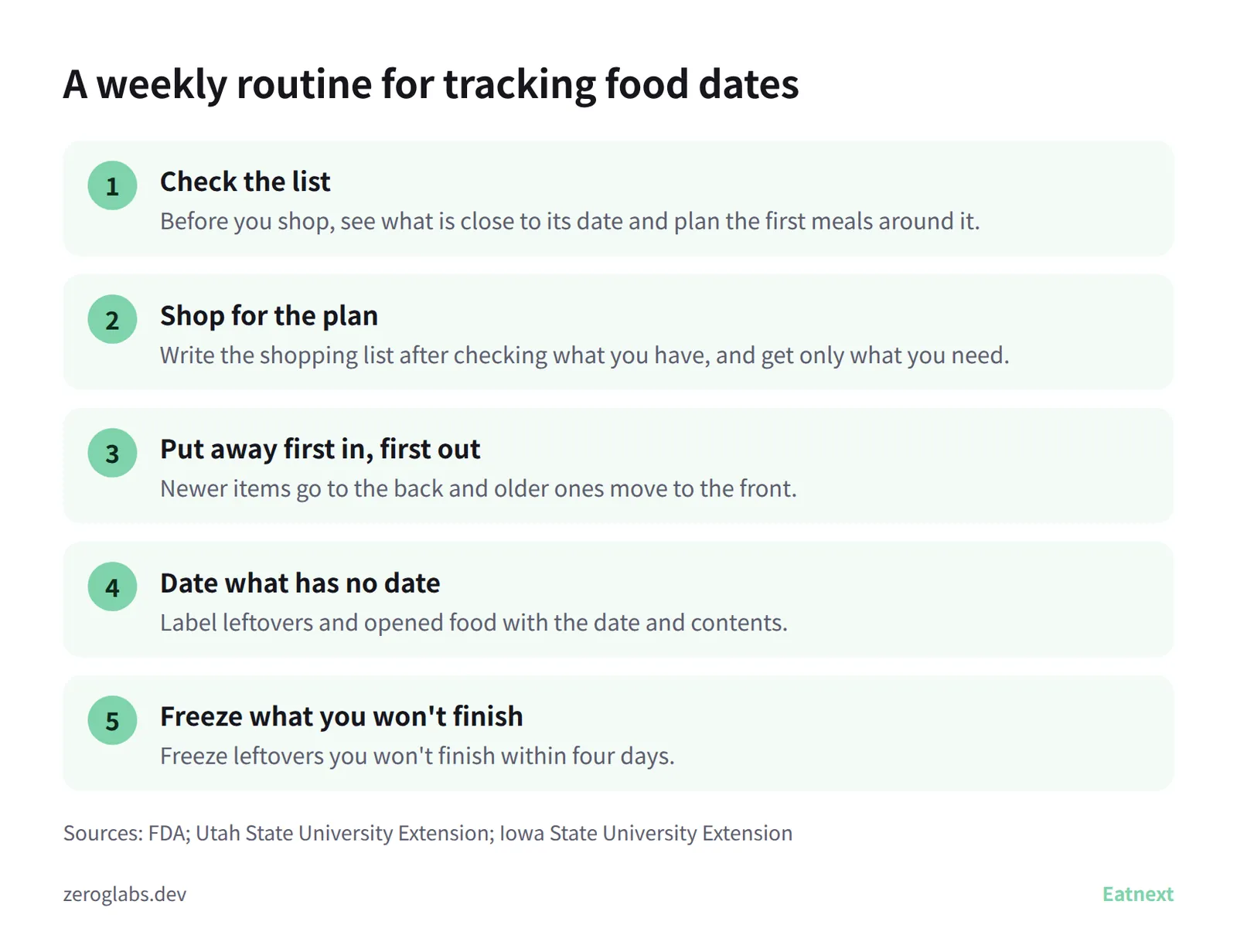
Start with your list, not the store. The FDA suggests checking what you already have before you write a shopping list, planning the coming week's meals and getting only what you need. Food that is close to its date goes into the first meals of the week.
When you put groceries away, use "first in, first out" (FIFO). Utah State University Extension describes it as putting the newest items at the back and moving the oldest to the front, so the earliest dates are the first ones you reach. Some households also keep an "eat first" bin on one fridge shelf for anything that should be used in the next few days.
Then date anything that has no date, and freeze what you won't get to. Iowa State University Extension suggests freezing leftovers right away if you won't finish them within four days. While you are at the fridge, check the temperature too. The FDA recommends keeping the fridge at 40°F (4°C) or below and the freezer at 0°F (−18°C).
Tracking food dates with Eatnext
If you'd rather let your phone do the remembering, Eatnext is the food expiry app we make for Android. It covers the fridge, freezer and pantry, and you don't need an account to use it.
Adding an item takes two steps. First, scan the barcode, and Eatnext fills in the product name from Open Food Facts, a free, open food database. How many products it knows varies a lot by country. If it doesn't find one, you type the name once and the app remembers it on your phone. Second, point the camera at the date on the package. Eatnext shows you the date it read before anything is saved, so you can correct it.
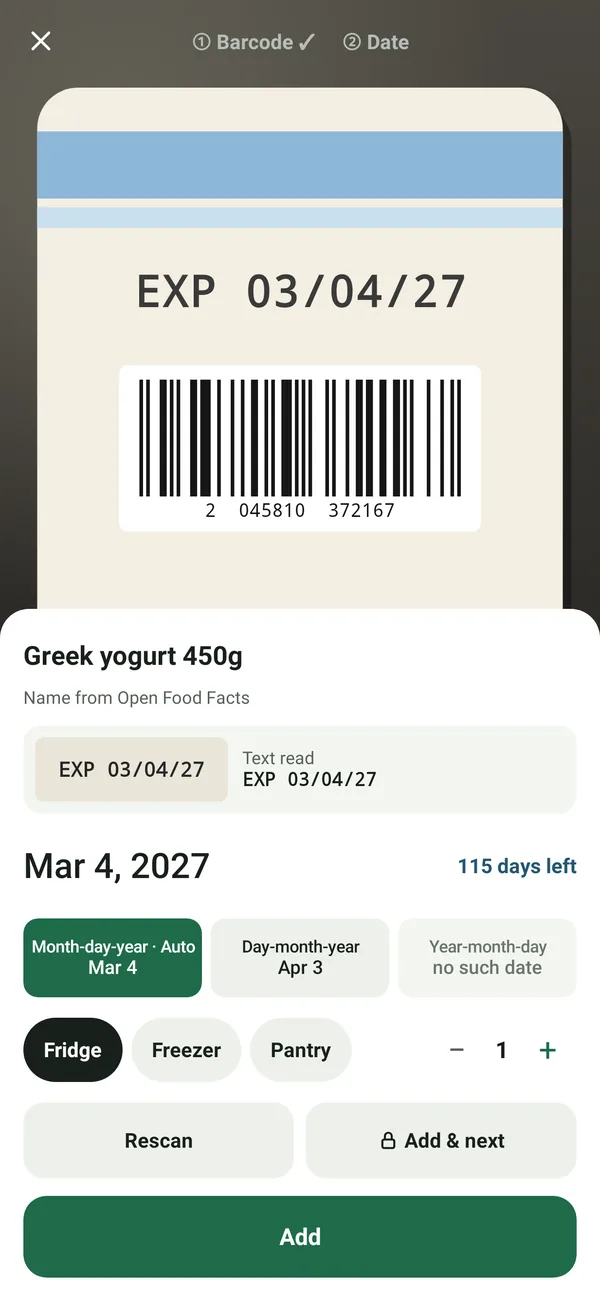
For leftovers and opened food without a printed date, pick a quick date such as +3 days, +1 week or +1 month, choose one on a calendar, or type it in. When a date can be read two ways, such as 03/04, you choose the order once and Eatnext remembers it for that product.
The list puts what expires first at the top, grouped into past, today, soon and later, with a tab for each place. You get at most one notification a day, at the time you choose, and only when something is due. It comes the number of days before the date that you pick, and on the day itself. When food is gone, mark it as eaten or tossed. If you tap the wrong one, you can undo it.
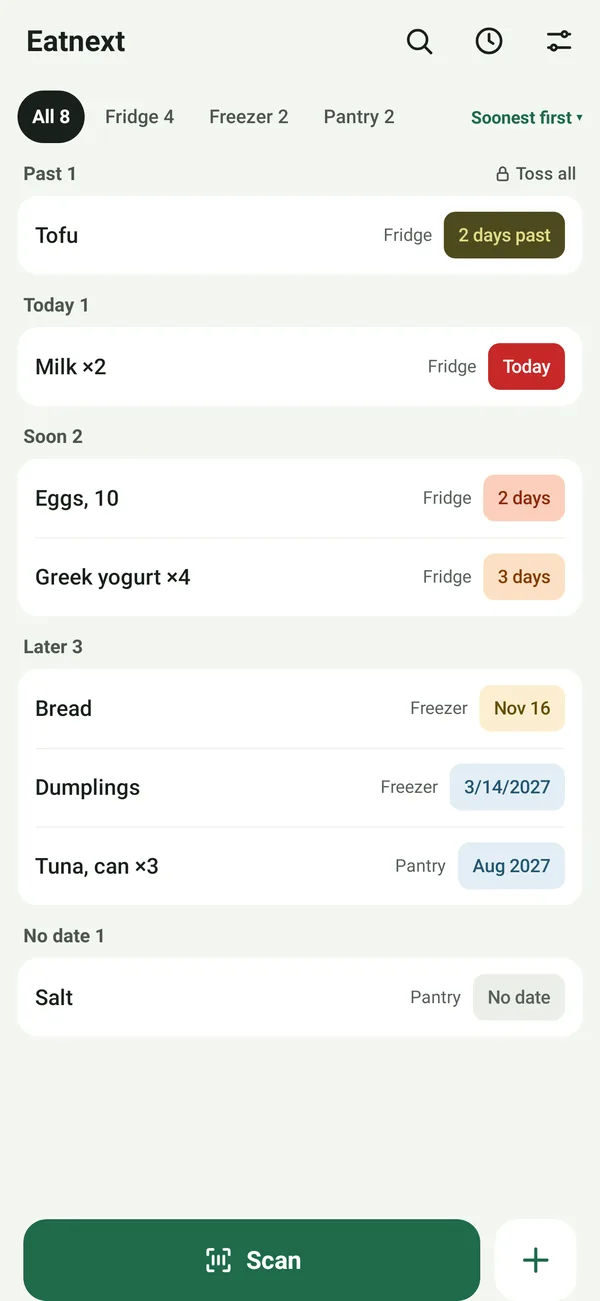
The free version holds 50 items and reads dates with the camera 5 times a day, and typing a date is always free. If you want more, you can watch an optional ad. Depending on the button, it adds date readings for the day, adds list spots for a few days, or opens extra features for 24 hours. Eatnext doesn't judge whether food is still good. It remembers the printed date, and you check the package and the food yourself.

Common questions
What happens to food after the best-by date?
The FDA says "Best if Used By" marks when a product has its best flavor and quality, not a safety cutoff. After the date, the FDA advises checking food for spoilage and avoiding it if its color, consistency or texture has clearly changed. Infant formula is the exception, because its date is a safety date.
What is the difference between best by, use by and sell by?
Sell-by is for the store's inventory. Utah State University Extension says best if used by and use-by both describe peak quality, and use-by is a safety date only on infant formula. The FDA notes that federal law doesn't require quality-based date labels on other foods.
How do I keep track of leftovers that have no date?
When leftovers go into the fridge, write the date and contents on the container with a marker or tape, as extension services recommend. Iowa State University Extension cites the USDA advice to eat refrigerated leftovers within 3 to 4 days, and to freeze them right away if you won't finish them in time.
Can a barcode tell me a product's expiration date?
No. A product barcode identifies the product, not its date, so scanning it can only help fill in the name. The date has to come from the package. You can read it yourself, or use a camera feature that shows you what it read so you can check it.
What is the FIFO method for food?
FIFO stands for "first in, first out." When you put new groceries away, place them behind the older ones so the earliest dates are always in front and get used first. It works with any tracking method and takes no extra time once it becomes a habit.