A GLP-1 injection log is a short record you fill in after every shot. It has five entries: the date and time, the medication by its ingredient name, the dose and unit exactly as prescribed, the injection site, and a one-line note. With those five entries you can see when your next shot is due and which site to use next, and your prescriber gets an accurate history at your next appointment. The log only records what your prescriber told you to do. It never decides a dose.
Weekly shots are easy to lose track of. A week is long enough to forget whether this week's shot happened on Sunday or Monday, or whether it happened at all. This guide covers the five entries, a paper template you can copy, how the log helps when you miss a shot or see your doctor, and how to keep the log private on your phone. This article is not medical advice. Follow your healthcare provider's instructions for your dose, your schedule and anything you are unsure about.
The five things to write down for every shot
Write the same five things every time, right after the shot and before you put your supplies away. If you log it later, you'll forget.
- Date and time. The date tells you when the next shot is due. The time shows whether your routine is slowly drifting. The NHS medicine pages advise injecting semaglutide and tirzepatide on the same day each week, and injecting liraglutide, which is a daily shot, at the same time each day.
- Medication, by ingredient name. Write the active ingredient printed on the label, such as semaglutide, tirzepatide, liraglutide or dulaglutide. That name is the same at every pharmacy and clinic. The FDA's advice on medication lists is to include each medicine's name and strength.
- Dose and unit, exactly as prescribed. Copy the number and the unit (mg, mL or units) from your prescription or pharmacy label, without converting it. When your prescriber changes the dose, the log shows the exact date the new dose started.
- Injection site. Write the area and the side, for example abdomen left, thigh right or upper arm left. The NHS advises changing the injection site each week: you can use the same area, but not the exact same spot. Our guide to GLP-1 injection site rotation covers this in detail.
- A short note. Write down anything you would want your prescriber to know: a shot taken a day late, a side effect such as nausea, or a dose change your prescriber made. One line is enough.
Some people also track their weight and other medicines. Keep those as separate lists or columns so the shot log stays quick to fill in.
A paper GLP-1 injection log template
A paper log works well if you fill in one row per shot and keep it next to your medication. Copy the table below into a notebook or onto a printed sheet.
At the top of the page, write down what you were prescribed: the ingredient name, the dose and unit, the schedule (for example, weekly on Sundays), the date this dose started, and your prescriber's or pharmacy's phone number. Start a new page each time the prescription changes, so you never mix two doses on one page.
| Date | Time | Medication | Dose and unit | Site | Note |
|---|---|---|---|---|---|
| Sun 2 Nov | 08:15 | semaglutide | copied from label | Abdomen, left | none |
| Mon 10 Nov | 19:40 | semaglutide | copied from label | Thigh, right | one day late, travelling |
Three habits make a paper log reliable:
- Fill in the row straight after the shot, never from memory a few days later.
- Copy the dose from the label every time. Don't copy it from the row above, because the row above may be from an old prescription.
- Leave a blank row if a week passes without a shot. A gap you can see is more useful than a gap you have to remember.
How a log helps when you forget a shot
Every missed-dose rule depends on knowing when your last shot actually happened, and your log tells you that. Without it, you are guessing.
The rules differ from one medicine to another. The NHS pages give these examples:
- Semaglutide (weekly): if it has been 5 days or less since the shot was due, inject it as soon as you remember. If it has been more than 5 days, skip it and go back to your usual day. If you miss more than one injection, contact your doctor.
- Tirzepatide (weekly): inject it if 4 days or less have passed since the shot was due. If more time has passed, skip it and go back to your usual day.
- Liraglutide (daily): inject it if 12 hours or less have passed since the shot was due. If more time has passed, skip it and take the next dose the next day.
For all three, the NHS says never to give two injections at once to make up for a missed one. Your own patient leaflet and your prescriber's instructions come first, because products and situations differ. If you can't find an entry and aren't sure whether you took the shot, don't guess. Ask your pharmacist or prescriber what to do.
The log also helps if you want to change your shot day. For semaglutide and tirzepatide, the NHS says you can change the day as long as at least 3 days have passed since your last injection. Your log shows the date of that last injection. Check any change with your prescriber.
How a log helps at appointments
A log turns "I think I've been regular" into dates your prescriber can actually use. The FDA advises bringing an up-to-date medication list to visits with doctors, labs and pharmacies. It also advises updating the list whenever something changes, such as a new prescription or a dose change, and notes that a photo on your phone counts as a copy.
A medication list says what you are supposed to take. An injection log shows what actually happened. Before an appointment, take two minutes to:
- count the shots since your last visit and note any weeks you missed,
- mark the dates any dose change started,
- read your notes for side effects that kept coming back, and
- write down the questions you want to ask.
Getting the dose and unit right
Copy the dose and unit exactly as your instructions give them, and never convert the dose yourself. In 2024, the FDA warned about overdoses caused by dosing errors with compounded injectable semaglutide. Most of the reports involved multiple-dose vials, where people draw up their own dose with a syringe. The errors came from confusing milligrams, milliliters and units. In one example from the alert, patients who were told to draw 5 units (0.05 mL) drew 50 units instead. In another, a patient recalculated their own dose in units and injected ten times the intended amount.
The FDA's advice to patients is to talk with their healthcare provider or compounder about how to measure and give the intended dose. For your log, that means:
- write the number and the unit exactly as they appear on your instructions,
- if the label and the instructions don't match, ask before you inject, and
- remember that a log can't tell you whether a dose is right. It only records what you did.
Keeping a GLP-1 injection log on your phone
A phone log works best if it is quick to fill in and keeps your records private. Notch, the GLP-1 shot log we make for Android, is built around the five entries above. It records the date and time, the medication, the dose in mg, mL or units, the injection site and a note.
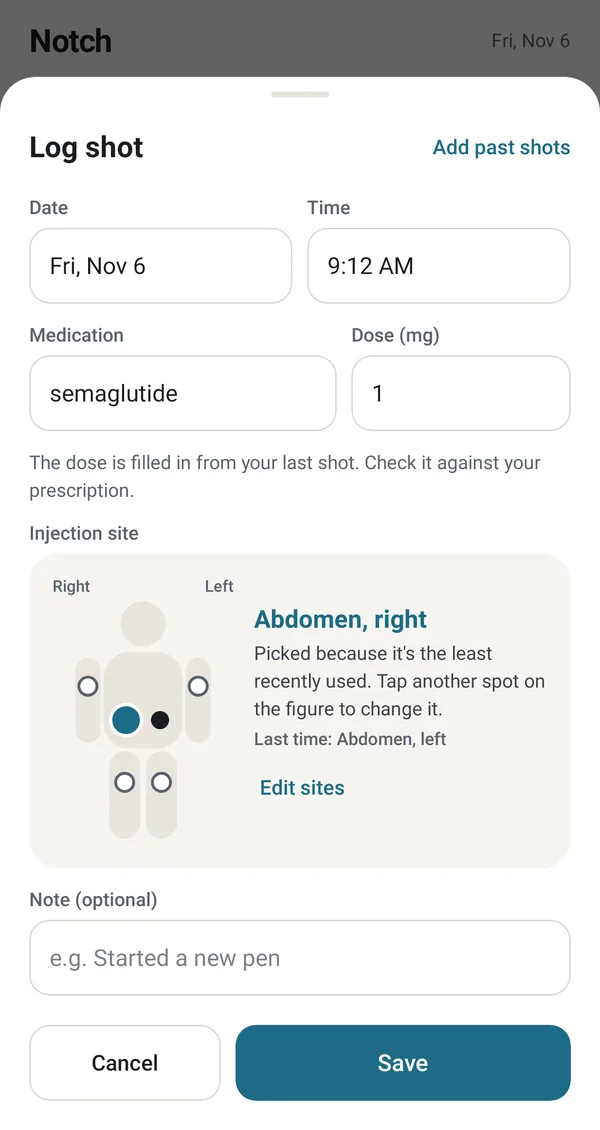
Notch fills in the dose from your last shot, so a routine shot takes a couple of taps. Check that dose against your prescription every time, especially after a change. If you are starting in the middle of treatment, you can add your past shots in one go. Enter your schedule as prescribed, either every few days or on chosen weekdays. Notch reminds you on shot day, and the day before if you like, and you can log the shot right from the notification. The notification never names your medication.
For injection sites, Notch shows a body map and selects the site you used least recently. Your whole history can be filtered by type, and any entry can be edited or undone. Before an appointment, the visit summary puts the last 4, 8 or 12 weeks of shots, doses, weight and side effects on one page. You can show it to your prescriber or share it as an image. The visit summary is open during the 7-day trial, and after that with the 24-hour unlock, which you get by watching one optional ad. Logging, reminders, site rotation and the full history stay free.
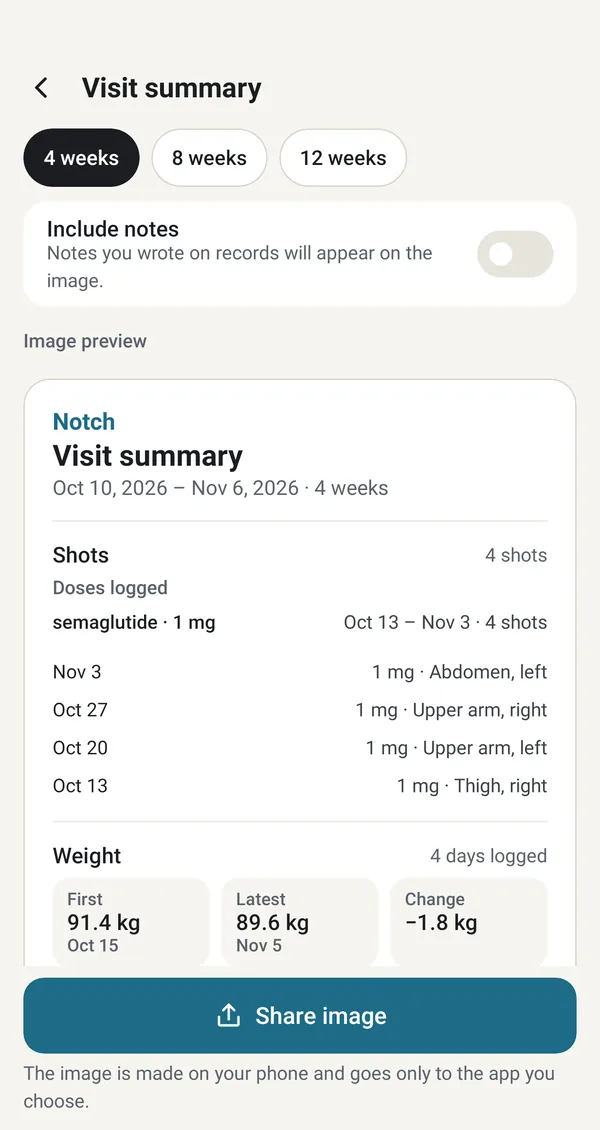
There is no account. Your records are stored encrypted on your phone and are not sent to us. The app shows ads, but your records are never given to the ad SDK. Android's own backup to your Google account can bring your records back on a new phone. Like a paper log, Notch is a personal record and not a medical device. It does not calculate, recommend or adjust doses.

Common questions
What should I write in a GLP-1 injection log?
For every shot, write the date and time, the medication by its ingredient name, the dose and unit exactly as prescribed, the injection site, and a short note. Those five entries are enough to know when the next shot is due, to rotate sites and to give your prescriber an accurate history.
Should I log the dose in mg, mL or units?
Log it in the same unit your prescription or pharmacy label uses, and copy the number exactly. Don't convert between units yourself. The FDA has reported overdoses caused by mix-ups between milligrams, milliliters and units. If you are unsure how to measure your dose, ask your prescriber or pharmacist.
What if I can't remember whether I took my shot this week?
Check your log first. If there is no entry and you really aren't sure, contact your pharmacist or prescriber rather than guessing. The NHS pages for semaglutide, tirzepatide and liraglutide all say never to give two injections at once to make up for a missed one.
Can I change the day I take my weekly shot?
For semaglutide and tirzepatide, the NHS says you can change the day as long as at least 3 days have passed since your last injection. Check the change with your prescriber, and use your log to confirm the date of your last shot.
Is a paper log or an app better?
Use the one you will actually fill in after every shot. Paper is simple and needs no phone. An app can remind you on shot day, suggest the next site and put your recent history on one page for appointments. Both only record what your prescriber told you to do.