When someone joins a trip late or leaves early, split the lodging by the nights each person stayed, and split meals, groceries and activities only among the people who took part. Costs that don't change with headcount, such as a non-refundable rental, follow whatever rule the group agreed before booking. If you agreed nothing, the fairest default is to charge each person for the nights they were actually there.
The hard part is not the math but the arguments. This guide gives you two ways to prorate a rental (prorating means splitting in proportion to use), a worked example with real numbers, a rule for non-refundable bookings, and the questions people most often ask when the group's dates don't line up.
The short rule: pay for what you were there for
The fairest split charges each person for the nights, meals and activities they were present for, and it is agreed before anyone books. NerdWallet's Sally French advises deciding before booking whether receipts will be pooled evenly or not, and, when one person gets less value from a shared cost, using your best judgment to compensate them.
In practice, sort every expense into one of three kinds:
- Per-night costs: the rental, hotel rooms, parking charged by the night. Split these by who slept there each night.
- Per-event costs: a restaurant meal, a boat tour, museum tickets, a taxi. Split these among the people who were there.
- Whole-trip costs: a deposit, a cleaning fee, a rental car the group needed anyway. Split these by the rule you agreed in advance, often evenly among everyone who signed up.
An even split of everything is still a valid choice. French notes it can make sense for groups that prefer to split things evenly. The point is to choose on purpose, not to discover the rule at the end of the trip.
Split lodging by nights stayed
Lodging is usually the biggest cost, and there are two fair ways to prorate it. Both give the late arrival and the early leaver less to pay than an even split; they differ in who carries a night when fewer people are there.
Take a worked example. Four friends rent a cabin for four nights at $300 a night, $1,200 in total. Ben and Cara stay all four nights. Alex arrives a day late and stays nights 2 to 4. Sam leaves after night 2.
Method 1, split each night among who was there. Night 1 has three people (Ben, Cara, Sam), so each pays $100. Night 2 has all four, so each pays $75. Nights 3 and 4 have three people again (Ben, Cara, Alex) at $100 each. The cabin costs the same whether three or four people sleep in it, so this method lets the people present carry each night.
Method 2, a flat price per person-night. Count every night each person slept: 4 + 4 + 3 + 2 = 13 person-nights. Divide $1,200 by 13 and each person-night costs about $92.31. Everyone pays the same rate for every night they slept there, no matter how full the cabin was.
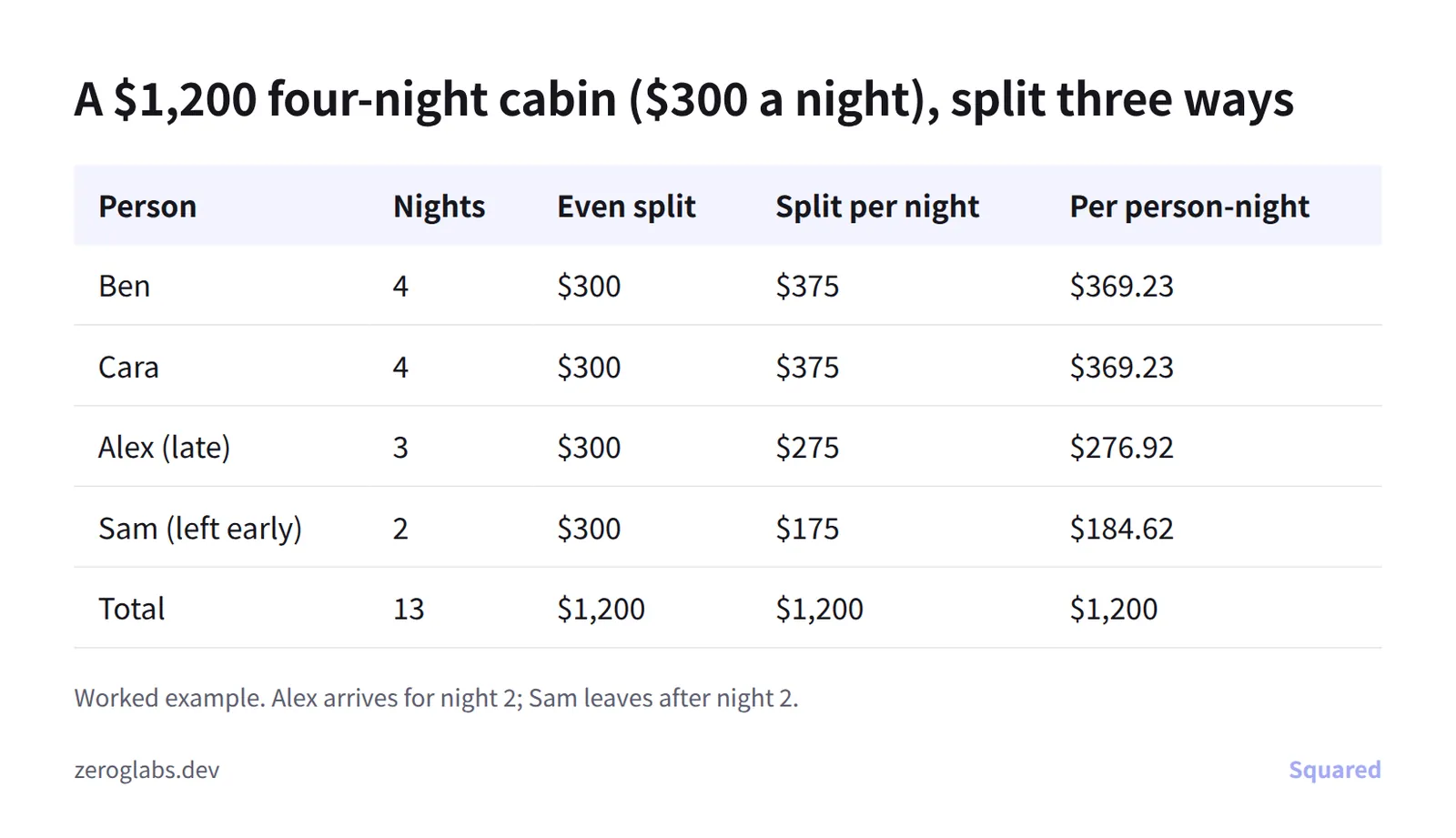
Method 1 is easier to do as you go, because each night is its own expense. Method 2 smooths things out when the group changes size a lot. Either is defensible; pick one before the trip. If people sleep in very different spaces, French's example of one person in the master suite while another gets the couch is a reminder that equal nights are not always equal value, and the group may want to adjust for that too.
Meals, groceries and activities: only the people who took part
Split each meal, ticket or ride only among the people who were there. Someone who arrived on day two doesn't pay for the first night's dinner, and someone who left early doesn't pay for the last day's boat trip.
Groceries are the grey area, because one shop often feeds the whole trip. French suggests that if someone arrived a couple of days after everyone else, you could split the cost of the home but leave them out of the grocery bill, since they likely ate less. A simple version: split each grocery run among the people who were staying when it was bought, and start a new run when someone arrives.
The same thinking covers people who skip part of an event. French asks whether a non-drinker should split bottle service just because they sat at the table, and suggests that if the non-drinker at dinner is also the designated driver, the group could cover their meal completely. Small gestures like that keep goodwill cheaper than any calculation.
Non-refundable bookings: agree before anyone pays
When plans change after booking, the rule you agreed in advance decides who pays, because the place often won't refund the nights. Agree on it while everyone still has the same dates.
Check the listing's cancellation policy first. Airbnb's help center says that under its Limited, Firm and Strict policies, a guest who cancels after check-in gets no refund, and the host is paid for all nights. So if Sam booked four nights and then leaves after two, the group's bill doesn't shrink at all.
Three rules groups commonly use, written so you can paste one into the group chat before booking:
- Dates known at booking: if someone said from the start that they would arrive late or leave early, prorate by nights stayed.
- Plans change after booking: the person who changed plans covers the share they signed up for, unless the booking is refunded or someone takes their place.
- Emergencies: for illness or a family emergency, the group decides together, and anything the booking or insurance refunds goes back to that person first.
None of these is the only fair answer. What makes a rule fair is that everyone agreed to it before money was spent. French's advice is the same: communicate budget preferences before you commit, and have a plan for when you disagree.
Handling late arrivals and early exits in Squared
If you track the trip in an app, the per-night method is easiest: enter the lodging as one expense per night on its date, then mark who was there. Squared, the bill-splitting app we make for Android, keeps a trip on a calendar, day by day, so each night and each meal sits on its own date.
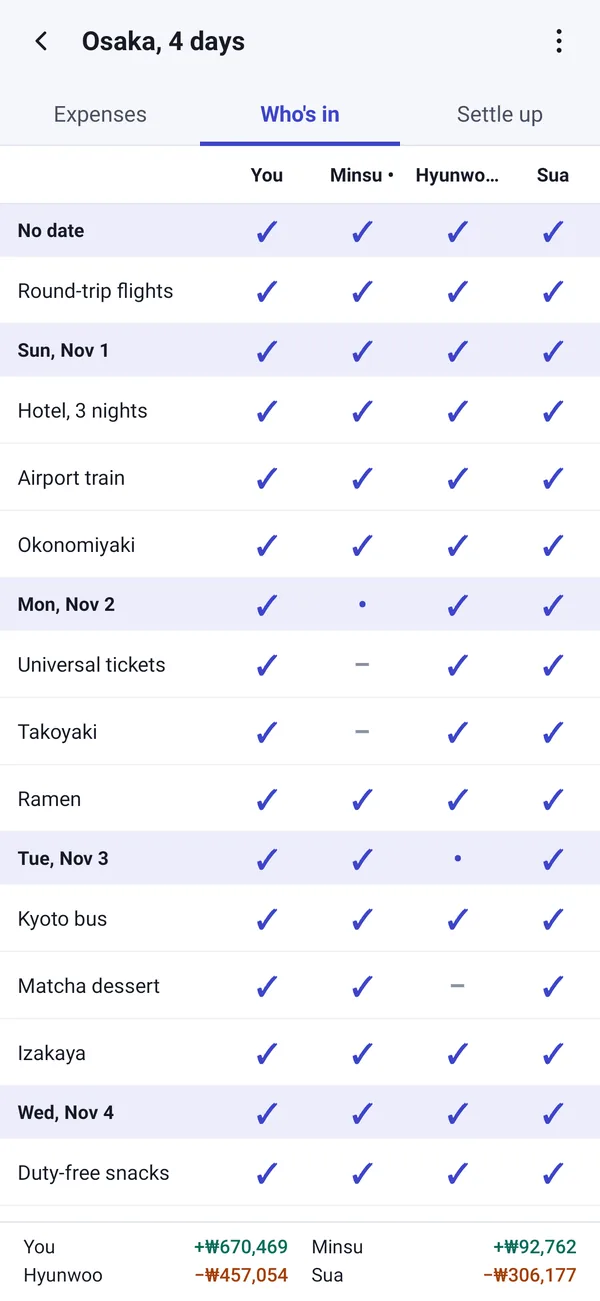
The who's-in table shows every expense and every person on one screen. Tap a cell to take someone out of an expense or put them back, for example to leave Alex out of the first night's dinner. When someone joins late or leaves early, a helper updates the expenses from that day on, so you don't have to untick Sam from every later night and meal by hand.
When the trip ends, Squared works out the fewest payments that settle everyone up, and See the math shows why each amount is what it is, which helps when the early leaver asks how their share was reached. Amounts that don't divide evenly are spread as evenly as possible across the whole total. There is no sign-up, and one phone can enter everything for the group. For the wider setup of a shared trip budget, see our guide on how to split expenses on a group trip.

Common questions
Should someone who arrives a day late pay for that night?
Usually not, if the late arrival was known when you booked. Prorate the lodging by the nights each person stayed. If they planned to come on time and changed plans after a non-refundable booking, the group's agreed rule decides, and many groups ask them to cover the night they signed up for.
Do I have to pay if I leave a group trip early?
It depends on what you agreed and on the booking. If your dates were known at booking, a nights-stayed split is fair. If you leave unexpectedly and the place won't refund the nights, as with Airbnb's stricter policies after check-in, the group still pays the full price, so offering to cover your original share is the fair move.
How do you split an Airbnb when people stay different nights?
Either split each night among the people who slept there, or divide the total by the number of person-nights and charge each person for their own nights. Both are fair; agree on one before booking. Whole-stay fees such as cleaning can be split evenly among everyone who joined.
How do you split groceries when people arrive at different times?
Split each grocery run among the people who were staying when it was bought. NerdWallet's Sally French suggests a late arrival could pay their part of the rental but skip the grocery bill, since they likely ate less. Keep receipts by date so this is easy to check.
What if someone cancels before the trip starts?
Check the refund first; if the booking refunds their part, they pay nothing for it. If it doesn't, they cover their share unless someone takes their place. Writing this rule down before anyone pays is the simplest way to avoid an argument later.