Use 25/5 for work that is hard to start, broken into small pieces or repetitive. Use 50/10 for work that takes a while to load into your head, such as writing, coding or long reading. Neither has been shown to be better: we could not find a controlled trial that compares the two directly, so the honest way to decide is to match the length to the task and then test it on your own work.
Both setups give you the same amount of focus time. What changes is how often you stop and restart, and that is the choice this guide helps you make. If you are new to the method, start with our guide to the 25/5 cycle.
The real difference is how often you restart
25/5 and 50/10 use the same ratio, five minutes of focus for every minute of rest, so choosing between them is not about working more. Over two hours, each one gives you 100 minutes of focus and 20 minutes of rest. Even 90/20 comes out the same if you keep going after the first break.
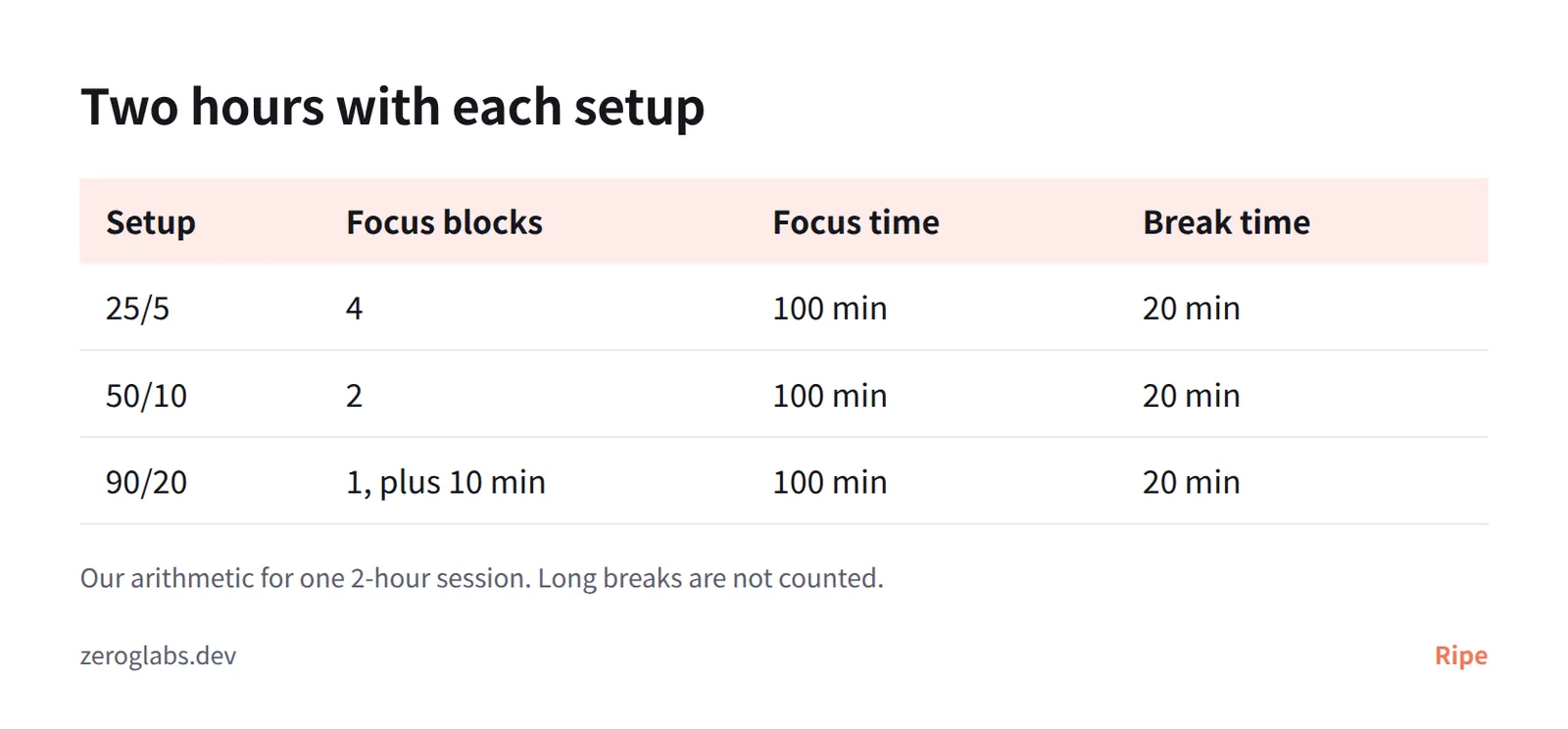
So the trade-off is about interruptions. A short block is easy to begin and gives you more chances to reset, but it can pull you out just as you get going. A long block gives you more unbroken time, but you can drift through the second half without noticing.
What the research shows, and where it stops
Research supports having a break plan more firmly than it supports any one length. The studies below tested schedules close to 25/5, but none of them assigned people to a fixed 50-minute block.
Scheduled breaks versus choosing your own
The results on fixed schedules are mixed. In a 2023 study of 87 Dutch university students during real self-study, some students followed a fixed schedule (24 minutes of study and 6 of rest, or 12 and 3) and others chose their own breaks. Those who chose studied and rested in longer stretches, and they reported more fatigue and distraction and less concentration and motivation. Both approaches got a similar amount of work done, but the scheduled students did it in less time.
A 2025 study at Maastricht University points the other way. Its 94 students worked for two hours with 25/5, with self-chosen breaks, or with Flowtime, where you work until your focus fades and then rest for a time based on how long you worked. Task completion, flow and how productive students felt did not differ between the groups, and motivation fell faster with 25/5 than with self-chosen breaks. The authors concluded that no technique should be recommended over the others on this data. They also pointed out the small sample and said two hours may be too short to show differences.
Short breaks help energy more clearly than output
A 2022 analysis that pooled 22 study samples and 2,335 people looked at breaks of 10 minutes or less. These breaks made people feel a little more energetic and a little less tired. Their effect on performance overall was small and not statistically clear.
The type of task mattered. Short breaks helped with creative and clerical tasks, although the clerical result rests on only two studies, and they did not help with cognitive tasks. Longer breaks went with larger performance gains, and the authors suggested, tentatively, that very draining work may need more than 10 minutes. That is a comparison across different studies, not a test of a 5-minute break against a 10-minute one.
Attention drifts on dull tasks
Long, repetitive tasks are where a brief switch has the most direct support. In a University of Illinois experiment, 84 people did a repetitive computer task for 50 minutes. Most got worse over time, but the group that was briefly interrupted twice by a small second task did not. The authors argue that the mind stops keeping a goal active when it has held that goal for a long time, and that a brief switch prevents this.
This was a lab task, and the switch was a moment of different work, not a rest. It suggests that 50 straight minutes of dull work can slip and that a very small change may help. It says nothing about whether 5 or 10 minutes of rest is better.
Match the length to the task
Choose by how easily you start and how much you have to hold in mind. The table below is a practical starting point drawn from the trade-off above. It is not a study result.
| Kind of work | Start with | Why |
|---|---|---|
| A task you keep putting off | 25/5 | A short block is easier to begin |
| Email, admin, data entry | 25/5 | The pieces are small, and a block can finish several |
| Flashcards and quick review | 25/5 | Easy to stop and pick up again |
| Essays, reports, long reading | 50/10 | You hold an argument in mind, and rebuilding it takes time |
| Coding and debugging | 50/10 | You keep many details in your head at once |
| Practice problems | 25/5 if each is quick, 50/10 if each is long | Fit at least one whole problem in a block |
| Long design or research sessions | 90/20, once 50/10 feels short | Only useful if you can really stay on one thing that long |
Two signs tell you when to change. If the timer keeps ringing just as you settle in, go longer. If your attention fades before the bell, or you reach for your phone in the second half, go shorter.
You don't need one answer for the whole day. Many people will do best with 25/5 for the inbox and 50/10 for the report, and a tired day may call for a shorter block than usual.
Make either length work better
Whichever length you pick, three habits around the break make it easier to come back.
- Write your next step before you stop. Experiments on interruptions found that longer and more demanding interruptions slowed people's return to a task. Those interruptions lasted up to a minute, so this is only a hint for longer breaks, but one line saying where you were costs almost nothing.
- Keep your phone out of the break. In a study of 414 students, people solved word puzzles with a break halfway through. Those who took the break on a phone took 19% longer on the second half and solved 22% fewer puzzles than the other break groups combined. It was one lab study with undergraduates, but it is a cheap thing to try.
- Get up and leave the screen. Walk around, get some water or look out of a window. The break is also your chance to rest your eyes and change position.
How to switch presets in Ripe
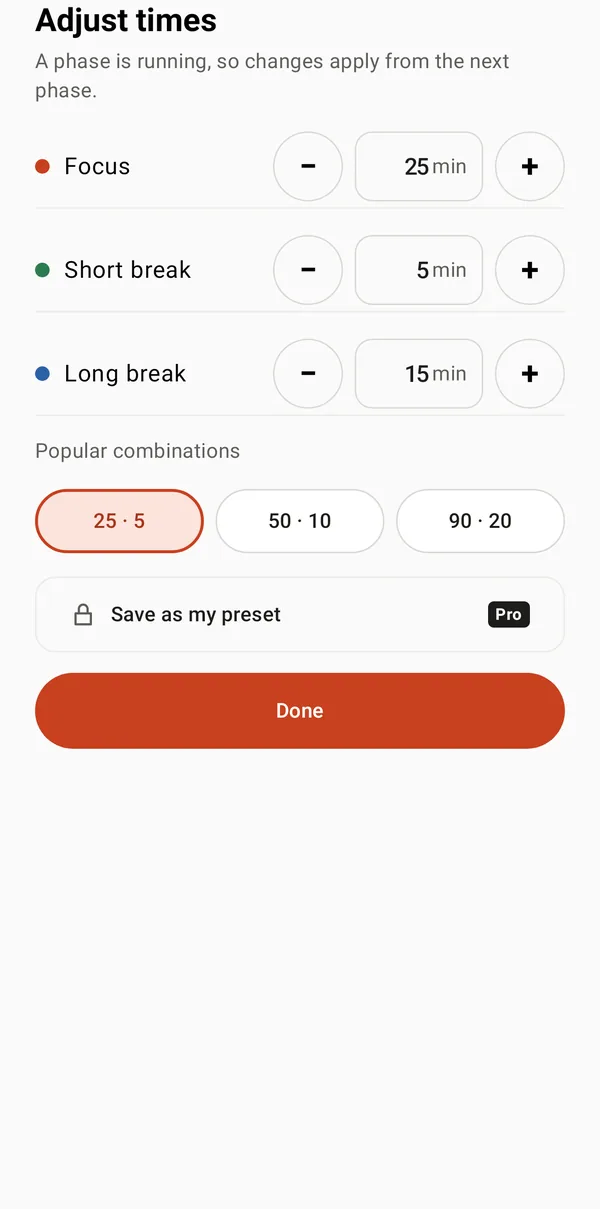
Any timer can run these lengths. In Ripe, the Pomodoro timer we make for Android, 25·5, 50·10 and 90·20 are one tap each.
- On the Adjust times screen, tap 25·5, 50·10 or 90·20.
- If you want something in between, such as 40/8, adjust the focus and break lengths yourself.
- Add a label for what you are focusing on, such as Thesis or Inbox.
- Tap the circle to start.
Two features fit the habits above. The 1-minute warning gives you time to write down your next step, and if the bell comes mid-sentence you can add 5 minutes from the notification. Each phase ends with an exact alarm, so Ripe rings on time with the screen off, and the long break comes every few rounds.
If you use different lengths for different work, a pass, which you earn by watching optional ads, lets you save your own presets and see stats by label.

Test both for two weeks
A short test on your own work will tell you more than the research can, because no study has compared these two lengths for your kind of task.
- Pick one kind of work, such as writing or problem sets, and keep the time of day similar.
- Use 25/5 for one week and 50/10 for the next.
- Record what you produced, such as pages, problems or tickets, and rate your tiredness from 1 to 5 at the end of each day.
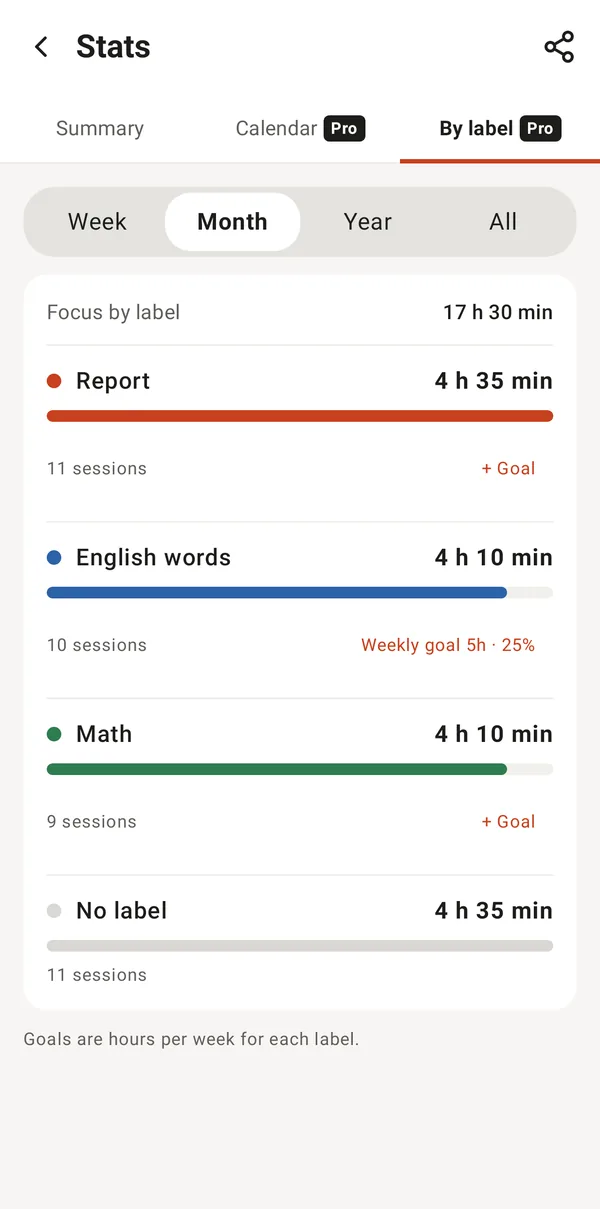
- Compare focus time, not completed sessions. 50/10 gives you half as many sessions for the same time. Ripe's free stats show this week compared with last week.
Two weeks are never identical, so treat small differences as a tie. If it is a tie, keep the one you find easier to stick with. That is a good result: the 2025 Maastricht study found no difference in task completion between its methods either.
Stay comfortable during long blocks
A longer block means a longer stretch without standing up or looking away, so plan for that. Ohio State's eye specialists say eye strain, blurred vision, headaches and dry eyes can follow more than two hours of screen use. They recommend the 20-20-20 rule: every 20 minutes, spend 20 seconds looking at something 20 feet away. You can do that in the middle of a 50-minute block without breaking it. If the symptoms keep coming back, see an optometrist or ophthalmologist.
Stop and rest if you feel pain, numbness or a headache building, and see a clinician if it continues. Don't use a timer to push past sleep or meals. If someone may need to reach you urgently, make sure their calls can get through before you silence your phone. A timer is a way to structure your work, not a treatment, so if trouble concentrating is affecting your daily life, talk to a doctor.
Common questions
Is 50/10 better than 25/5?
Not in any general way we could confirm. We found no controlled trial that compares them directly, and both give the same share of focus time. 50/10 tends to make more sense for work with a lot to hold in mind, and 25/5 for work that is hard to start or comes in small pieces.
Is 25 minutes too short for deep work?
It can be. If the timer keeps ringing just as you get into the problem, try 50/10 for a week. If 25 minutes is what gets you to start at all, it isn't too short for you.
How long should the long break be with 50/10?
No study has tested this, so here is a rule of thumb. The original method is usually described as a 20 to 30 minute break after four 25-minute blocks, which is 100 minutes of focus. Two 50-minute blocks add up to the same, so a 20 to 30 minute break after every second block keeps the same proportion.
Is 52/17 better than 50/10?
There's no good evidence that it is. The figure comes from DeskTime's data on its most productive 10% of users, and when the company repeated the analysis in 2021 the pattern had become 112 minutes of work and 26 of rest. DeskTime makes time-tracking software, and this is an observation of its users, not an experiment. A number that moves that much is not a rule.
Should I stop if I'm in flow when the timer rings?
You don't have to stop mid-thought. Finish the sentence or the step, write down what comes next, and then take the break. If this happens in nearly every block, your block is too short for that task.
Is 90/20 worth trying?
It is worth trying if 50/10 regularly feels too short and you can protect that much time. We found no trial showing that 90 minutes works better than shorter blocks. Start with one block a day, and pay attention to whether the last 20 minutes are still useful work.