To use the Pomodoro technique for studying, pick one specific study task, work on it for 25 minutes, take a 5-minute break, and take a longer break of 15 to 30 minutes after four rounds. The timer only organizes your time, so what you do inside each round matters more: test yourself from memory, and come back to the same subject on later days.
This guide gives you a four-round study block, a review calendar for tests from one week to one year away, and a 10-minute weekly check of where your study time went. It also says plainly what the research on Pomodoro does not show. If you are new to the method, start with our Pomodoro technique guide.
What the timer can and can't do
Scheduled breaks can make studying feel more manageable, but we found no study showing that a Pomodoro timer by itself raises exam scores.
In a 2023 study of 87 Dutch university students during a day of real self-study, students either set their own breaks or followed a fixed schedule (24 minutes of study and 6 of rest, or 12 and 3). Those who set their own breaks worked and rested in longer stretches, and reported more fatigue and distraction and less concentration and motivation. Task completion did not differ, and the fixed-break groups finished similar work in less time.
A 2025 study of 94 university students in a 2-hour session was less flattering. With 25/5 breaks, fatigue rose faster than with self-chosen breaks. By the end, the groups did not differ overall in fatigue, motivation, productivity, task completion or flow.
A 2025 scoping review, which maps the existing studies on a topic, found that 88% of 32 studies reported positive outcomes. Only 3 of the 32 were randomized trials, though, and none looked at Pomodoro in anatomy courses, the setting the review set out to assess.
These studies mostly measured how studying felt and how much got done. Treat the timer as a structure that helps you start, stop and rest on purpose. The learning itself comes from the next two sections.
Fill each round with recall, not rereading
Spend most of your rounds pulling information out of memory instead of reading it again. A 2013 review of 10 study techniques gave its highest rating to only two: practice testing and distributed practice, which means spreading study over time. Rereading and highlighting were rated low.
The classic demonstration is a 2006 experiment in which students read prose passages, then either restudied them or wrote down what they could recall, with no feedback. Restudying won on a test 5 minutes later. Recall practice produced much better retention after 2 days and after 1 week. Restudying also made students feel more confident, which helps explain why rereading feels like it is working.
A 2017 meta-analysis, a study that combines the results of many earlier studies, found practice tests more beneficial than restudying and every other comparison, with the size of the benefit varying by test and setting. Three habits make recall work harder for you:
- Start from a blank page when you can. A 2014 meta-analysis found larger benefits from recall tests than from recognition tests, where you only pick out the right answer.
- Check your answers. Feedback, usually seeing the correct answer, appears to increase the benefit.
- Redo what went wrong. The UNC Learning Center suggests working sample problems for technical courses and repeating the ones that give you trouble.
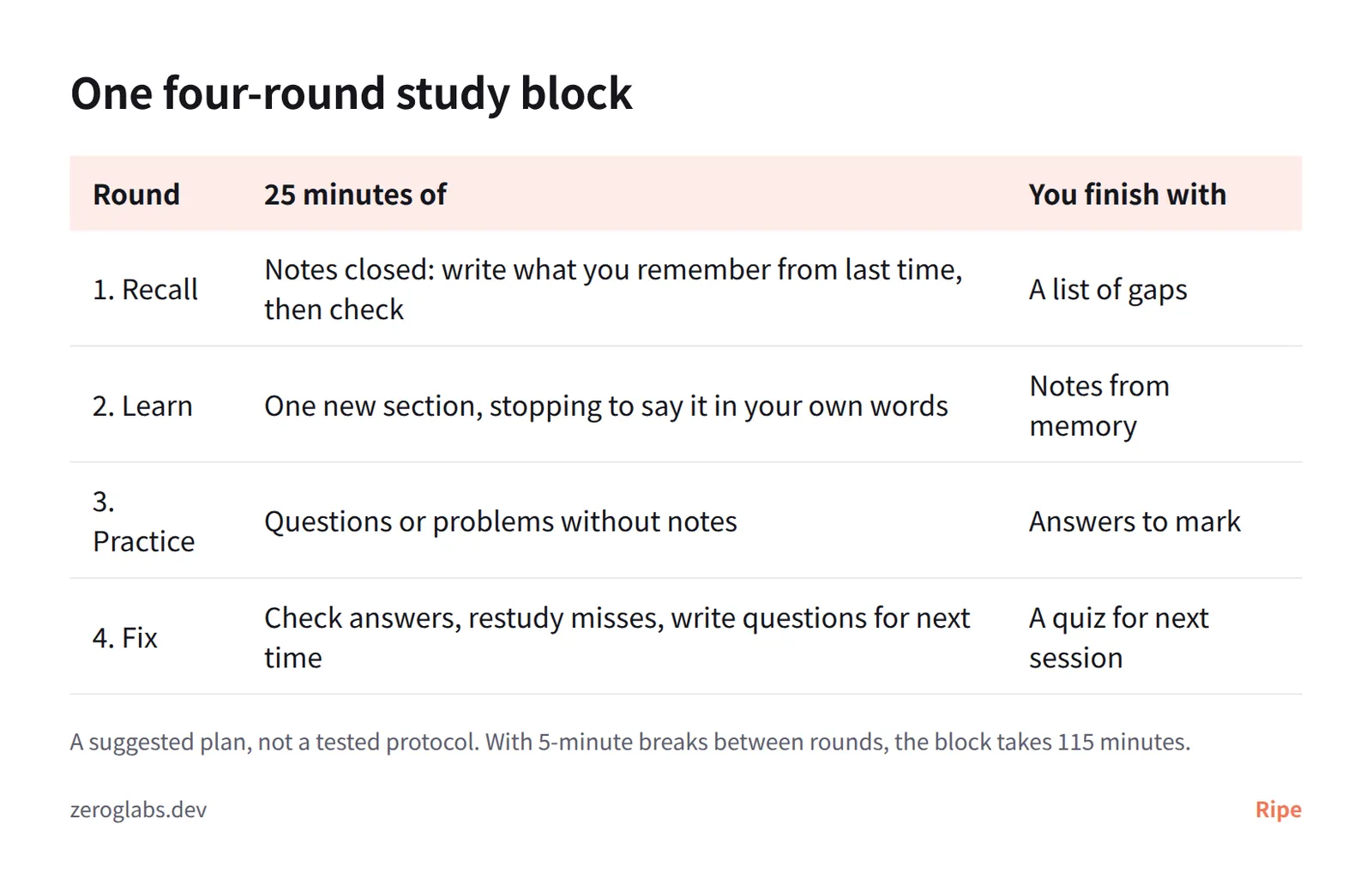
One way to apply this is to open with recall of the last session, learn one new section, practice without notes, and finish by fixing what you missed.
Spread each subject across days
Split a subject's rounds over several days and leave a gap before you review. The UNC Learning Center says 30 minutes per class each day over six days is more effective than one three-hour session. That is about one 25/5 round a day instead of six in a row.
How long should the gap be? In a 2008 study, more than 1,350 people learned a set of facts, reviewed them after a gap of up to 3.5 months, and took a final test up to a year later. The best gap grew as the time until the test grew, but shrank as a share of it: from about 20–40% of a 1-week delay to about 5–10% of a 1-year delay. One of the authors put it simply: for one week of retention, space study over about a day or two, and for one year, over about a month.
| Test or exam | Research anchor | A practical calendar |
|---|---|---|
| About 1 week away | For a 1-week delay, a gap of 20–40%, about 1.5 to 3 days | Learn on day 1, recall on day 3, recall again on day 6 |
| About 1 month away | Between the two ratios (our estimate) | Learn in week 1, recall 5 to 7 days later, recall again in the final week |
| Needed in a year | For a 1-year delay, a gap of 5–10%, about 18 to 36 days | Learn now, recall about a month later, then keep revisiting |
The limits are real. That study tested one review of a set of facts, so a calendar with several reviews is a practical extension and not a tested prescription. Material that builds week by week, such as math, may need earlier and more frequent contact.
You can also mix topics or problem types in your practice round. The 2013 review rated this kind of interleaving as moderately useful, because the evidence is more limited.
Choose the round length by the material
Start with 25/5 and change only when the bell keeps arriving at the wrong moment. The research has not settled on one best length, and the UNC Learning Center simply recommends short, intense sessions of 30 or 45 minutes. Flashcards and short problem sets fit 25-minute rounds, while long readings and essays often suit 50/10. Our comparison of 25/5 and 50/10 shows how to test both.
Take the breaks seriously, but don't expect five minutes to fix everything. A 2022 meta-analysis of breaks of 10 minutes or less found small gains in energy and small drops in fatigue. It found no significant overall effect on performance, and benefits appeared only for less demanding tasks. The authors suggest recovering from very draining work may take more than 10 minutes, so use your long break after the hardest rounds.
Keep your phone out of the break if you can. In a study of 414 undergraduates solving word puzzles, those who took a phone break needed 19% longer for the remaining task and solved 22% fewer problems than the other break groups combined. Puzzles are not studying, but standing up and getting water costs you nothing.
Give every round a subject label
Use one label per course or exam, and put the chapter or skill in your goal for the round. Broad labels add up into totals you can compare, while a new label for every chapter leaves you with dozens of tiny numbers. Keep the goal concrete: "Biology: write the steps of cellular respiration from memory" gives you something to finish, and "study biology" does not.
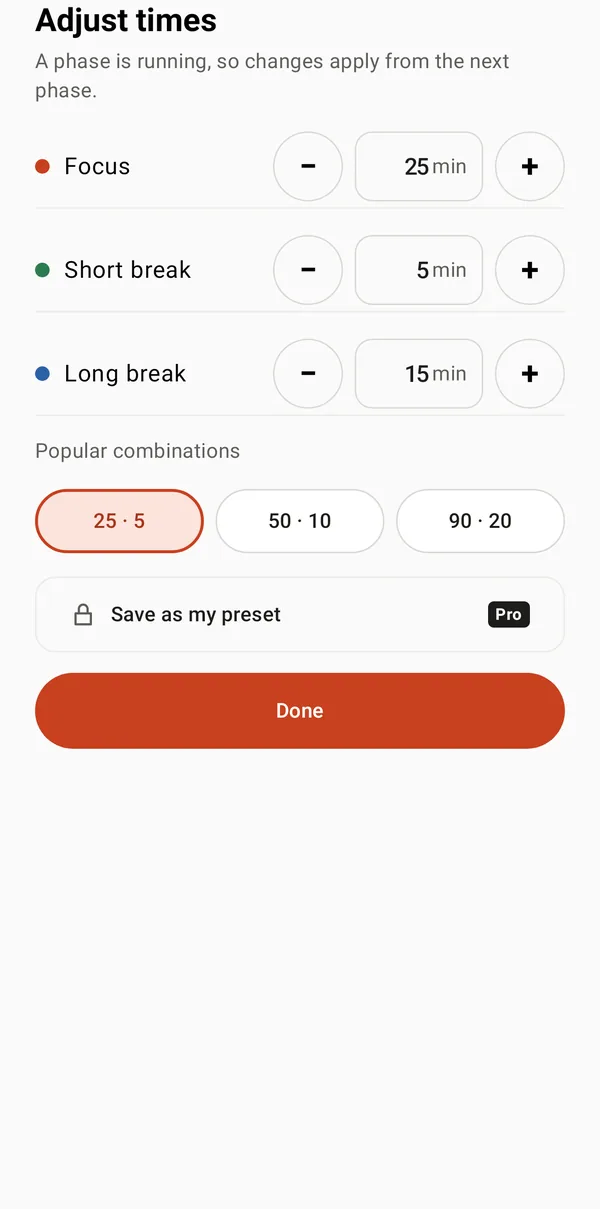
Ripe, the Pomodoro timer we make for Android, is built for this routine. Add a label for what you are focusing on, then tap the circle to start. You can pick 25·5, 50·10 or 90·20 in one tap, adjust the lengths, and set auto-start and a daily goal. Each phase ends with an exact alarm, so it rings on time with the screen off and your phone can stay out of reach. Choose “Ring like an alarm” to hear it even in silent mode, and turn on the 1-minute warning if you want a moment to finish your thought.
Review your week in 10 minutes
Once a week, compare where your time went with what you can actually recall. Focus time measures effort, not learning, so it can only tell you part of the story.
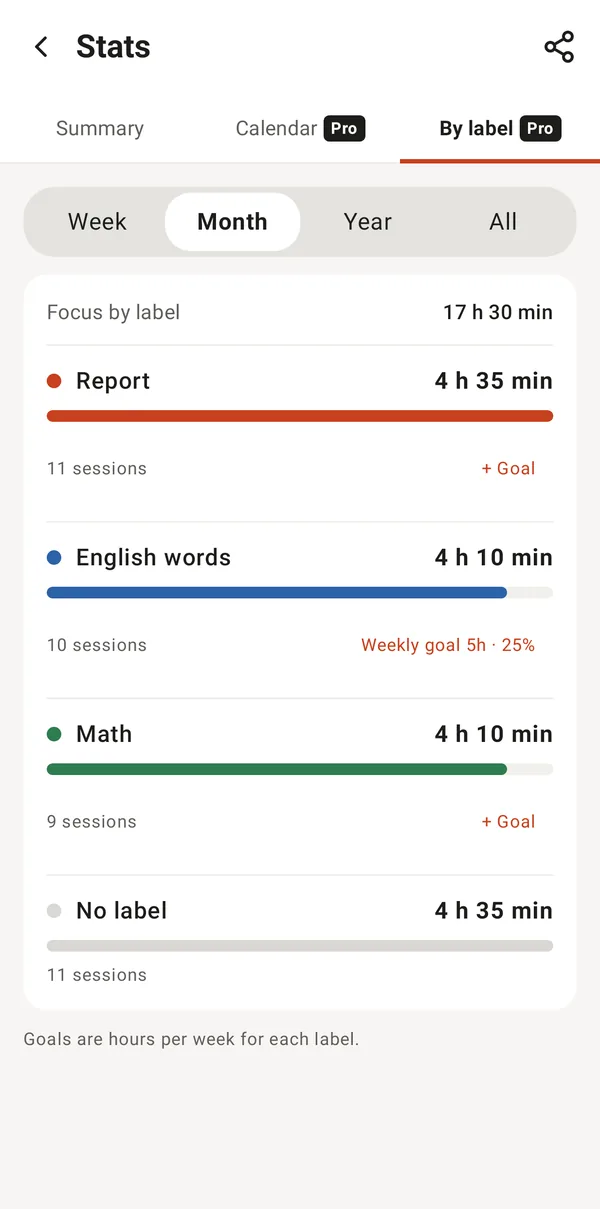
- Add up each subject. Look at rounds or focus time by subject, and find any exam subject that got almost nothing.
- Count separate days. A subject studied on three days is usually in better shape than one with the same time in a single day.
- Test yourself. Give each subject a few minutes on a blank page, without notes, and rate what you recalled.
- Move next week's rounds. Give extra rounds to the subjects you recalled worst, even if they already got plenty of time.
- Set your review dates. Use the calendar above to put the next recall rounds on specific days.
Ripe shows today's completed sessions, focus time and streak, plus this week compared with last week. Stats by label, weekly goals and the 12-month calendar open with a pass, which you earn by watching optional ads. Without a pass, a paper tally per subject does the job.

Keep the schedule sustainable
Don't trade sleep for extra rounds. The CDC recommends 8 to 10 hours for teens aged 13 to 17 and 7 or more hours for adults aged 18 to 60. Stand up during breaks and look away from your screen.
If studying brings pain, eye strain that does not go away, or anxiety or low mood that does not lift, stop pushing through and talk to a doctor, counselor or your school's support service. This is general study advice, not medical advice, and a timer cannot promote or protect your health by itself.
Common questions
Is the Pomodoro technique good for studying?
It is good for organizing study time, especially when starting is the hard part. The evidence is small and mixed, and it covers fatigue, motivation and completed work more than grades. Pair the timer with self-testing and spaced review, which earned the highest ratings in the 2013 review.
How many pomodoros should I study a day?
Research does not give a number. Start with one four-round block, which takes 115 minutes with short breaks, then adjust based on your weekly recall check and how tired you feel. Spreading rounds across days matters more than a large count on one day.
What should I do during a 5-minute break?
Stand up, get some water or move around, and stay away from screens if you can, as Duke's Academic Resource Center advises. Avoid starting anything you will not want to stop after five minutes. Scrolling on your phone is the classic example.
What if the timer rings in the middle of a problem?
Finish the line you are on, write down your next step, and then take the break. If this happens in most rounds, try a longer round for that subject. In the 2025 study, flow did not differ between students on 25/5 breaks and students choosing their own, so one bell does not have to ruin a session.
Does the Pomodoro technique work with ADHD?
It may help as a structure, but the studies cited here did not look specifically at students with ADHD. Experiment with shorter rounds and keep what helps you start and return to work. A clinician or your school's disability service can give advice that fits you.
Can I use Pomodoro to cram the night before an exam?
It can organize a last-minute session, but it cannot replace spacing. In the 2006 experiment, restudying led at 5 minutes and recall led at 2 days, and a next-morning exam falls between those. Do recall first, reread only what you missed, and protect your sleep.