The Pomodoro Technique is a time management method created by Francesco Cirillo. You pick one task, work on it for 25 minutes, then take a 5-minute break. After four of those rounds, you take a longer break of 15 to 30 minutes.
It is popular because it is easy to begin: all you need is a timer and a piece of paper. It is also a structure, not magic, and the research on it is small and mixed. This guide covers where the method came from, how the classic cycle runs, what to do about interruptions, the mistakes that make it fail, when to change the 25 minutes, and a plan you can use today.
What the Pomodoro Technique is and where it came from
The method began as one student's attempt to concentrate. According to the official site, Cirillo started developing it in the 1980s while preparing for a university exam, and he first challenged himself to concentrate for just two minutes, using a tomato-shaped kitchen timer. Pomodoro is the Italian word for tomato, and each work interval is called a pomodoro.
The form most people know splits work into 25-minute intervals with 5-minute breaks in between. Cirillo wrote it up in a 130-page book in 2006 and offered it as a free download, and a retail edition followed in 2018, according to the publisher.
The timer is only the visible part. The official site calls the method much more than a sequence of 25-minute sessions, because it connects attention and breaks with planning, estimating effort, recording what you did and reflecting on it. You can start with the timer alone, but the planning and reviewing are where you learn how long your work really takes.
The classic cycle: 25 minutes, 5 minutes, then a long break
One full cycle is four focus blocks separated by short breaks, followed by one long break. University study guides from Duke and UC San Diego describe it the same way:
- Choose one task.
- Set a timer for 25 minutes.
- Work only on that task until the timer rings.
- Stop and put a tick on paper.
- Take a short break of about 5 minutes (UC San Diego says 3 to 5), then go back to step 2.
- After the fourth pomodoro, take a long break of 15 to 30 minutes, reset your ticks and choose your next task.
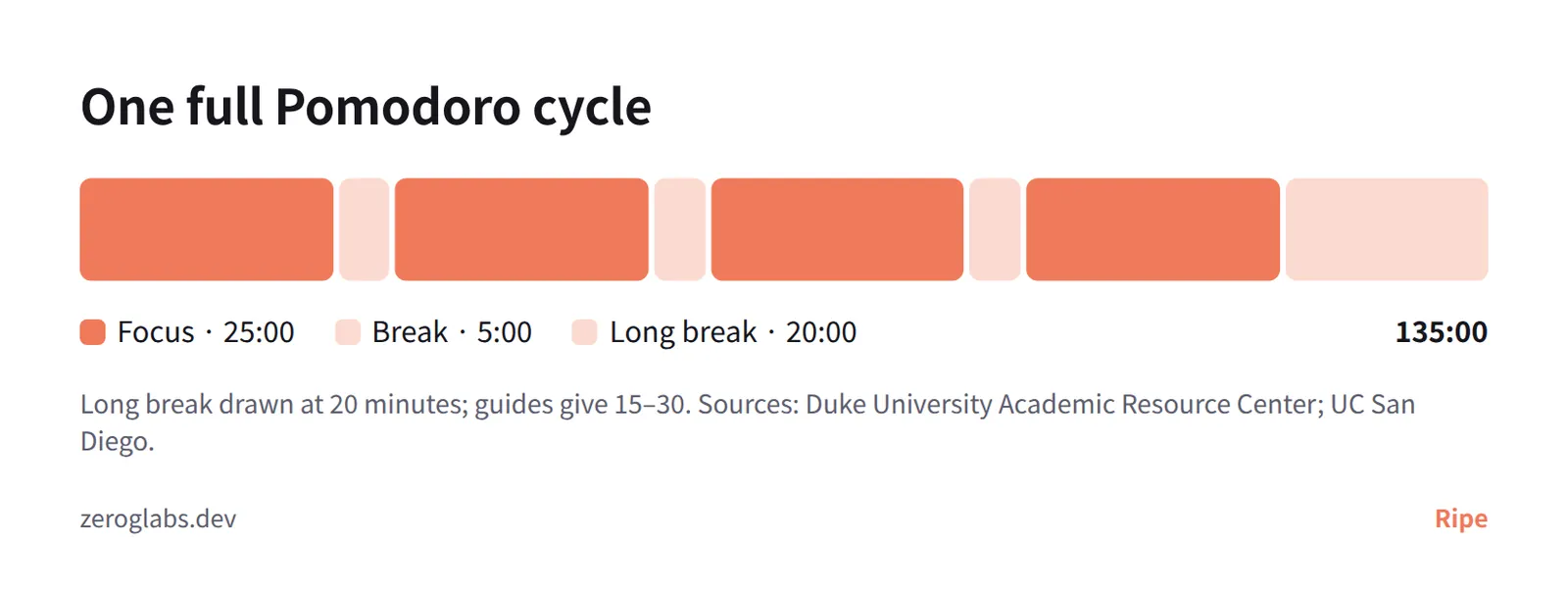
Four focus blocks and three short breaks add up to 115 minutes. With the long break, a full cycle takes 130 to 145 minutes, so one cycle fills a good part of a morning. That matters when you plan your day: you do not need many cycles for the method to be useful.
What to do when you get interrupted
The classic rule is that a pomodoro cannot be divided, so you deal with an interruption in one of two ways. UC San Diego's guide says you either record the other activity and postpone it, or you abandon the round.
To postpone a request from another person, the guide uses a four-part strategy: inform, negotiate, schedule, call back. In everyday terms, it goes like this:
- Inform: tell them you are in the middle of something.
- Negotiate: agree on when you can get back to them.
- Schedule: write it down so it is not lost.
- Call back: follow up at the time you agreed.
The official site treats interruptions from yourself in the same spirit, because a sudden urge to check something also breaks your focus. A simple way to handle these is to keep a note beside you, write the thought down and return to the task. That part is our practical suggestion, not a finding from research. And if something is truly urgent, stop. No timer rule is worth more than a real emergency.
Does the Pomodoro Technique work?
It can help, but the evidence is small and mixed, and we found no study showing that 25 minutes is the best length. Here is what three useful papers found:
- Fixed breaks compared with self-chosen breaks (2023): In a study of 87 Dutch university students during one day of real study, students who chose their own breaks studied and rested longer. They also reported more fatigue and distraction, and less concentration and motivation, than students on fixed schedules of 24/6 or 12/3 minutes. Task completion did not differ, so the fixed schedules got similar results in less time.
- Pomodoro, Flowtime and self-chosen breaks (2025): In a 2-hour online study session, 94 psychology students were analyzed. Pomodoro was linked to a faster drop in motivation over the session, and overall levels of fatigue and motivation did not differ. Productivity, task completion and flow did not differ either. The authors concluded that no one technique should be recommended over the others. They also noted limits, including a small, mostly female sample and no way to watch what students actually did.
- Short breaks in general (2022): A review of 22 samples and 2,335 people looked at breaks of up to 10 minutes. These breaks gave small improvements in vigor and fatigue. The overall effect on performance was not significant, and longer breaks were linked to larger performance gains. The authors suggest that recovering from very draining tasks may take more than 10 minutes.
The honest summary: fixed intervals are a reasonable way to organize a work session, and they do not suit everyone better than other schedules. Treat the method as an experiment on your own work.
Common Pomodoro mistakes and how to fix them
Most failures come from using the timer without the rest of the method. These are the ones to watch for:
- Starting with a vague task. "Work on the report" gives you nothing to finish. Define the task first, as Duke advises: "Draft the introduction" is clear enough to begin.
- Working through the breaks. The official site is plain about this: breaks are part of the practice, not a reward for doing more. When the timer rings, stop, even if the next sentence is in your head. Write down that sentence so it is waiting for you.
- Spending the break on a screen. Duke suggests taking the short break away from screens. Stand up, get some water or look out of a window. A five-minute scroll can easily turn into twenty.
- Giving every tiny task its own round. Duke suggests combining tasks that take less than one pomodoro, such as checking email and booking an appointment, into one session.
- Never recording anything. UC San Diego points out that recording each pomodoro gives you data for reviewing your habits. Without those ticks, you lose the part that teaches you how long tasks really take.
- Treating 25 minutes as a law. Duke encourages you to experiment and find what suits your energy and the task. If the timer often cuts you off in the middle of good work, the next section is for you.
How to choose a different interval
Start with 25/5 for a few sessions, and change it only if you have a clear reason. That advice is ours; none of the studies above found a universal best length. These are the setups we could trace to a source, and the last column is our own suggestion:
| Setup | Focus | Break | Where it comes from | Worth trying when |
|---|---|---|---|---|
| Classic | 25 min | 5 min, then 15–30 min after four | Duke, UC San Diego | You are starting out |
| Short | 12 min | 3 min | Short schedule in the 2023 study | A task feels too hard to begin |
| Long | 52 min | 17 min | Example from Duke | The work needs long stretches of thought |
| Flowtime | As long as you can focus | 5 min after up to 25 min, 8 min after 25–50 min, 10 min after more than 50 min | 2025 study | Fixed timers keep cutting you off |
Keep the break in proportion. A long focus block with a tiny break is the usual way people end up exhausted while still following the rules.
How to start today
You can try this in the next ten minutes. This plan is our suggestion, built from the steps above, and it asks for only one or two rounds at first:
- Write down the three things that matter today.
- Turn the first one into a small, clear job, such as "Outline section two".
- Set up your space before you start. Duke recommends limiting distractions in advance, so put your phone out of reach and close tabs you do not need.
- Keep a sheet of paper beside you for ticks and stray thoughts.
- Set a timer for 25 minutes and work on that one job.
- When it rings, stop, add a tick and take 5 minutes away from your screen.
- Do one or two more rounds. If you reach four, take a long break.
- At the end of the day, compare your ticks with what you expected. If the job took six rounds and you guessed two, you have learned something useful for tomorrow's plan.
Run the cycle in Ripe
Any timer works for this, including a kitchen timer. Here is how it works in Ripe, the Pomodoro timer we make for Android. The official site notes that Pomodoro is a registered trademark; Ripe is our own app, not a product of the method's creator.
On the home screen, tap the circle to start or pause, and add a label for what you are focusing on. Ripe runs focus, short break and long break phases, with the long break every few rounds. To use the classic timing, pick 25·5 in one tap, or adjust the focus and break lengths yourself. The presets also include 50·10 and 90·20 for longer work.
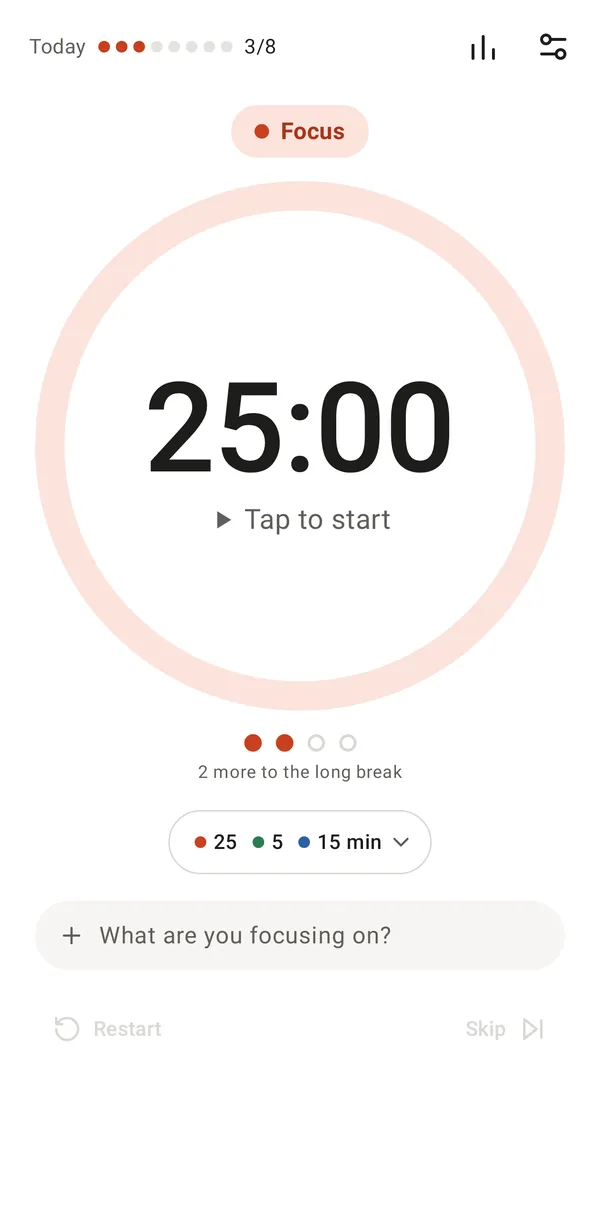

A few settings fit the method well:
- Ringing on time. Each phase ends with an exact alarm, so Ripe rings on time with the screen off. Choose "Ring like an alarm" to hear it even in silent mode. Some phone makers limit background apps, and the app has a guide for those phones.
- Your own pace between phases. Turn on auto-start if you want phases to run on without a tap, and set a daily goal. A short alert 1 minute before a phase ends can help you finish a thought.
- Controls outside the app. You can pause, add 5 minutes, skip or start the next phase from the notification, the Quick Settings tile or app shortcuts. A strict Pomodoro has no pauses, so leave those buttons alone if you want the classic rule.
- Your ticks, recorded. The stats show today's completed sessions, focus time and streak, and this week compared with last week.
With a pass, earned by watching optional ads, you also get a 12-month calendar, stats by label, weekly goals and Do Not Disturb during focus. No account is needed, and your sessions stay on your device.
Common questions
Why is a pomodoro 25 minutes?
The 25-minute block is the classic form of the method, and we found no study showing it is the best length. Cirillo's own first attempt was just two minutes. Duke's guide encourages you to experiment, and it mentions 52 minutes of work with a 17-minute break as another option.
Does the Pomodoro Technique work for studying?
It can, and many university study centers teach it. In one study, students on fixed breaks reported better concentration and motivation than students who chose their own breaks, with similar task completion. A later study found no overall advantage for any break method, so try it on your own work before you decide.
What should I do during the break?
Step away from the work. Duke suggests staying away from screens during the short break, so stand up, drink some water or look out of a window. Save meals and longer errands for the 15- to 30-minute long break.
What if I finish a task before the timer rings?
UC San Diego's guide says to use the remaining time to review what you did. If you keep finishing early, your tasks may be too small for a full round. Duke suggests combining small tasks into one pomodoro instead.
How many pomodoros should I do in a day?
We could not confirm any official or research-based daily target. One full cycle already takes more than two hours, so one or two cycles is a sensible place to begin. Record your rounds for a week and let your own results set the number.
Is the Pomodoro Technique good for ADHD?
It depends on the person and the task. ADHD UK, a UK charity, recommends it for small tasks but advises against it for big pieces of work, because the breaks can interrupt hyperfocus (long, intense concentration on one thing). This is practical guidance rather than a clinical result, and a timer is not a treatment for ADHD.
A few safety notes
This method organizes your time; it is not a treatment and we cannot promise a health or medical result. The World Health Organization says all age groups should limit the time they spend sedentary, so use your breaks to stand up and move. Do not use a timer to push through pain, headaches or a serious lack of sleep. If trouble concentrating is affecting your work or daily life, talk to a doctor or another health professional.
If you might receive urgent calls, check your phone's priority settings before you silence it. With Do Not Disturb during focus in Ripe, only priority interruptions get through while focus runs, and your previous mode returns when you pause, skip or finish.
The Pomodoro Technique will not make hard work easy. It makes the next 25 minutes clear, and it tells you when to stop. Start with one task and one round, and see what your own ticks tell you.