The HIIT work to rest ratio is how long you work compared with how long you recover in each interval. The three most common ratios are 1:2 (for example 20 seconds on, 40 off), 1:1 (30 on, 30 off) and 2:1 (20 on, 10 off). As a rule, the harder and shorter the effort, the more rest it needs. Start new or all-out work at 1:2 or longer, and save 2:1 for short bursts or for circuits done at a moderate effort.
The ratio is only half the story, though. The same 2:1 can be a gentle bodyweight circuit or the hardest four minutes of your week, depending on how hard you push. This guide explains what each ratio is good for, what studies say about rest, and gives six presets you can copy into any interval timer.
What a work-to-rest ratio means
A work-to-rest ratio compares the length of the work part of an interval with the length of the recovery part. Thirty seconds of work and 15 seconds of rest is 2:1. Twenty seconds of work and 60 seconds of rest is 1:3. By convention the work comes first.
Three things together decide how a session feels:
- Intensity: how hard each work interval is.
- Ratio: how much rest you get compared with work.
- Interval length: 10 seconds of work at 2:1 feels nothing like 4 minutes of work at 2:1.
Change one and the others usually have to move with it. The American Council on Exercise (ACE) says in its beginner routine that there is no set rule on which interval times work best, but that typically the shorter the work time, the more intense the exercise should be.
1:2 and longer rest for hard efforts
Choose 1:2 or even more rest when each effort is close to all-out, or when you are new to intervals. The extra rest lets you recover enough to do the next effort hard and with good form, instead of each round getting sloppier than the last.
At the far end, sprint training uses much longer rest. In a 2019 randomized trial, 36 people did ten 6-second all-out cycling sprints per session for two weeks, with work-to-rest ratios of 1:8, 1:10 or 1:12. All three training groups improved their peak power and 10 km time-trial performance, while a control group that did not train did not, and there was no significant difference between the ratios. The authors concluded that any of the three suits athletes and people can pick by preference. It was a short, small study, but it makes a useful point: for very short sprints, a lot of rest is normal, not lazy.
The classic lab version is the Wingate-style session described in a 2012 review by Martin Gibala and colleagues: a few 30-second all-out cycling efforts with rest between them, adding up to about 2 to 3 minutes of hard work in a session of roughly 20 minutes. The same review warns that this kind of training is extremely demanding and may not be safe, tolerable or appealing for some people.
For everyday workouts, 1:2 is a comfortable starting point: 20 seconds of hard work and 40 seconds of easy movement or rest, for 8 to 10 rounds.
1:1 for steady, repeatable intervals
1:1 is the all-rounder. It is hard enough to feel like HIIT, with enough recovery to repeat good efforts for 10 to 20 minutes, so it suits people who already exercise and want a session they can do regularly.
The best-known example comes from the same Gibala review, which proposed a more practical model than all-out sprints: ten 1-minute efforts at a steady load that brings you to about 90% of your maximum heart rate, each followed by 1 minute of recovery. That is only 10 minutes of hard work in a 20-minute session. The authors present it as a time-efficient option, while noting that evidence in people with or at risk of conditions such as type 2 diabetes was still limited and that larger studies were needed.
A simpler 1:1 to start with is 30 seconds on, 30 seconds off. Pick a pace you could hold for every round, not just the first three.
2:1 for short rest and dense work
2:1 gives you less rest than work, so fatigue builds quickly. It fits two quite different situations: very short, very hard intervals done for only a few minutes, and moderate circuits where the effort is nowhere near your limit.
The famous example is Tabata. In the 1996 study by Izumi Tabata and colleagues, seven people trained on an exercise bike five days a week for six weeks. Each session was 7 to 8 sets of 20 seconds at about 170% of their VO2max (an effort well above the pace at which your aerobic system tops out), with 10 seconds of rest between sets. Both their VO2max and their anaerobic capacity went up. Two honest limits: the group was tiny, and most home Tabata workouts are nowhere near that intensity. Our guide on how to do a Tabata workout covers how to build up to it.
The other use of 2:1 is the gentle kind. ACE suggests 30 seconds of work and 15 seconds of rest (30:15) as a safe place to start for beginners in a simple bodyweight circuit, with the effort kept at 4 to 6 on a 0 to 10 scale. Here the short rest works because the effort is moderate. That is the key point of this whole guide: 2:1 at a moderate effort and 2:1 at an all-out effort are different workouts.
How long should the rest be
For longer intervals, there is a point where extra rest stops helping. In a study by Stephen Seiler and Kjell Hetlelid, nine well-trained male runners did 4-minute treadmill intervals at a pace they chose themselves, with 1, 2 or 4 minutes of rest. Going from 1 to 2 minutes of rest let them run slightly faster, but 4 minutes gave no further gain. When the runners picked their own rest, they took about 2 minutes on average. The authors concluded that, when people set their own pace, rest of 1 to 4 minutes had limited impact on performance, and suggested about 2 minutes of active recovery as a good balance.
In ratio terms, 4 minutes of work with 2 minutes of rest is 2:1, and it worked as well as 1:1. So for long intervals, a rest shorter than the work is common and reasonable. For a full session built on 4-minute intervals, see our Norwegian 4x4 guide.
A practical check you can use anywhere: if your last two rounds are clearly slower, weaker or sloppier than your first two, the rest is too short for the effort you chose. Either add rest or ease the effort. This is our rule of thumb, not a research finding.
Presets to copy
These six presets cover most needs. The total is work plus rest, times the rounds, and does not include a warm-up or cool-down.
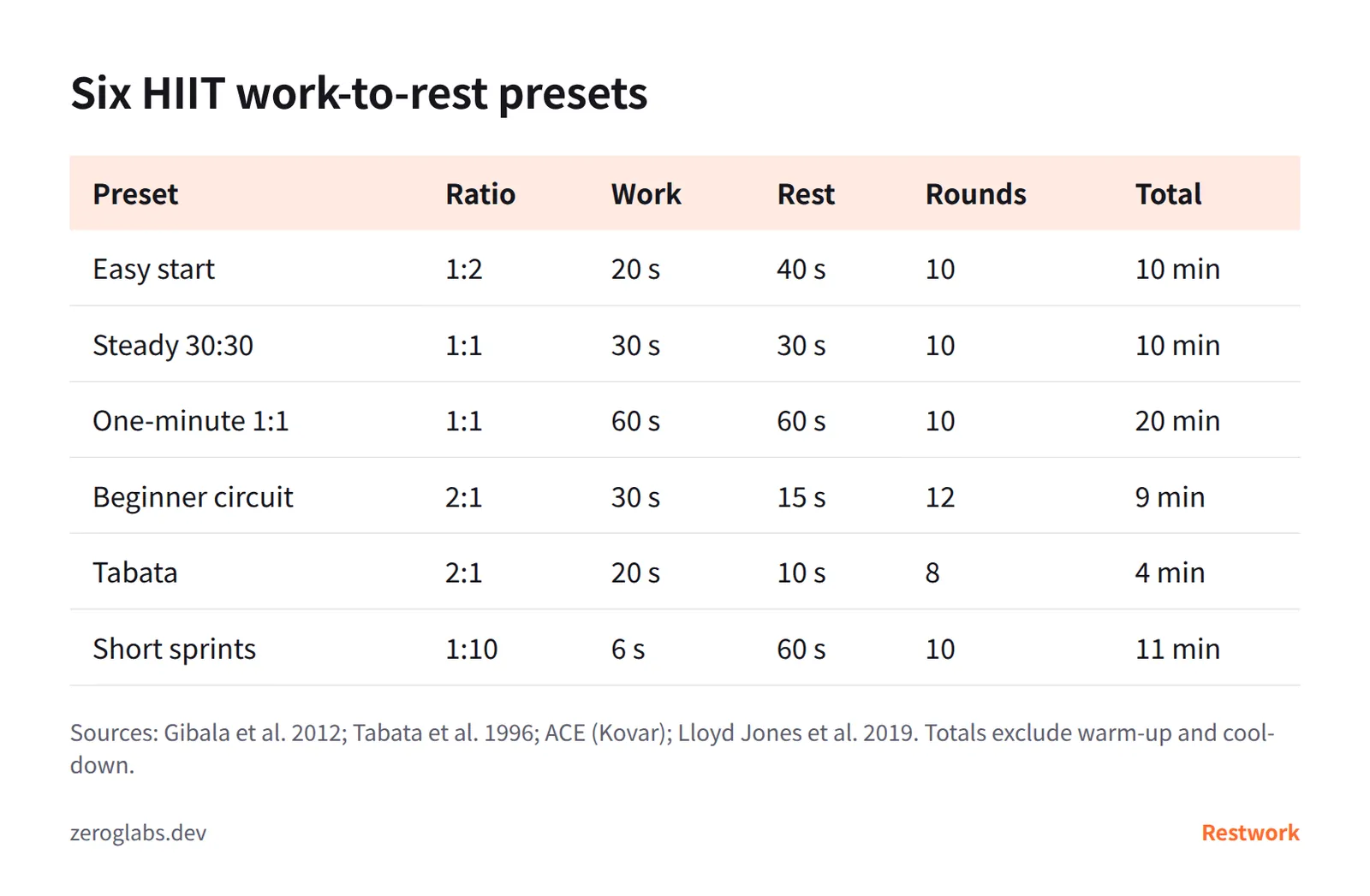
Where they come from: the 1-minute 1:1 preset follows Gibala's practical model, the Tabata preset follows the length of the 1996 protocol (the original intensity was far above what most people do at home), the 30:15 circuit follows ACE's beginner suggestion, and the sprint preset uses the middle ratio from the 2019 sprint study. The 20:40 and 30:30 presets are common starting formats, not study protocols.
A simple way to progress is to change one thing at a time over a few weeks: first add rounds, then shorten the rest (from 1:2 toward 1:1), and only then push the effort. Avoid cutting rest and raising intensity in the same week.
Set up any ratio in Restwork
Any interval timer that lets you set work, rest and rounds can run these presets. Here is how it works in Restwork, the Android interval timer we make.
For a quick session, use Quick start on the home screen and set Work, Rest and Repeat, then tap Start. Restwork remembers your last values, so your usual 30:30 is ready the next time. Tabata is also one of the ready-made workouts, one tap away.
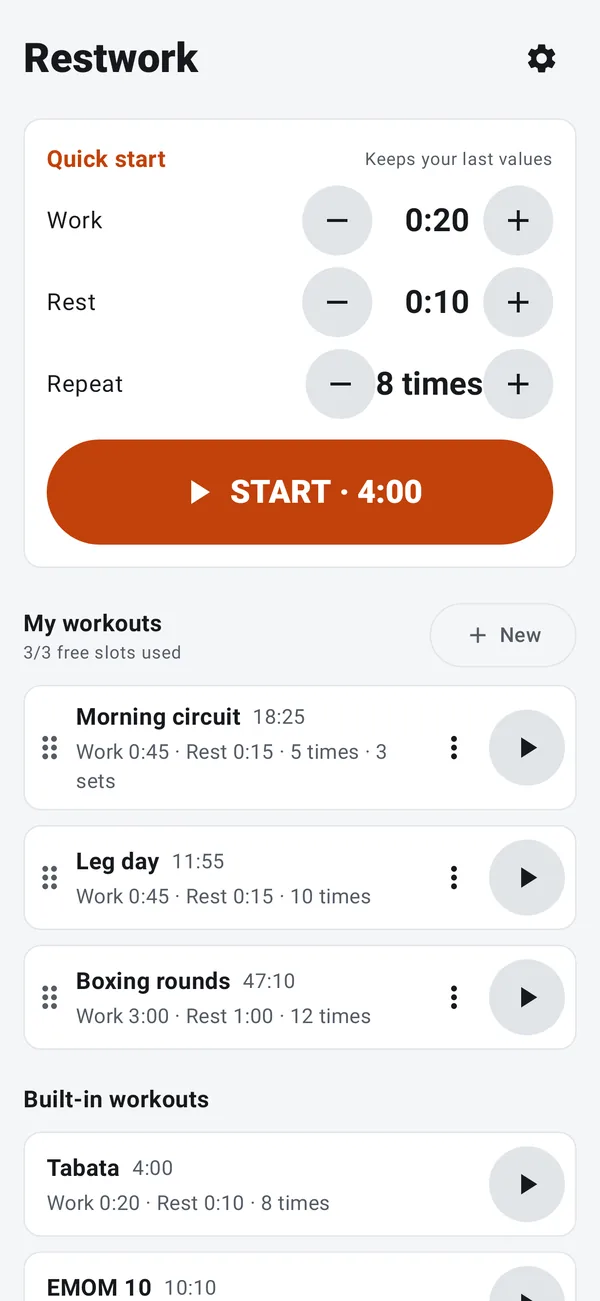
To keep a preset together with its warm-up, save it as your own workout in the workout editor, which lets you add a warm-up, sets, rest between sets and a cool-down. The free version keeps 3 saved workouts, enough for one 1:2, one 1:1 and one 2:1 session.

During the session you don't need to watch the clock. Beeps and a 3-2-1 countdown mark each change, spoken cues such as “Work”, “Rest” and “Last round” tell you where you are, and the timer keeps going with the screen off or locked. Your music keeps playing and only dips briefly at each cue.
Common questions
What is the best work-to-rest ratio for HIIT?
There isn't one best ratio. It depends on how hard each effort is and how long it lasts. Most people do well starting at 1:2 or 1:1 and using 2:1 only for short intervals or moderate circuits. If your pace or form falls apart in the later rounds, you need more rest.
Is 1:1 or 2:1 better for burning fat?
The studies in this guide did not compare ratios for fat loss, so no ratio can be promised to burn more fat. A session you can repeat week after week matters more than the exact numbers. The CDC advises adults to get 150 minutes of moderate or 75 minutes of vigorous activity a week, plus muscle-strengthening activity on at least 2 days.
How long should I rest between HIIT intervals?
For short intervals of 10 to 60 seconds, rest is usually equal to or longer than the work, and many times longer for all-out sprints. For intervals of several minutes, about 2 minutes of rest was enough in Seiler and Hetlelid's study, and longer rest did not improve pace further.
Should rest be active or passive?
Either can work. ACE says rest can be passive or active and suggests adding active recovery once you have built stamina and coordination. Easy walking or pedaling between longer efforts is a common choice.
Is 20 seconds on, 10 seconds off good for beginners?
It can be, if the effort is moderate. The original Tabata protocol was an effort far beyond what a beginner should start with. If you are new to HIIT, start at 1:2 or 1:1 and build up over a few weeks.
A few safety notes
Warm up before your first interval and cool down afterwards. Choose moves you can do safely when tired, and add rest or ease off as soon as your form slips. Stop if you feel chest pain, dizziness, unusual shortness of breath or sharp pain. All-out sprint training is very demanding, so if you have a heart condition, high blood pressure, an injury, or have not exercised in a long time, talk to a doctor before starting hard interval training.
A ratio is a tool, not a magic number. Pick the one that matches how hard you plan to work, keep the last rounds as good as the first, and let a timer handle the counting.