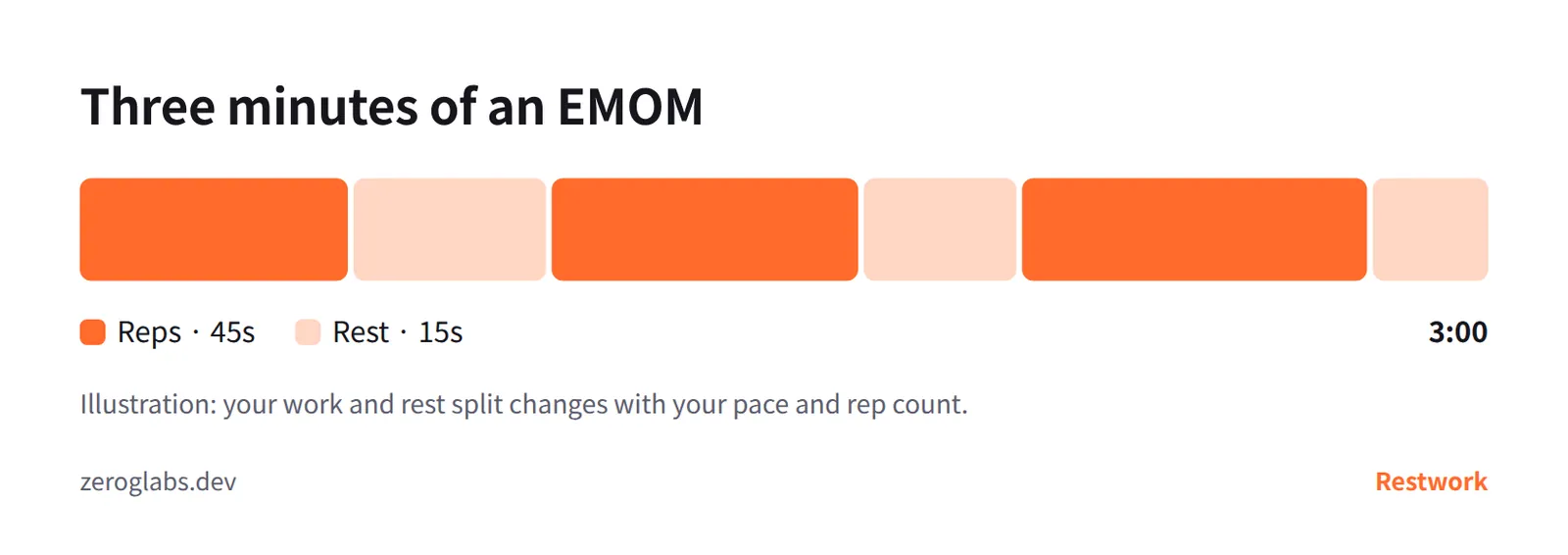
An EMOM workout (short for "every minute on the minute") is a simple interval format. At the start of each minute you do a set number of reps, and whatever is left of that minute is your rest. When the next minute begins, you start the next set, ready or not, so fast reps earn you more rest and slow reps eat into it.
Because there is only one rule, EMOM is easy to learn and easy to make harder or easier. This guide explains how the format works, how to pick a rep count that still leaves you time to breathe, two sample sessions (EMOM 10 and EMOM 20), and how to time it all without staring at a clock.
How an EMOM workout works
The clock sets the pace, and you choose how much work goes into each minute. The American Council on Exercise (ACE) describes EMOM as a way to change the work-to-rest ratio: each set has a set number of reps that must be done within the minute, and if you finish faster, you get a longer break.
A typical EMOM goes like this:
- Start the timer. At 0:00, do your reps.
- Rest for whatever is left of the minute.
- At 1:00, start the next set, either the same exercise or the next one on your list.
- Keep going until the planned number of minutes is up.
"EMOM 10" means 10 minutes, so 10 sets. "EMOM 20" means 20. Some workouts alternate two moves (squats on odd minutes, push-ups on even minutes); others rotate through three, four or more. ACE's own sample, called EMOM Express, uses seven moves, one per minute, for a seven-minute round, and repeats the round once more after a few minutes of rest.
Pick reps so you keep your rest
The rep count decides what kind of workout you get. ACE puts it simply: for strength, choose only a few heavy reps per set, so the rest is built right in; for endurance and a metabolic challenge, choose reps and a load that take just under a minute, which leaves very short breaks.
Most people start somewhere in between. A practical way to find your number:
- Test first. Do one set of the exercise at a steady pace and note how many seconds it takes.
- Leave clear rest. For a first session, pick a count you can finish with a good part of the minute left, roughly a third of it or more. This is our rule of thumb, not a number from research.
- Plan for the last minute, not the first. Reps that take 25 seconds when you are fresh can take 45 seconds by minute 15. If the first two minutes feel easy, you are usually in the right place.
- Adjust as you go. If you miss the minute twice in a row, drop a rep or two, or turn the next minute into a rest minute. Missing the minute means the format has stopped giving you rest, and form usually goes next.
ACE stresses that proper form is still the most important part of this or any workout. In an EMOM, the clock should push your pace, never your technique.
Sample EMOM 10 for beginners
This short session needs no equipment and alternates two moves. Do a 5- to 10-minute warm-up first, as ACE recommends before its EMOM workout.
- Odd minutes (1, 3, 5, 7, 9): 10 bodyweight squats
- Even minutes (2, 4, 6, 8, 10): 8 push-ups, on your knees or with your hands on a bench if you need to
That adds up to 50 squats and 40 push-ups in 10 minutes, with a rest inside every minute. These are starting points, not targets. Use the test above to move them up or down. If the whole session felt easy, add two reps to each move next time, or move on to the longer session below.
Sample EMOM 20 with four moves
The longer version rotates four moves, so each one comes back every four minutes. Twenty minutes gives you five rounds of each.
- Minute 1: 10 kettlebell swings (or 10 squats if you have no kettlebell)
- Minute 2: 10 push-ups
- Minute 3: 12 alternating lunges (6 per leg)
- Minute 4: 20 plank shoulder taps (alternating sides)
Some of these numbers come from ACE's sample sessions: its kettlebell EMOM pairs 10 two-hand swings with 10 push-ups, and its EMOM Express uses 20 plank shoulder taps. Choose a kettlebell you can swing with good form in every round, and treat the reps as something to work toward, not a test you must pass on day one.
If 20 minutes is too much for now, ACE's kettlebell workout shows a gentle way to build up: start with 6 minutes and add a minute every two weeks until you reach 10. The same idea works for any EMOM. Grow the session slowly instead of jumping straight to the longest version.
Set up an EMOM timer
Any timer that signals the start of every minute works for an EMOM. Here is how it works in Restwork, the interval timer we make for Android.
EMOM is one of the ready-made workouts on the home screen, next to Tabata, so you can start it with one tap without setting anything up.
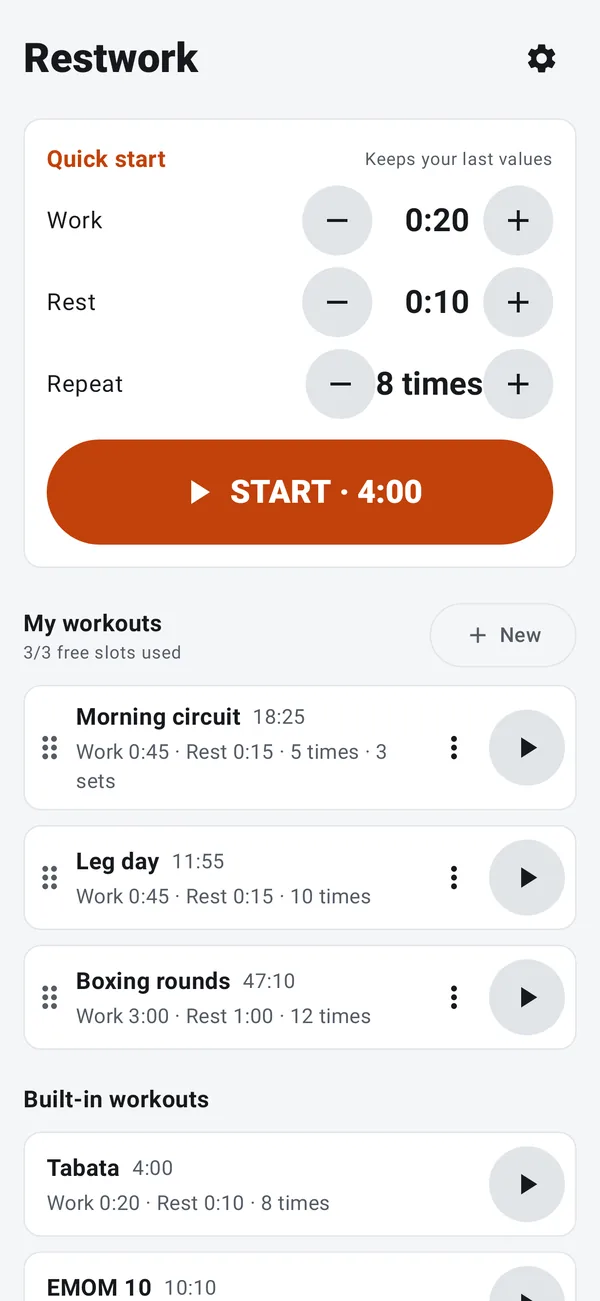
If you would rather split each minute into fixed work and rest phases, use Quick start and set Work, Rest and Repeat. For example, 40 seconds of work and 20 seconds of rest, repeated 10 times, also takes 10 minutes. Strictly speaking that is a slightly different format, because your rest no longer grows when you move faster, but it suits people who like a fixed signal to stop.

For longer sessions, the workout editor lets you save your own workout with a warm-up, sets, rest between sets and a cool-down, so your EMOM 20 and its warm-up are ready every time.
During the workout, the cues do the counting for you:
- Beeps and a 3-2-1 countdown tell you the next set is about to start.
- An optional halfway alert gives you a mid-point signal, a quick way to check whether you are on pace.
- Spoken cues such as "Last round" tell you when you are nearly done. Your music keeps playing and only dips briefly at each cue.
- The screen can be off. The timer keeps going with the screen off or locked, and the lock screen shows the time left. Stopping takes a long press, so a sweaty tap won't end your workout.
EMOM, AMRAP and Tabata compared
All three are interval formats. The difference is who controls the rest.
- EMOM: the clock fixes when each set starts, and you control how much rest you get by how fast you work.
- AMRAP (as many rounds or reps as possible): you get a fixed block of time and keep working through it. You rest whenever you choose, and the score is how much you got done.
- Tabata: the timer fixes both the work and the rest, 20 seconds on and 10 seconds off, eight times. Our guide on how to do a Tabata workout explains the format and how to build up to it.
If you like structure and want rest you can count on, EMOM is a good place to start. If you like pushing until the time runs out, AMRAP fits better.
Common questions
What does EMOM stand for?
EMOM stands for every minute on the minute. You start a new set at the top of each minute, and the time left in that minute is your rest. When the next minute starts, so does the next set.
What if I can't finish the reps within a minute?
Start the next set when the minute changes anyway, or use that minute to rest. Then lower the reps for the rest of the session. If you regularly miss the minute, the count is too high, because the format only works when there is some rest left.
How long should an EMOM workout be?
There is no single right length. ACE's EMOM Express is two seven-minute rounds, and its kettlebell EMOM starts at 6 minutes and builds to 10. Ten to twenty minutes is a common range, and a short session is a good start. Keep the bigger picture in mind too: the WHO recommends that adults get at least 150 minutes of moderate-intensity activity a week.
Is EMOM cardio or strength training?
It can be either, depending on the reps. A few heavy reps a minute make it strength work with built-in rest, while reps that fill most of the minute make it an endurance challenge. The CDC advises adults to do muscle-strengthening activity on at least 2 days a week, working the major muscle groups, and a strength-focused EMOM is one way to do that.
How often can I do EMOM workouts?
ACE suggests its kettlebell EMOM workout three times a week. If you are new to it, two or three sessions a week with a day off in between is a comfortable start. Add more only if you recover well.
A few safety notes
Warm up for 5 to 10 minutes before your first set and cool down afterwards. Choose moves you can do safely when tired, and drop the reps or the weight as soon as your form slips. Stop if you feel chest pain, dizziness or sharp pain. If you have a heart condition, high blood pressure, an injury, or you have not exercised in a long time, talk to a doctor before you start hard interval training.
EMOM works because it is honest: the clock never waits, and your rest shows you how hard you are really working. Pick reps that leave a little breathing room, let a timer call the minutes, and the only job left is the next set.