Tabata is probably the most famous interval format there is: 20 seconds of hard work, 10 seconds of rest, eight times in a row. It takes four minutes, and it is easy to remember. It is also easy to get wrong, because the clock does all the thinking in a Tabata session and most phone clocks are not built for it.
This guide covers what the original research actually tested, how to build up to the full 20/10 format if you are new to intervals, and how to set up the timer so you never have to look at your phone mid-round.
What the original Tabata study tested
The format comes from a 1996 study led by Izumi Tabata, published in Medicine & Science in Sports & Exercise. A small group of men trained on an exercise bike five days a week for six weeks. Each session was seven to eight bouts of 20 seconds at about 170% of their VO2max, with 10 seconds of rest between bouts.
That intensity matters. 170% of VO2max is an all-out sprint well beyond what you could hold for a minute. Over six weeks, the interval group raised their VO2max by about 7 ml/kg/min and their anaerobic capacity by 28%. A comparison group doing an hour of steady cycling at 70% of VO2max improved their VO2max too, but their anaerobic capacity did not change significantly.
So the headline is real: very short, very hard intervals trained both the aerobic and the anaerobic system. But the people in the study were young, fit and supervised, and they were going flat out on a bike.
What a Tabata class usually means today
Most workouts called Tabata today keep the 20/10 rhythm and the eight rounds, but swap the bike sprint for bodyweight moves such as squats, burpees, mountain climbers or kettlebell swings. That is fine. It is still a hard, efficient interval session, and the timing is what keeps it honest.
What it is not is a guarantee of the study's results. If you are doing burpees at a pace you can keep for four minutes, you are working hard but probably not at 170% of your VO2max. Think of 20/10 as a structure, not a magic number.
Build up to 20 on, 10 off
If intervals are new to you, the 10-second rest is the hard part. It is barely enough to breathe. A gentler start is to give yourself more rest and work your way down.
The American Council on Exercise suggests a 30:15 work-to-rest ratio as a safe place for beginners to start, at an effort of about 4 to 6 on a 0 to 10 scale. A simple four-week ramp could look like this:
| Week | Work | Rest | Rounds | Effort (0–10) |
|---|---|---|---|---|
| 1 | 30 s | 15 s | 6 | 4–5 |
| 2 | 30 s | 15 s | 8 | 5–6 |
| 3 | 20 s | 15 s | 8 | 6–7 |
| 4 | 20 s | 10 s | 8 | 7–8 |
Change one thing at a time: first add rounds, then shorten the work, then shorten the rest. If your form falls apart in the last rounds, stay on that week a little longer.
Set up a Tabata timer in under a minute
You can run all of the plans above with any interval timer that lets you set work, rest and rounds. Here is how it works in Restwork, the interval timer we make for Android.
On the home screen, Quick start has three rows: Work, Rest and Repeat. Set Work to 0:20, Rest to 0:10 and Repeat to 8 times. The Start button shows the total time, so you can check the plan at a glance before you begin. Restwork remembers your last values, so next time it is one tap.
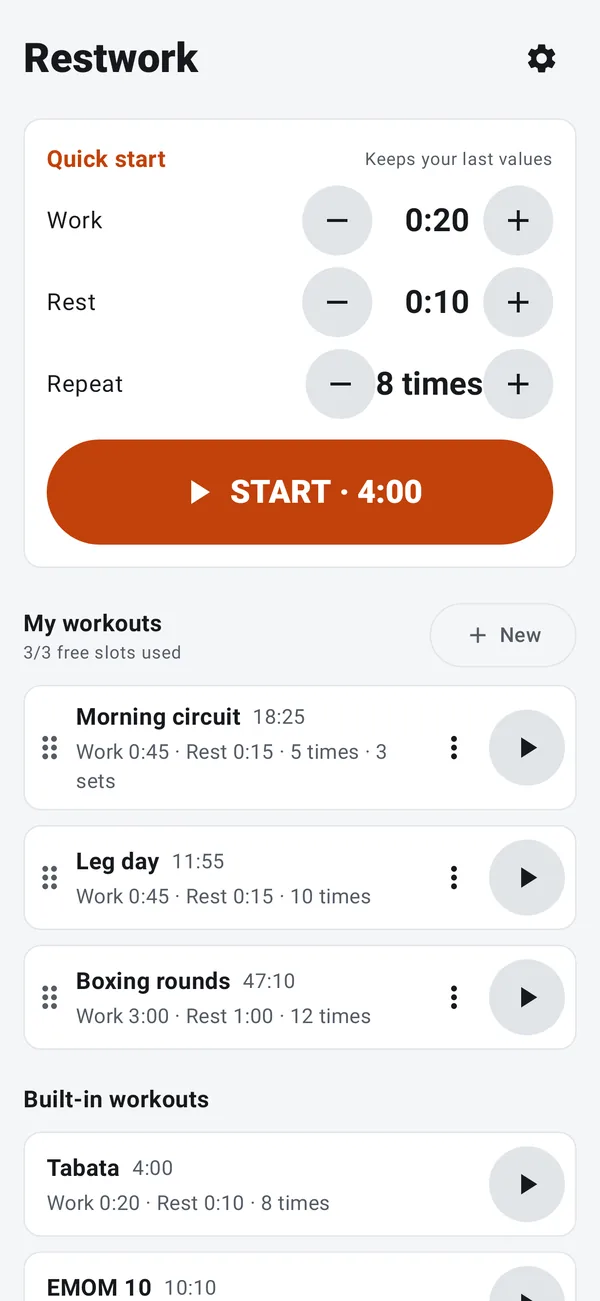
If you would rather not type anything, Tabata is also one of the built-in workouts on the same screen.

Stack several Tabata blocks
A single four-minute Tabata is short. A common way to make a full session is to do three or four blocks with a minute of easy movement between them, each block with a different exercise.
In the workout editor, add your work and rest, set the repeats to 8, then use "Repeat all of it several times (sets)" to add sets and a rest between sets. Add a short get-ready phase at the start and a cool-down at the end, and save it as your own workout.
Cues you can follow without looking
The whole point of a timer in a Tabata session is that you stop thinking about time. In practice that means three things.
- Signals you can hear over your breathing. Restwork plays beeps, a 3-2-1 countdown and spoken cues such as "Work", "Rest" and "Last round". Your music keeps playing and only dips briefly at each cue.
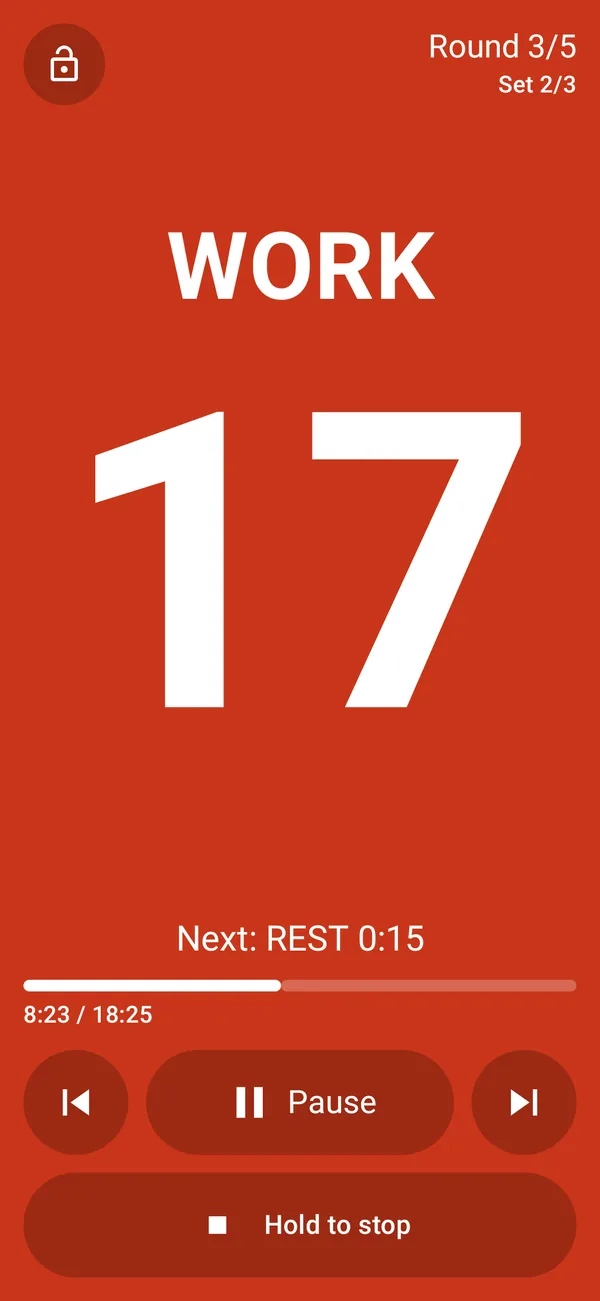
- Numbers you can read from across the room. The work and rest phases use big numbers on different colors, so a glance from the floor is enough.
- A timer that survives a locked phone. The timer keeps going with the screen off or locked, and the lock screen shows the time left. You can lock the screen against sweaty taps, and stopping takes a long press.
Choose exercises that suit the format
Twenty seconds is short, so pick moves you can start instantly and do safely when tired.
- Lower body: squats, squat jumps, alternating lunges, step-ups.
- Full body: burpees, kettlebell swings, mountain climbers, jumping jacks.
- Low impact: fast marching, step-back lunges, standing knee drives, or a bike or rower if you have one.
Save the most technical lifts for slower sessions. When the rest is only 10 seconds, form breaks down faster than you expect.
Common questions
Is a 4-minute Tabata workout enough?
It can be a solid training stimulus, but it is a small dose of exercise. In the original study, people went all out on a bike five days a week. If you are doing bodyweight moves at a pace you can hold, stack three or four blocks into one session. For the bigger picture, the WHO recommends that adults get at least 150 minutes of moderate-intensity activity a week.
How often should I do Tabata?
The study participants trained five days a week under supervision. For most people starting out, two or three hard sessions a week on non-consecutive days is a more comfortable place to begin, with easier activity on the other days. Add more only if you recover well.
Can beginners do Tabata?
Yes, with a gentler start. Begin with more rest, such as the 30:15 ratio that ACE suggests for beginners, at a moderate effort. Work down to 20 seconds on and 10 off over a few weeks, as in the ramp above.
What is the difference between Tabata and HIIT?
HIIT (high-intensity interval training) is the general idea of alternating hard work with rest. Tabata is one specific HIIT format: 20 seconds of work and 10 seconds of rest, repeated eight times. Formats like EMOM or 30:30 intervals are also HIIT, just with different timing.
A few safety notes
Warm up for five minutes or so before your first hard round, and cool down afterwards. Keep high-intensity days apart at first instead of doing them back to back. If you have a heart condition, high blood pressure, an injury, or you have not exercised in a long time, talk to a doctor before you start hard intervals.
Tabata works because it is simple: a clear structure, done hard, timed exactly. Get the timer out of the way and the only thing left to think about is the next 20 seconds.