The Norwegian 4x4 workout is four hard 4-minute intervals with 3 minutes of easy, active recovery between them. In the research from the Norwegian University of Science and Technology (NTNU), each interval brings your heart rate to roughly 85–95% of its maximum and each recovery keeps it around 70%. With a 10-minute warm-up and a 5-minute cool-down, a full session takes about 40 minutes.
The format is simple, but most people who try it on their own get one of three things wrong: they sprint the first interval, stand still during the rest, or guess their heart rate targets. This guide covers where the protocol comes from, how hard each part should feel, how to work out your own numbers, a session you can follow today and how to time it without watching the clock.
Where the 4x4 protocol comes from
The 4x4 comes from a series of NTNU studies that compared 4-minute intervals with steady, moderate training. The results were encouraging, but most of the studies were small, so read them as good evidence for a structure, not a guarantee.
The best-known trial, by Jan Helgerud and colleagues (2007), put 40 moderately trained men into four groups for 8 weeks, 3 days a week, with the same total work in every group. One group ran steadily at 70% of maximum heart rate, one ran at 85% (around the lactate threshold, the point where hard breathing and burning legs start to build), one did 15-second intervals and one did 4x4: 4 minutes at 90–95% of maximum heart rate followed by 3 minutes of active rest at 70%. The interval groups raised their VO2max significantly more than the steady groups. VO2max is the most oxygen your body can use during hard exercise and a common measure of cardio fitness.
The same structure was then tried in very different groups:
- Heart patients. Wisløff and colleagues (2007) studied 27 people with stable heart failure after a heart attack, training 3 times a week for 12 weeks. Peak oxygen uptake rose 46% with aerobic interval training and 14% with moderate continuous training. This was a small clinical trial, not a plan for home use.
- Older adults. In the Generation 100 study, 1,567 people aged 70 to 77 in Trondheim were followed for five years. The interval group did a 10-minute warm-up and 4x4 intervals at about 90% of peak heart rate twice a week. Exercise as a whole did not change the death rate compared with following the national guidelines. Deaths in the interval group were lower (3.0% versus 4.7% in the control group), but that difference was not statistically significant.
Why four minutes? NTNU researchers explain that the heart typically needs 2–3 minutes to reach its maximum pumping rate, so shorter intervals end before the heart has been fully worked.
How hard the intervals and the rest should be
The intervals should be hard but even, and the rest should be easy movement, never standing still. Getting this balance right matters more than hitting an exact number.
The 4-minute intervals. NTNU's Cardiac Exercise Research Group (CERG) advises adults to reach about 90% of maximum heart rate during the intervals. In the Generation 100 study, about 90% matched a rating of about 16 on the Borg scale, a 6-to-20 scale of how hard exercise feels. Your heart rate lags behind your effort, so do not sprint at the start. CERG says that in the later intervals you should reach the target within 1–2 minutes.
Even effort from first to last. CERG's rule of thumb is that you should be equally tired after every interval, and that after the fourth you should feel you could do one more. The intervals are not meant to be run until you drop. If interval four is a struggle to finish, you started too hard.
The 3-minute active rest. Keep moving at an easy pace. Helgerud's study used active rest at 70% of maximum heart rate, and CERG gives about 70% as the target between intervals (60–70% in its protocol for teenagers). Jogging, brisk walking or easy pedalling all work. Easy movement means you start the next interval with a lower heart rate but warm muscles.
Find your heart rate numbers
The quickest way is an age formula, but treat the result as an estimate. NTNU's HUNT fitness study tested 3,320 healthy adults and found that maximum heart rate was best predicted by 211 − 0.64 × age. The typical error was 10.8 beats per minute, so your real maximum can easily be about 11 beats higher or lower.
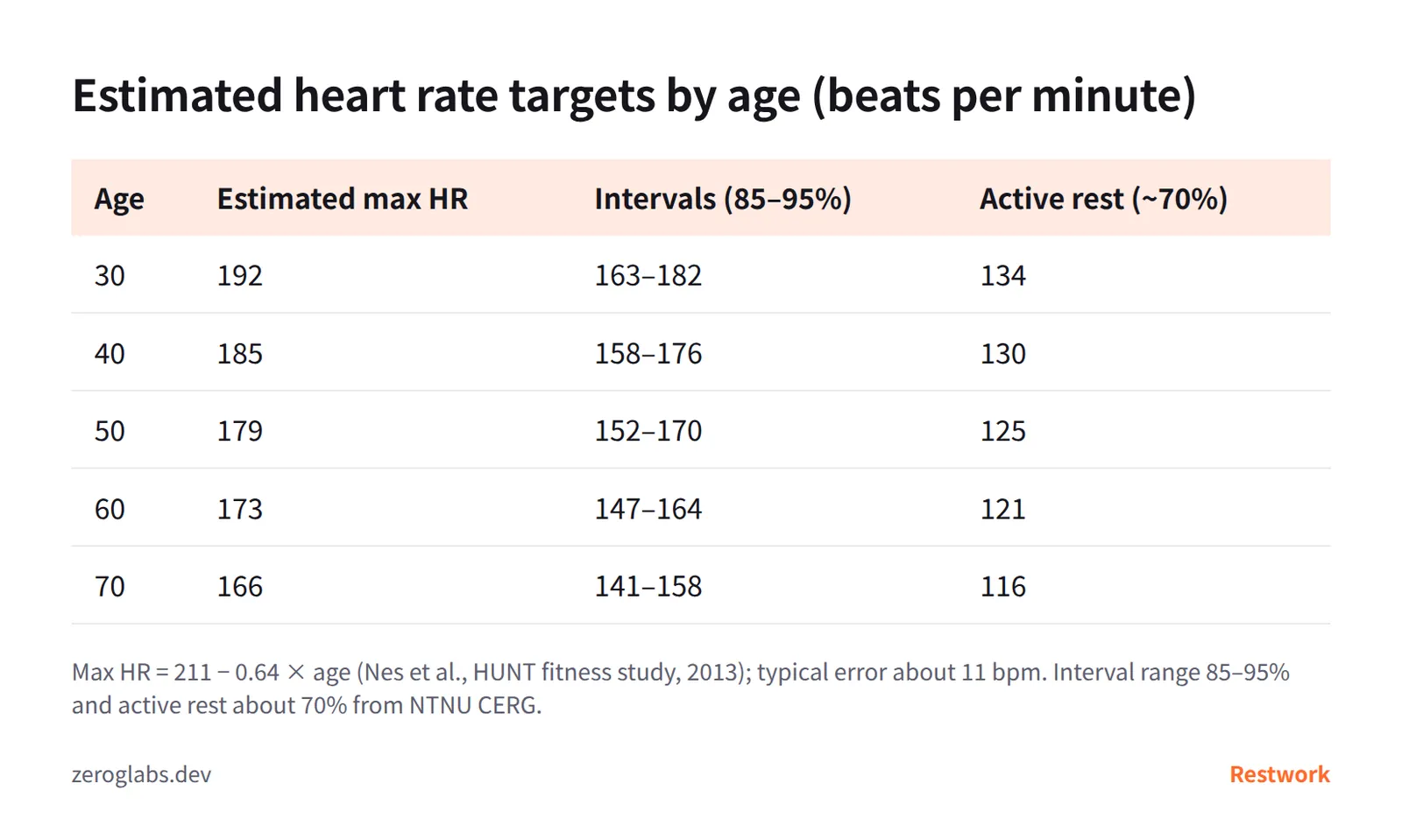
If you are healthy and used to hard exercise, CERG describes a field test: warm up until you sweat, do two 4-minute intervals that leave you short of breath with 3 minutes of slow walking between them, then start a third and, after two minutes, go as fast as you can until you can't go on. The highest heart rate you see is your maximum. This is an all-out effort, so skip it if you have any doubt about your health.
No heart rate monitor? Use effort instead: about 16 out of 20 on the Borg scale during the intervals, and the even-effort rule above. It is less precise, but it is how many people train.
A 40-minute Norwegian 4x4 session
Here is the session as NTNU describes it, step by step. It adds up to 40 minutes: 10 minutes of warm-up, 16 minutes of intervals, 9 minutes of active rest and 5 minutes of cool-down.
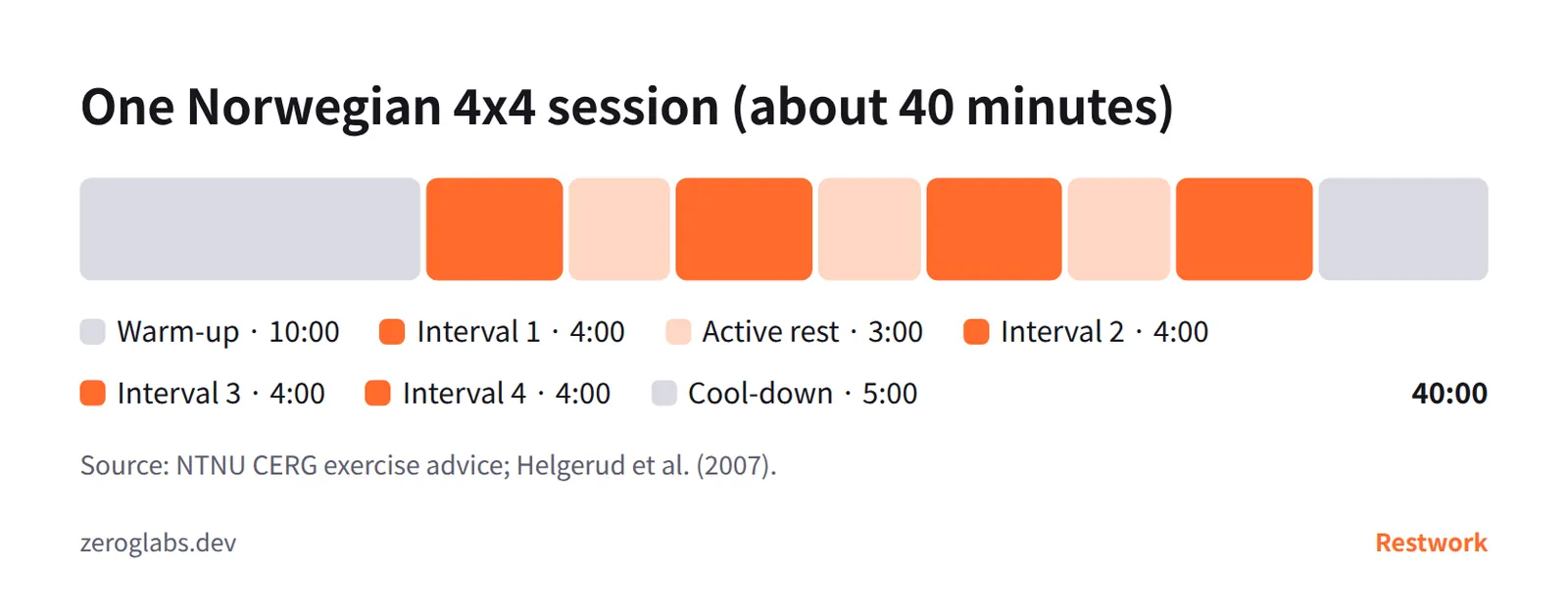
- Warm up for 10 minutes at an easy to moderate pace, around 60–70% of maximum heart rate.
- Interval 1, 4 minutes. Build steadily so you reach about 90% of maximum heart rate.
- Active rest, 3 minutes at around 70%.
- Intervals 2, 3 and 4, each followed by active rest, except the last.
- Cool down for 5 minutes at an easy pace.
Any activity that lets you hold a high heart rate for four minutes works: running or walking uphill, cycling, rowing. Many people find uphill walking easier on the joints than flat sprinting.
How often. CERG recommends 2–3 interval sessions a week to improve fitness and says one a week may maintain it. Around eight a week did not give the desired adaptations, probably because people were doing too much. Helgerud's trial used three sessions a week, and Generation 100 used two. NTNU researchers also warn against making 4x4 your only workout: keen exercisers can stall without other kinds of training, and, as Ulrik Wisløff puts it, no study shows that 4x4 prolongs life more than any other type of exercise.
How to time 4 minutes on and 3 minutes off
The easiest way is to let a timer call every change so you can watch your effort, not the clock. Here is how it works in Restwork, the interval timer we make for Android.
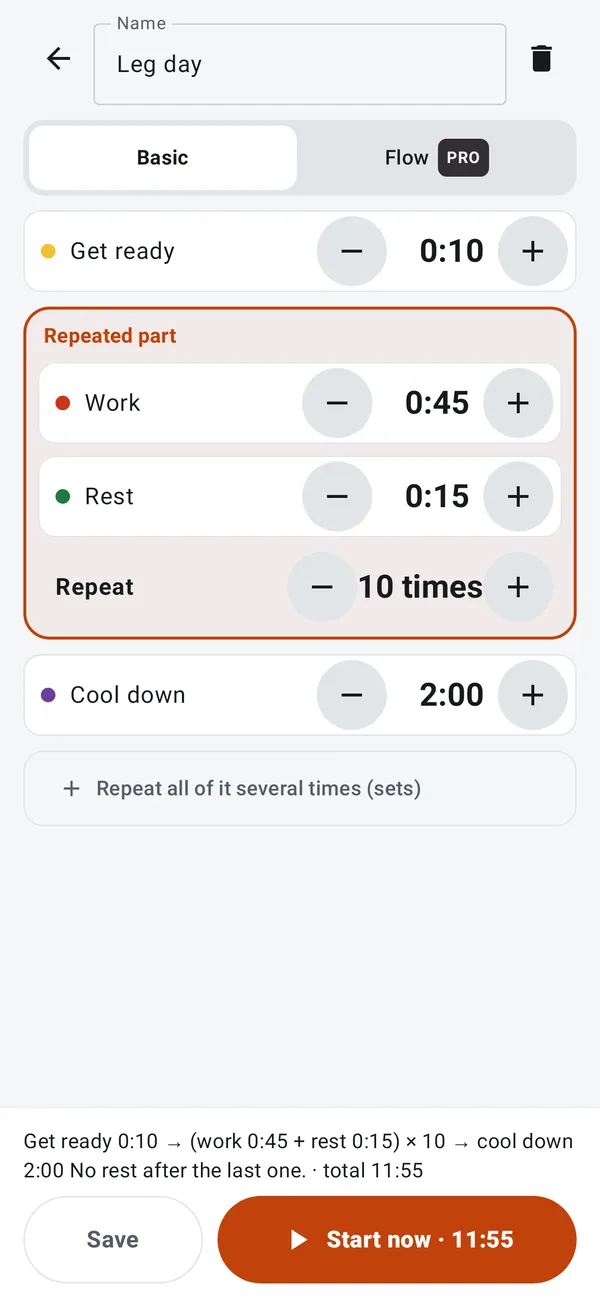
On the home screen, open Quick start and set Work to 4 minutes, Rest to 3 minutes and Repeat to 4, then tap Start. Restwork remembers your last values, so next time the 4x4 is ready right away.
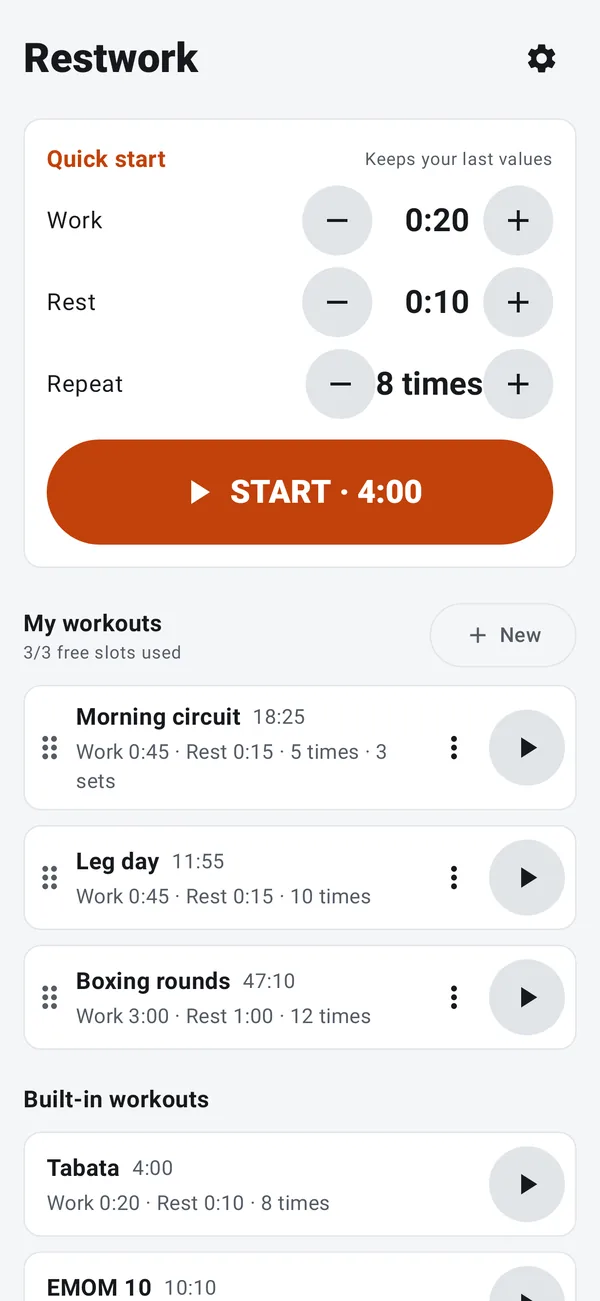

To keep the whole 40-minute session in one place, save it as your own workout in the workout editor, with a 10-minute warm-up before the intervals and a 5-minute cool-down after them. The free version keeps up to 3 saved workouts.
A few cues are especially useful for the 4x4:
- The optional halfway alert sounds 2 minutes into each interval, a good moment to check whether your heart rate has reached the target.
- Beeps and a 3-2-1 countdown warn you that the next interval is about to start, so you can raise your pace before it does.
- Spoken cues such as “Work”, “Rest” and “Last round” tell you where you are without looking. Your music keeps playing and only dips briefly at each cue.
- Screen off on a treadmill or bike. The timer keeps going with the screen off or locked, and the lock screen shows the time left. Stopping takes a long press, so a sweaty tap won't end the session.
Norwegian 4x4, Tabata and easy cardio compared
The 4x4 sits between short, very hard intervals and long, easy cardio. Each has a place in a week.
- Norwegian 4x4: long intervals at about 90% of maximum heart rate with active rest. About 40 minutes with warm-up and cool-down.
- Tabata: 20 seconds of all-out work and 10 seconds of rest, eight times, for 4 minutes. Our guide on how to do a Tabata workout explains it.
- Easy, steady cardio: around 70% of maximum heart rate, which NTNU researchers say can be held for one to two hours. In Helgerud's trial it raised VO2max less than intervals did, but it is gentle and easy to recover from.
A common mix is one or two 4x4 sessions a week plus easier cardio on other days.
Common questions
Can beginners do the Norwegian 4x4 workout?
Often yes, because the targets are relative to your own maximum heart rate, so a less fit person reaches them at a slower pace. NTNU researchers point out that fit and less fit people train at the same relative intensity. If you have not exercised for a while, start with uphill walking and talk to a doctor first if you have any health condition.
How long does it take to see results?
In Helgerud's study, the improvement in VO2max was measured after 8 weeks of three sessions a week. Results differ a lot from person to person, so treat that as the length of one study, not a promise. Give a new routine at least several weeks before judging it.
Can I do the 4x4 without a heart rate monitor?
Yes. Aim for a hard effort of about 16 on the 6-to-20 Borg scale during the intervals, and be equally tired after each one. You should finish the fourth interval feeling you could do another.
Should I walk or stand still during the 3-minute rest?
Keep moving. The NTNU protocols use active rest at around 70% of maximum heart rate, such as a jog, brisk walk or easy pedalling. Standing still lets your heart rate fall further than the protocol intends.
How many times a week should I do it?
CERG recommends two to three interval sessions a week to improve fitness, and one to maintain it. More is not better: around eight sessions a week did not give the expected gains. Leave easy days between hard sessions.
A few safety notes
A 4x4 session is hard work for your heart, so start carefully. If you have heart disease, atrial fibrillation, high blood pressure, an injury, or have not exercised for a long time, talk to a doctor before you start; CERG suggests that people with coronary artery disease who are unsure ask to be referred for an exercise test. Always warm up first, keep the intervals below an all-out sprint, and stop at once if you feel chest pain, dizziness, unusual shortness of breath or sharp pain. Skip the maximum heart rate test unless you are healthy and used to hard exercise.
The Norwegian 4x4 asks for four hard efforts of four minutes each, and nothing more. Find your targets, keep the rest moving, let a timer call the changes, and finish each session feeling you had one more interval in you.