The run-walk method for beginners is simple. You don't try to run nonstop. Instead, you switch between short, planned runs and walking breaks, for example 1 minute of running and 90 seconds of walking, repeated for about 20 minutes. Over the weeks the runs get longer and the walks get shorter. You walk when the plan says so, before you are exhausted, not when you can't go on.
This guide explains where the method comes from, how to pick a starting ratio and how to move up week by week with an 8-week plan with exact numbers. It also shows how to let a timer call the changes, so you don't keep checking your phone.
What the run-walk method is
Run-walk is a planned interval format. The walk breaks are part of the workout from the first minute, not a sign that you failed. Jeff Galloway started teaching his Run Walk Run method in 1974 to a class of beginners. He still describes walk breaks as a way to push back fatigue and soreness, and his method uses them even in half marathons and marathons.
The best-known beginner plan uses the same idea. The NHS Couch to 5K programme starts by switching between 1 minute of running and 90 seconds of walking. You do it three times a week with rest days in between, and you build up to 30 minutes of running in about 9 weeks. The NHS also says it is fine to take longer than 9 weeks.
There is some research on walk breaks too, though not much, and none of it in beginners. A randomized trial put 42 recreational marathon runners into two groups. Runners told to use a run/walk strategy finished in times similar to those who ran the whole way, and they reported less muscle pain and fatigue afterwards. The authors found that run/walk did not reduce the strain on the heart. It was one small study of marathon runners. Treat it as encouraging, not as proof that run-walk works better for everyone.
How to choose your starting ratio
Start with a ratio that feels almost too easy. Your first goal is to finish every session and want to come back. The ratio is your run time compared with your walk time: 1:3 means you walk three times as long as you run.
Some practical guidelines:
- If you don't exercise yet: walk briskly for 20 to 30 minutes for a week or two before you add runs. The CDC guidelines already count brisk walking as moderate activity.
- If you can walk briskly for 30 minutes: start with 30 seconds of running and 90 seconds of walking (1:3).
- If that feels comfortable: try 1 minute of running and 90 seconds of walking, the NHS week 1 setup.
- Run slowly. The runs should be an easy jog. The CDC talk test is a handy check. At moderate effort you can talk but not sing. If you can only say a few words before you need a breath, you are working at a vigorous level. In your runs, aim to keep talking in short sentences.
- Walk with purpose. Keep the walks brisk. They are active recovery, not a full stop.
Galloway has his own simple rule for the runs: if you are huffing and puffing, slow down and walk more often. For work and rest ratios in other kinds of interval training, see our guide to HIIT work to rest ratios.
An 8-week run-walk plan for beginners
Do three sessions a week with a rest day or an easy walk between them. Start each session with a 5-minute brisk walk and end it with a 5-minute easy walk. In between, follow the intervals for that week:
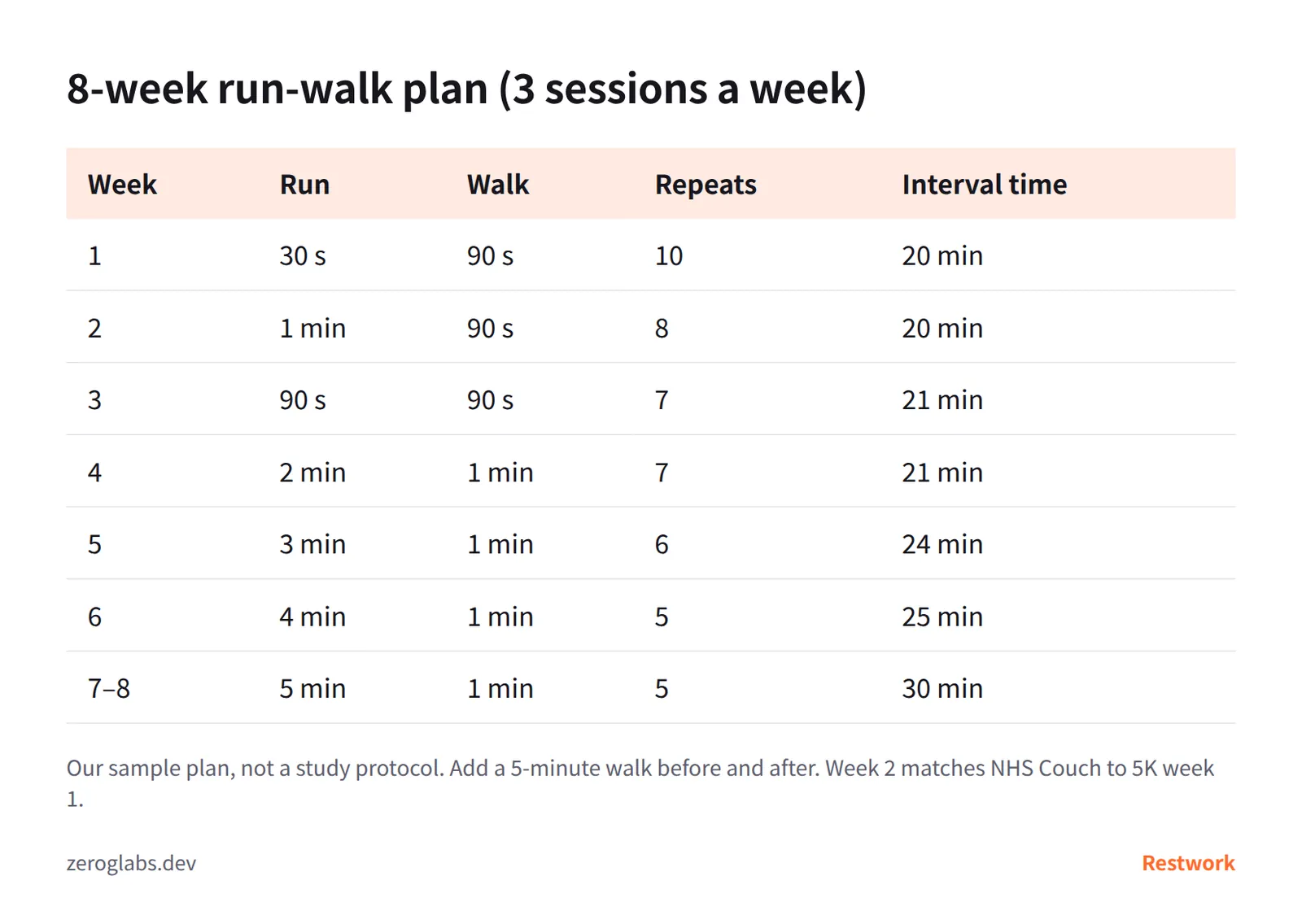
This is our sample plan, not one taken from a study. It moves slowly. The walks never get shorter than 1 minute, and the session grows only a few minutes at a time. Week 2 matches week 1 of the NHS Couch to 5K.
How to move through the plan:
- Move up only when the last session of the week felt manageable. If you couldn't finish the runs or needed extra walks, repeat the week. Repeating a week is normal, not a setback.
- Don't add speed and time at once. When the runs get longer, keep the same easy pace.
- Pain is a reason to stop. Tired muscles that recover in a day or two are expected. Pain that makes you limp, or that gets worse while you run, is not. Rest, and get it checked if it doesn't go away.
After week 8 you can go one of two ways. Some people keep run-walk for good and make the sessions or the runs longer. Others keep lengthening the runs until they can run 20 to 30 minutes without walking, which is the goal of Couch to 5K.
Time your intervals with voice cues
With a timer that announces each change, you can watch the road instead of your phone. Here is how to set up the plan in Restwork, the interval timer we make for Android. Restwork calls its phases Work and Rest, so Work is your run and Rest is your walk.
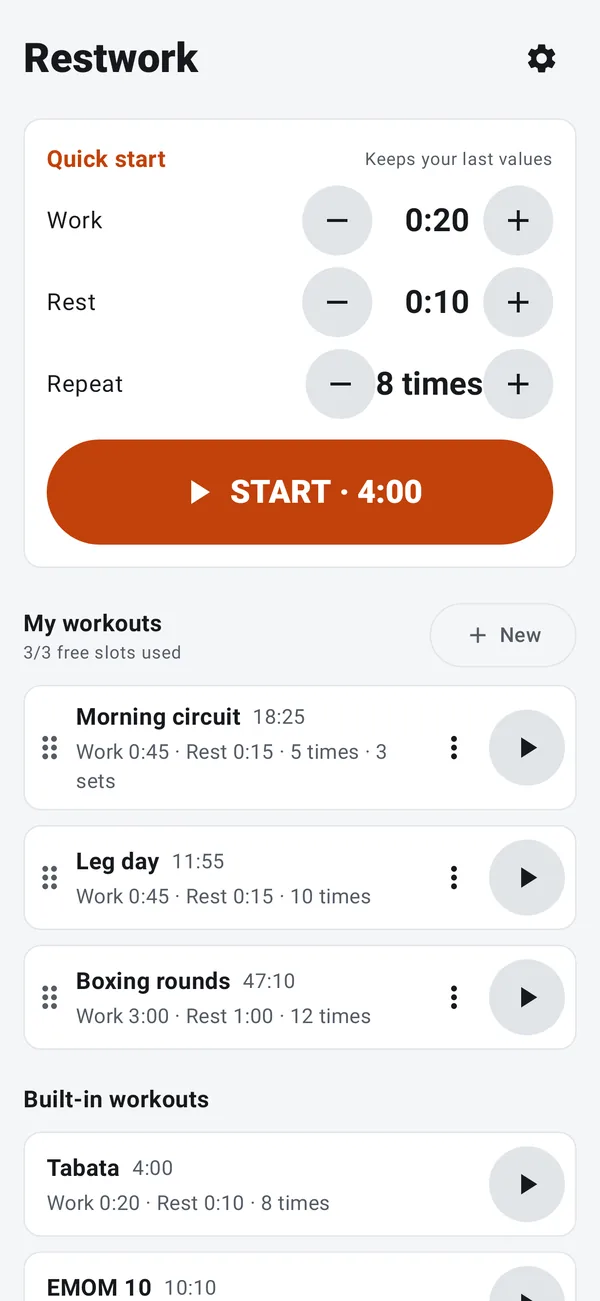
For a simple session, open Quick start and set Work, Rest and Repeat. Week 1 is Work 30 seconds, Rest 90 seconds, Repeat 10. Restwork remembers your last values, so the next session of the same week is ready to start.

To time the warm-up and cool-down walks as well, build the session in the workout editor. You can save a workout there with a warm-up, sets, rest between sets and a cool-down. The free version holds 3 saved workouts. An easy approach is to save one run-walk workout and change its numbers each time you move up a week.
While you run:
- Spoken cues such as “Work”, “Rest” and “Last round” tell you when to switch, in your language.
- Beeps and a 3-2-1 countdown warn you that a change is coming, and vibration helps if you run without headphones.
- Your music keeps playing and only dips briefly at each cue.
- The phone can stay in your pocket. The timer keeps running with the screen off or locked, and the lock screen shows the time left. Stopping takes a long press, so a bump in your pocket won't end the workout.
The NHS reminds runners who wear headphones to watch for traffic, cyclists and pedestrians. Keep the volume low enough to hear what is going on around you.
Common questions
Is the run-walk method good for beginners?
Yes, it is the usual way to start. Galloway's method and the NHS Couch to 5K plan both begin with short runs and walk breaks and build up step by step. You can run regularly before your body is ready to run nonstop.
What run-walk ratio should a beginner use?
Begin with a ratio that feels easy, such as 30 seconds of running and 90 seconds of walking. Another option is the NHS starting point of 1 minute of running and 90 seconds of walking. Make the runs longer only after the current ratio has felt comfortable for a full week.
Is walking during a run cheating?
No. Planned walk breaks are part of the training, and Galloway's method uses them even in marathons. In one marathon trial, runners using run/walk finished in times similar to those who ran the whole way. They also reported less muscle pain and fatigue afterwards.
How long until I can run 30 minutes without stopping?
The NHS Couch to 5K plan builds up to 30 minutes of running in about 9 weeks of three runs a week, and it says taking longer is fine. Many people repeat a week or two along the way, and that is normal.
How many days a week should I run-walk?
The usual beginner pattern is three days a week with a rest day between sessions, as in Couch to 5K. For the bigger picture, the CDC recommends that adults get at least 150 minutes of moderate activity a week, such as brisk walking, or 75 minutes of vigorous activity, such as running.
Stay safe while you build up
If you are worried about your health, see a doctor before you start, as the NHS advises. This matters most if you have a heart condition, high blood pressure or joint problems, are pregnant, or have not been active for a long time. Wear comfortable, supportive shoes, start and finish with a walk, and stop if you feel chest pain, dizziness, unusual breathlessness or sharp pain. If you run in the dark, choose well-lit routes and wear something reflective.
Run-walk takes the pressure off the first weeks. Pick a ratio that feels easy, let the cues tell you when to switch, and move up a week only when you are ready.